
Official statement
Other statements from this video 14 ▾
- 5:33 Can you really control which image appears in Google's text search results?
- 7:30 Why do your Search Console reports keep contradicting each other?
- 8:40 Should you really upload your disavow list only on the current domain?
- 10:06 Is Google really ranking your internal pages above your category pages—and should you be worried?
- 11:21 Why does the public URL test fail so frequently in Search Console?
- 13:33 Does Google really prioritize content quality over technical optimization when facing the 'Crawled - not indexed' status?
- 15:15 Do 'Crawled – not indexed' pages really harm your entire website's visibility?
- 16:27 Why is Google treating your e-commerce category pages as duplicate content?
- 21:21 Do simple URLs really impact your Google rankings?
- 22:22 Can Google ignore your JavaScript if you place a noindex tag in the head?
- 24:24 Are iframes in your <head> really killing your SEO?
- 26:06 How can you accurately verify redirect behavior for Googlebot?
- 28:06 Can a misconfigured 301 redirect actually block your pages from being indexed?
- 30:28 How can you control the date displayed in Google search results?
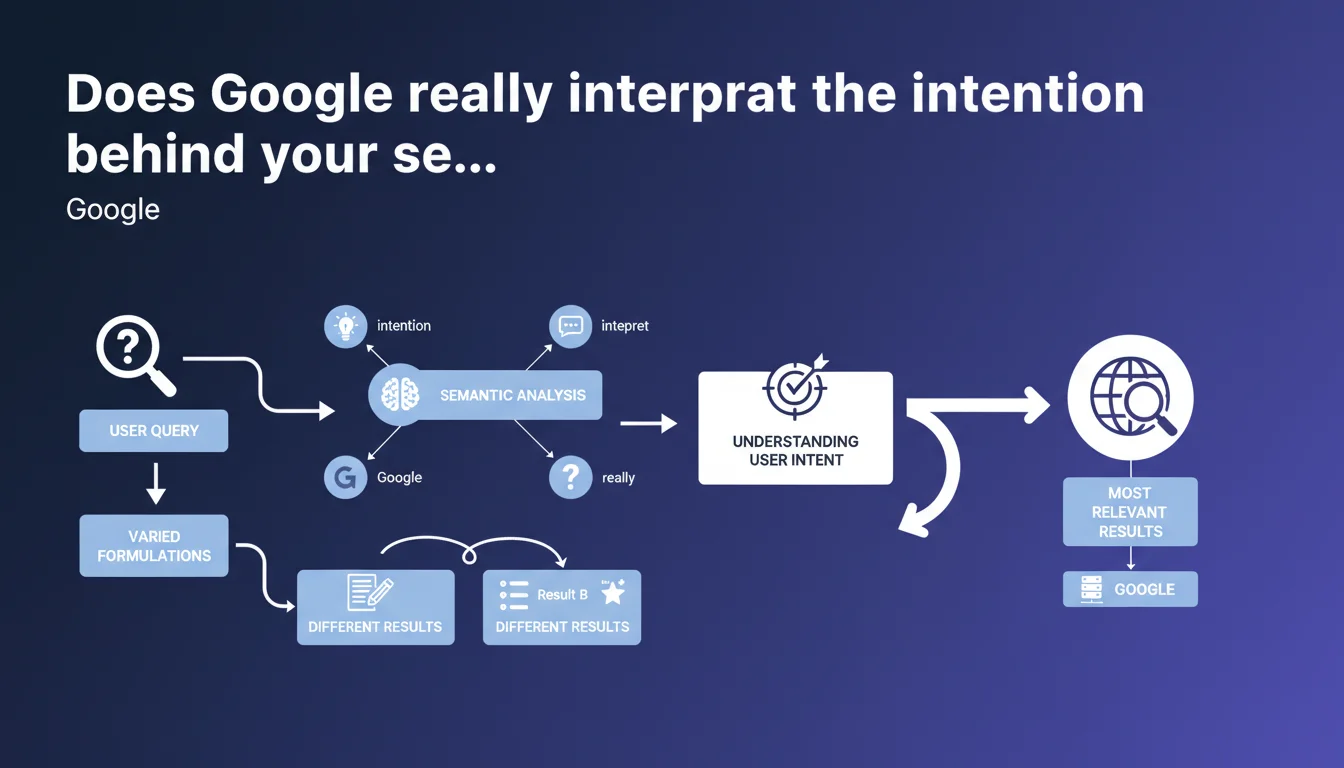
Google analyzes user intent rather than limiting itself to exact keywords. Two different formulations of the same question can generate distinct results based on the engine's semantic interpretation. Direct consequence: optimizing solely for specific keywords without considering intentional context drastically limits your visibility.
What you need to understand
Google stopped treating search queries as simple character strings long ago. The engine analyzes semantic context to determine what users really want to find — buy a product, get a definition, compare solutions, solve a technical problem.
What does user intent mean according to Google?
User intent represents the final objective behind a search. Google generally categorizes queries into four types: informational (learning something), navigational (finding a specific site), transactional (buying), and commercial (comparing before buying).
This distinction isn't new, but Google confirms here that its algorithm prioritizes this intentional understanding over exact term matching. A search for "best CMS" won't produce the same results as "create a website" even if the underlying intent sometimes overlaps.
Why do two different formulations generate different results?
Because Google interprets linguistic nuances as signals of distinct intent. "How does X work" indicates a search for detailed explanation. "X definition" suggests a need for a short answer. "Buy X" reveals clear transactional intent.
The engine therefore adapts the type of content displayed — long articles vs featured snippets vs product cards — based on this analysis. Two pages optimized for similar variations can target different intents and never directly compete in the SERPs.
What is the practical dimension of this semantic analysis?
This means that your keyword strategy must start from intent, not isolated search volumes. A high-volume keyword with intent misaligned to your content will never convert properly.
Google uses multiple signals to decode intent: user search history, location, exact query formulation, time of day. The same keyword can trigger different results depending on the personal search context.
- Intent takes priority over exact keyword matching in the ranking algorithm
- Two closely related semantic variants can target distinct intents and generate different SERPs
- Google categorizes queries according to four main intents: informational, navigational, transactional, commercial
- Personal context (location, history) influences how the engine interprets intent
- Optimizing for intent requires analyzing the format and type of content currently ranked in the results
SEO Expert opinion
Does this statement match real-world observations?
Yes, but with a major caveat: Google significantly oversimplifies the actual complexity of how it processes queries. In the field, we see that intent isn't always decoded correctly, especially for ambiguous queries or niche markets where behavioral data is limited.
A/B tests show that Google frequently adjusts its interpretation of intent for the same query — what was considered transactional can shift toward informational based on evolving user clicks. Intent therefore isn't fixed in the algorithm; it evolves dynamically based on behavioral signals.
What nuances does Google omit from this statement?
The statement doesn't clarify how Google handles mixed-intent queries, which represent a significant portion of actual traffic. "iPhone 15" can mean buying, comparing, finding reviews, searching specs — and Google displays a mix of all these formats.
Another unclear point: the relative weight of different signals in intent determination. [To verify] Google mentions "semantic analysis" without detailing the actual weight of BERT, MUM, or other language models in this process. SEO professionals know that behavioral signals (CTR, session time, pogo-sticking) play a crucial role — not just query text analysis.
And let's be honest: on certain lucrative commercial queries, Google Ads takes up so much space that organic intent becomes secondary. The statement completely ignores this business dimension that biases result display.
In which cases does this intent logic fail?
On emerging or highly specialized queries where Google lacks historical behavioral data. The engine then falls back on more traditional term matching, which can generate less relevant results.
Another problematic case: ambiguous local queries. "Italian restaurant" in Paris generates different results from "best Italian restaurant Paris", but the user's actual intent may be identical — only the formulation changes. Google isn't always able to detect this intentional equivalence.
Practical impact and recommendations
How do you concretely optimize for user intent?
Start by mapping your keywords according to intents, not just by topic or volume. Create four distinct categories in your content strategy: info, navi, transac, commercial. Each type requires a different format and structure.
Next, analyze the SERPs for each priority keyword. Note the dominant format: long articles, lists, videos, product cards, featured snippets. This format reveals how Google interprets intent — your content must match this format to be competitive.
For mixed-intent queries, create hub pages that address multiple facets simultaneously. For example, a high-performing product page includes technical specs (info), comparisons (commercial), customer reviews (commercial), and a purchase button (transac).
What optimization mistakes must you absolutely avoid?
Stop optimizing a transactional page for an informational keyword just because volume is high. Misaligned intent kills conversion rate and sends negative signals to Google through bounce rate and pogo-sticking.
Don't overlook semantic variants. "Buy X", "X price", "X cheap", "where to find X" target the same transactional intent but with nuances — create distinct content or dedicated sections rather than grouping everything on a generic page.
Also avoid duplicating identical content for queries with different intent. Google detects this cannibalization and will arbitrarily choose which page to display, often not the one you want ranked.
How do you verify your content matches Google's intent?
Use Search Console to identify queries that generate impressions but few clicks. This is often a sign of misalignment between the intent Google assigns to your page and what users actually search for.
Test your priority pages in private browsing from different locations. If your page doesn't appear in the top 10, analyze the content actually ranked — their format and structure indicate what Google considers relevant for that intent.
Also measure session duration and pages per visit for each intent segment. Informational content should generate long sessions with multiple page views. High-performing transactional content generates short sessions but high conversion rate.
- Map your keywords according to the four intent types (info, navi, transac, commercial)
- Analyze SERPs to identify the content format expected by Google for each priority query
- Create distinct content for each semantic variation targeting a different intent
- Avoid cannibalization between pages optimized for similar but distinct intents
- Use Search Console to detect intent/content misalignments via the impression/click ratio
- Measure behavioral signals (session time, bounce rate) to validate intent alignment
- Adapt your page format and structure to the dominant content type in current SERPs
Optimizing for user intent goes far beyond the traditional keyword approach. It requires continuous SERP analysis, precise segmentation of your content strategy according to intents, and constant adaptation to behavioral signals.
This complexity — between semantic analysis, algorithmic understanding, and field testing — can quickly become time-consuming for already-stretched teams. Facing these technical and strategic challenges, partnering with a specialized SEO agency often allows you to structure a methodical approach and avoid costly intent/content alignment errors that durably undermine your organic performance.
❓ Frequently Asked Questions
Google analyse-t-il l'intention différemment selon la localisation de l'utilisateur ?
Peut-on forcer Google à interpréter une intention différente pour notre page ?
Les featured snippets sont-ils réservés aux intentions informationnelles ?
Comment identifier si deux requêtes ciblent la même intention ?
L'intention utilisateur remplace-t-elle totalement l'importance des mots-clés exacts ?
🎥 From the same video 14
Other SEO insights extracted from this same Google Search Central video · published on 05/03/2026
🎥 Watch the full video on YouTube →
💬 Comments (0)
Be the first to comment.