
Official statement
Other statements from this video 14 ▾
- 5:33 Can you really control which image appears in Google's text search results?
- 7:30 Why do your Search Console reports keep contradicting each other?
- 8:40 Should you really upload your disavow list only on the current domain?
- 10:06 Is Google really ranking your internal pages above your category pages—and should you be worried?
- 11:21 Why does the public URL test fail so frequently in Search Console?
- 13:33 Does Google really prioritize content quality over technical optimization when facing the 'Crawled - not indexed' status?
- 16:27 Why is Google treating your e-commerce category pages as duplicate content?
- 18:55 Does Google really interpret the intention behind your searches better than you think?
- 21:21 Do simple URLs really impact your Google rankings?
- 22:22 Can Google ignore your JavaScript if you place a noindex tag in the head?
- 24:24 Are iframes in your <head> really killing your SEO?
- 26:06 How can you accurately verify redirect behavior for Googlebot?
- 28:06 Can a misconfigured 301 redirect actually block your pages from being indexed?
- 30:28 How can you control the date displayed in Google search results?
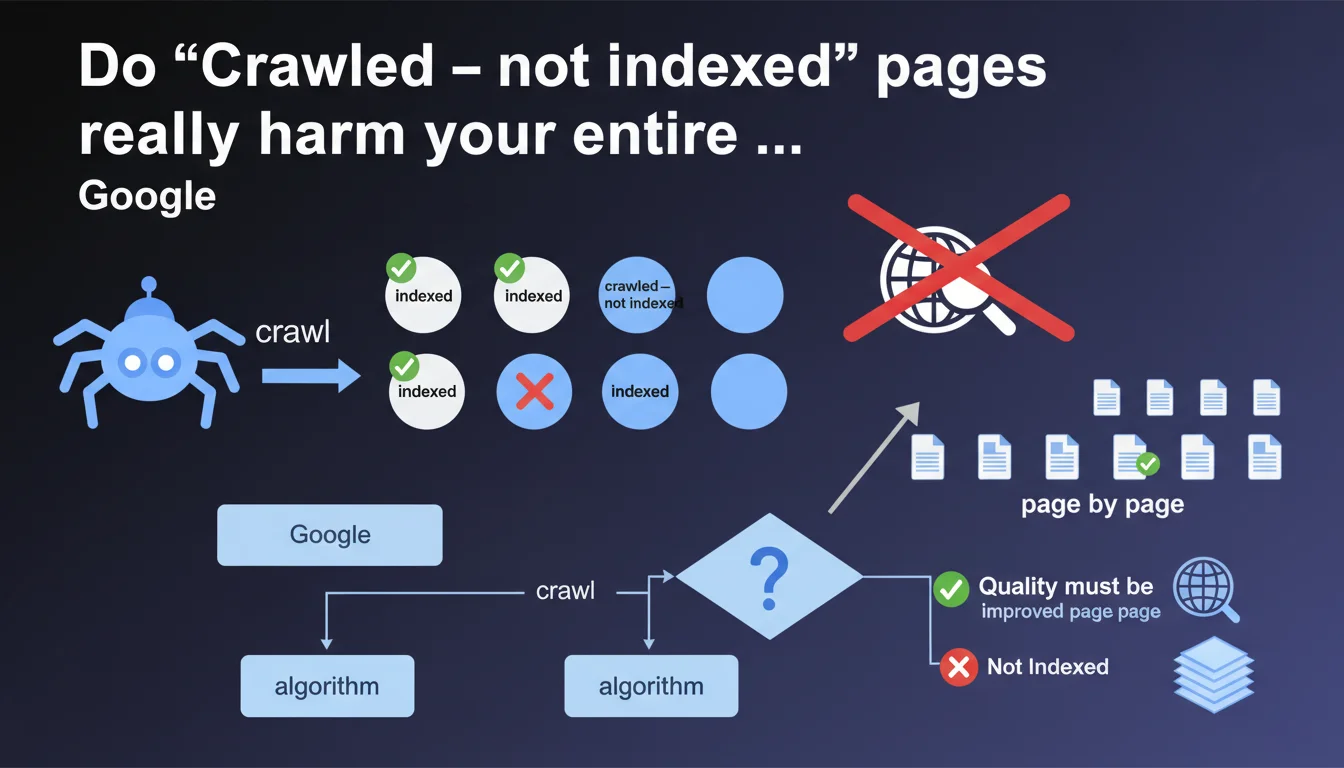
Google states that a high volume of pages with 'Crawled – not indexed' status does not trigger site-wide algorithmic penalties. Each page is evaluated individually. The solution lies in improving page by page, not in a global correction approach.
What you need to understand
What does 'Crawled – not indexed' status really mean?
Google visits the page (crawl), but refuses to include it in its index. No site-wide penalty is applied: it's a decision at the URL level.
This status reflects a deliberate choice by Google, not a technical bug. The reasons can be multiple: content too similar to other pages, insufficient added value, or simply an indexation priority deemed too low.
Why is Google publicly taking this position?
Confusion reigns among many SEO professionals: seeing hundreds of 'Crawled – not indexed' pages in Search Console triggers irrational panic. Google wants to calm things down and avoid counterproductive mass corrections.
The nuance is important: if your site is not globally penalized, that does not mean everything is fine. These non-indexed pages often reveal structural or quality issues that need to be addressed.
What's the difference with a real algorithmic penalty?
An algorithmic penalty (Helpful Content Update, for example) impacts entire sections or the entire domain. Rankings drop sharply on hundreds of queries simultaneously.
With 'Crawled – not indexed', you simply observe that certain URLs never enter the competition. Your indexed pages can perform very well. It's selective exclusion, not global sanction.
- No site-wide penalty triggered by this status alone
- Each page is evaluated individually on its relevance
- The volume of non-indexed pages is not a signal of overall site quality
- The corrective approach must be page by page, not in bulk
- This status often reveals quality or structural issues to be corrected
SEO Expert opinion
Is this statement consistent with real-world observations?
Yes and no. In my practice, I have indeed observed sites with 40-50% of 'Crawled – not indexed' pages that performed very well on their strategic pages. No visible penalty at the global level.
But — and this is crucial — these sites had a solid core of quality indexed pages. The non-indexed pages were often filters, minor variations, or marginal content. When the problem affects your strategic pages, the story changes drastically.
What nuances is Google deliberately omitting?
Google says 'improve page by page', but does not specify the concrete criteria that make a page switch from 'non-indexed' to 'indexed'. Length? Depth? Originality? Internal backlinks? [To verify] — the signals remain unclear.
Let's be honest: this statement is technically true but strategically incomplete. If 80% of your product pages are 'Crawled – not indexed', Google may not formally penalize you, but your organic visibility will be decimated. It's a practical defeat, penalty or not.
And that's where it pinches: Google separates the concept of 'algorithmic penalty' (active sanction) from 'pages deemed not relevant' (passive exclusion). For the SEO practitioner, the result is identical: zero traffic.
In what cases should you really worry?
If your strategic pages (those generating business) are affected, it's a red alarm signal. An e-commerce site with 70% of product pages non-indexed has a major structural problem, even without formal penalty.
Another critical case: if this status appears suddenly on previously indexed pages. This can signal a perceived quality degradation by Google or an algorithmic change targeting your content type.
Practical impact and recommendations
What should you concretely do with these non-indexed pages?
First, segment them. All 'Crawled – not indexed' pages are not created equal. Identify those that absolutely must be indexed (strategic pages, high-potential content) versus those that can remain off-index without business impact.
For strategic pages: enrich the content, add depth, work on internal linking to give them more weight. Consolidate overly similar variations via canonicals or content mergers.
For non-strategic pages: consider outright deletion if they add nothing, or switch them to noindex to free up crawl budget. The less time Google wastes on marginal content, the more efficiently it crawls your important pages.
What mistakes should you absolutely avoid?
Don't force indexation in bulk via XML sitemaps stuffed with mediocre URLs. Google will crawl them, judge them insufficient, and you'll remain at the same point — with wasted crawl budget.
Also avoid over-optimizing mechanically (adding 500 words of filler to each page). Google is looking for real added value, not artificial text volume. If a page has nothing to say, it's better to delete it than to artificially inflate it.
And above all: don't panic over raw volume. A 10,000-page site with 3,000 'Crawled – not indexed' pages isn't necessarily sick. Focus on the pages that really matter for your business.
How do you verify that your approach is working?
Track status evolution in Search Console after each modification. Monitor last crawl dates: if Google recrawls an improved page but still doesn't index it, the improvement was insufficient.
Test in batches: take 10-20 similar pages, apply your improvements, and observe the rate of transition to 'indexed' over 4-6 weeks. This will give you a reliable benchmark before scaling your efforts.
- Segment non-indexed pages: strategic vs. marginal
- Qualitatively enrich strategic content (depth, originality)
- Strengthen internal linking to priority pages
- Delete or set to noindex pages without added value
- Don't force indexation via overloaded XML sitemaps
- Avoid mechanical over-optimization (text padding)
- Monitor status evolution in Search Console post-optimization
- Test in batches before scaling corrections
❓ Frequently Asked Questions
Faut-il supprimer les pages en « Crawlé - non indexé » ?
Le statut « Crawlé - non indexé » peut-il évoluer naturellement ?
Ce statut impacte-t-il le crawl budget ?
Combien de temps faut-il pour voir un changement après optimisation ?
Un concurrent peut-il déclencher ce statut via du negative SEO ?
🎥 From the same video 14
Other SEO insights extracted from this same Google Search Central video · published on 05/03/2026
🎥 Watch the full video on YouTube →
💬 Comments (0)
Be the first to comment.