
Official statement
Other statements from this video 14 ▾
- 5:33 Can you really control which image appears in Google's text search results?
- 7:30 Why do your Search Console reports keep contradicting each other?
- 8:40 Should you really upload your disavow list only on the current domain?
- 11:21 Why does the public URL test fail so frequently in Search Console?
- 13:33 Does Google really prioritize content quality over technical optimization when facing the 'Crawled - not indexed' status?
- 15:15 Do 'Crawled – not indexed' pages really harm your entire website's visibility?
- 16:27 Why is Google treating your e-commerce category pages as duplicate content?
- 18:55 Does Google really interpret the intention behind your searches better than you think?
- 21:21 Do simple URLs really impact your Google rankings?
- 22:22 Can Google ignore your JavaScript if you place a noindex tag in the head?
- 24:24 Are iframes in your <head> really killing your SEO?
- 26:06 How can you accurately verify redirect behavior for Googlebot?
- 28:06 Can a misconfigured 301 redirect actually block your pages from being indexed?
- 30:28 How can you control the date displayed in Google search results?
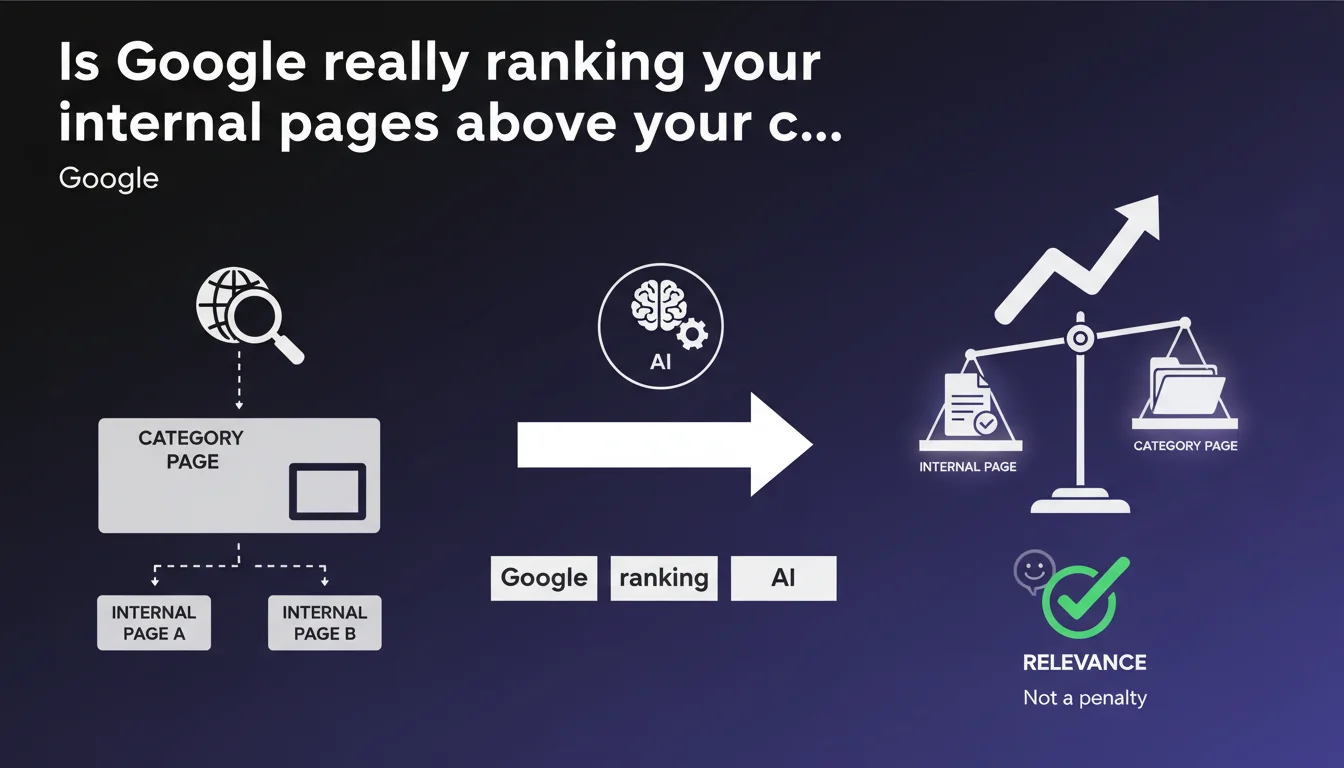
Google prioritizes detailed internal pages when they better match user search intent than the category page. This isn't a penalty, but a signal that your category may lack relevance or depth for certain queries. Practically speaking: your site architecture should support this reality rather than fight it.
What you need to understand
What does this Google statement really mean?
Google doesn't work with a fixed hierarchy. The algorithm evaluates relevance page by page, not according to your internal site structure. If a product page or detailed article answers a specific query better than a generic category page, it will rank above it.
This logic is built on search intent. A precise query ("Nike Pegasus 40 running shoes") naturally finds more value in a product page than in a "running shoes" category. Google knows this — and acts accordingly.
Is it a problem if my internal pages outrank my category?
Not necessarily. It depends on your strategy. If your internal pages capture qualified traffic on long-tail keywords, that's a win. The problem appears when your category page should rank on broader terms but isn't.
In that case, Google is telling you clearly: your category isn't compelling enough. Either it lacks unique content, its intent is unclear, or it's not delivering anything that an internal page doesn't do better.
How does Google determine which page is "more relevant"?
Officially, Google doesn't detail the precise relevance signals — but real-world experience shows a mix of factors: content depth, semantic match with the query, behavioral signals (click-through rate, time on page), internal linking structure.
A category page that's too generic, with minimal text and just a product list, will struggle against a product page enriched with reviews, technical specs, and FAQs. Granularity wins when intent is specific.
- Search intent: Google favors the page that best answers the query, regardless of its position in your site hierarchy
- Contextual relevance: a detailed internal page beats a generic category on long-tail queries
- Not a penalty: this ranking reflects the relative performance of your pages, not an algorithmic sanction
- Optimization signal: if your category should rank but doesn't, it's an indicator that it lacks substance or differentiation
SEO Expert opinion
Is this statement consistent with what we observe in the field?
Yes — and it's actually a classic in e-commerce. We regularly see product pages ranking on terms we'd expect to belong to categories. Google has no sacred respect for your site architecture. It ranks what performs.
But here's the catch: this statement is vague on one critical point. Google says "at that moment" — implying the ranking can shift depending on search context (location, history, device). This ambiguity leaves a lot of room for interpretation. [To verify] how much these contextual variations actually impact SERPs at scale.
What nuances should we add to this rule?
Let's be honest: it's not always commercially optimal. A well-designed category page can convert better than an isolated product page because it offers more options. If your internal pages cannibalize your categories on broad terms, you could lose revenue.
The problem is Google doesn't care about your conversion rate. It optimizes for user satisfaction as it measures it — and its metrics don't always align with your business goals. This is why actively managing your internal linking structure and on-page signals matters so much.
When does this logic really become a problem?
When you've invested in a rich category strategy — with buying guides, comparatives, advanced filters — and Google keeps pushing minimal product pages instead. That's frustrating. And it's often linked to technical mistakes: broken canonicals, internal links favoring products, nearly identical title and H1 tags between category and product pages.
Practical impact and recommendations
What should you do concretely to optimize this dynamic?
First, audit your current rankings. Identify which queries your internal pages outrank your categories on — and ask yourself if that's desirable. If not, strengthen your categories: add unique content, trust-building elements, contextual guides.
Next, work on your internal linking strategy. If you want a category to rank, it needs link juice. Link to it from your product pages, blog articles, and homepage. And vary your anchor text — not always the same exact match.
What mistakes should you absolutely avoid?
Don't de-optimize your internal pages to force your categories up. That's fratricidal warfare — and you'll lose overall traffic. Google is telling you clearly that it ranks what performs best. If an internal page deserves its position, let it have it.
Also avoid intent duplication. If your category and products target the exact same keywords with the same angle, Google has to choose — and it won't necessarily choose what you want. Differentiate intentions: category for discovery and comparison, products for direct purchase.
How do you verify your strategy is working?
Track your positions by page type in Search Console. Segment: categories vs products vs articles. See which URLs gain ground on which terms. If your categories are stalled despite optimization, that's a signal.
Also test title and meta description variations to improve your categories' CTR. Sometimes Google ranks them but users click elsewhere. Tweaking these elements can flip the trend — without touching content.
- Audit queries where internal pages outrank categories and validate if it aligns with your strategy
- Strengthen unique content on category pages: guides, comparisons, contextual FAQs
- Optimize internal linking to redistribute PageRank to priority categories
- Clearly differentiate search intent between categories and internal pages
- Check your canonicals, titles, and H1s to avoid signal duplication
- Monitor positions by page type in Search Console to measure real impact
- Test CTR through title and meta description adjustments on strategic categories
❓ Frequently Asked Questions
Est-ce un problème si mes fiches produits rankent mieux que mes catégories ?
Comment Google décide-t-il quelle page classer en premier ?
Dois-je désoptimiser mes pages internes pour favoriser mes catégories ?
Mes catégories ne rankent jamais — est-ce une pénalité ?
Le maillage interne peut-il vraiment inverser cette tendance ?
🎥 From the same video 14
Other SEO insights extracted from this same Google Search Central video · published on 05/03/2026
🎥 Watch the full video on YouTube →
💬 Comments (0)
Be the first to comment.