
Official statement
Other statements from this video 14 ▾
- 7:30 Why do your Search Console reports keep contradicting each other?
- 8:40 Should you really upload your disavow list only on the current domain?
- 10:06 Is Google really ranking your internal pages above your category pages—and should you be worried?
- 11:21 Why does the public URL test fail so frequently in Search Console?
- 13:33 Does Google really prioritize content quality over technical optimization when facing the 'Crawled - not indexed' status?
- 15:15 Do 'Crawled – not indexed' pages really harm your entire website's visibility?
- 16:27 Why is Google treating your e-commerce category pages as duplicate content?
- 18:55 Does Google really interpret the intention behind your searches better than you think?
- 21:21 Do simple URLs really impact your Google rankings?
- 22:22 Can Google ignore your JavaScript if you place a noindex tag in the head?
- 24:24 Are iframes in your <head> really killing your SEO?
- 26:06 How can you accurately verify redirect behavior for Googlebot?
- 28:06 Can a misconfigured 301 redirect actually block your pages from being indexed?
- 30:28 How can you control the date displayed in Google search results?
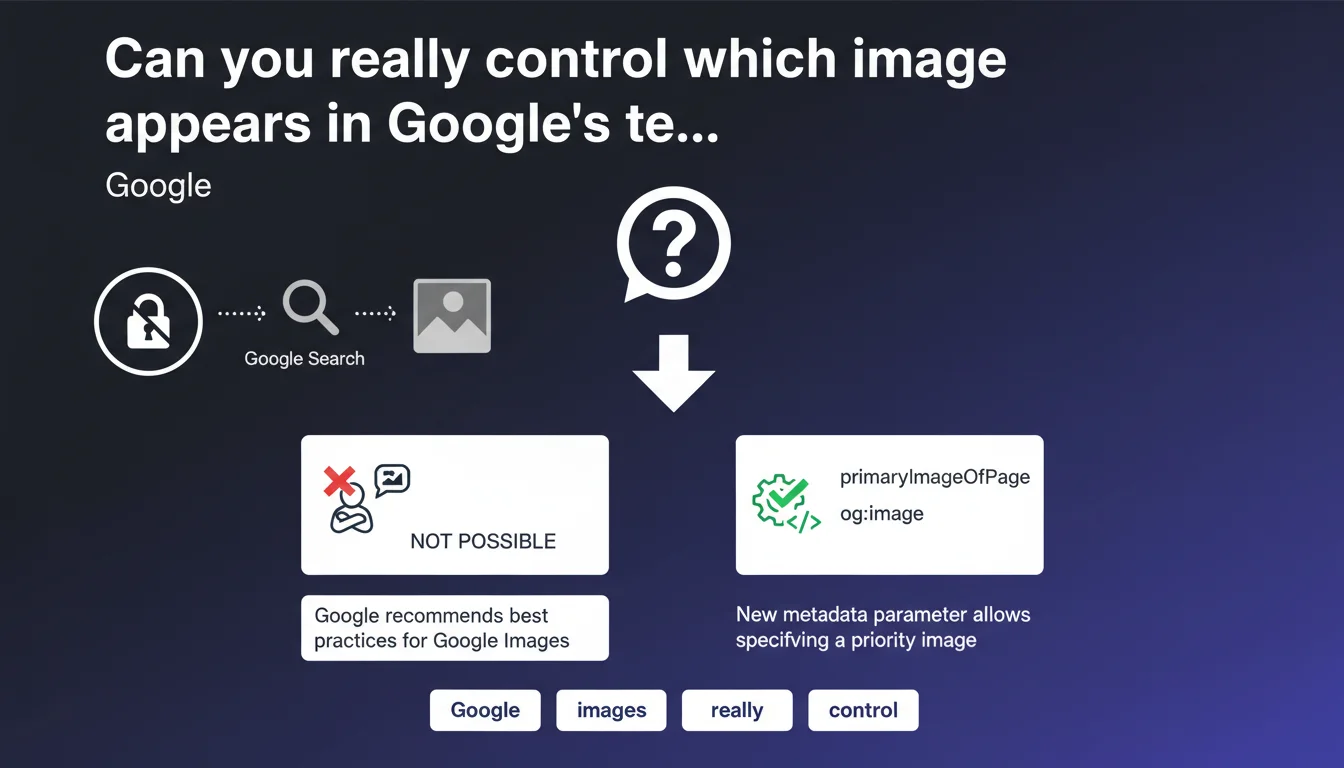
Google claims it's impossible to precisely control which image displays in text search results. The company recommends following best practices for Google Images and introduces a new metadata parameter allowing you to designate a priority image via primaryImageOfPage or og:image.
What you need to understand
Why does Google say you can't control the displayed image?
Google automatically selects the image it deems most relevant to accompany a text search result. This selection is based on opaque criteria: search query context, image quality, semantic relevance, and position on the page.
The search engine doesn't just pick the most visible image or the first one in the DOM. It analyzes the content and decides what will best serve the search intent. As a result — you can technically mark an image as priority, but Google retains final control over the choice.
What is the primaryImageOfPage metadata parameter?
Google introduces the ability to signal a priority image via the primaryImageOfPage (schema.org) or og:image (Open Graph) tags. These metadata elements indicate to the search engine which image you consider as the main one.
Heads up — this is not a directive, it's a suggestion. Google can ignore it if another image seems more relevant for a given query. It's one signal among many, not an absolute control lever.
What are the best practices for Google Images?
Google points to its general recommendations for optimizing images: quality files, descriptive filenames, relevant alt attributes, textual context around the image, and ImageObject structured data.
- Use high-quality images with appropriate dimensions
- Provide alt attributes in a descriptive and precise manner
- Place images in coherent textual context
- Implement primaryImageOfPage or og:image to signal the main image
- Avoid decorative or off-topic images in strategic areas
SEO Expert opinion
Is this statement consistent with real-world observations?
Yes and no. On paper, Google has always been vague about controlling images in text SERPs. The novelty here is that they're finally formalizing a preference signal via primaryImageOfPage.
In practice, we've observed for years that Google sometimes picks unexpected images — logos, ad banner images, off-context visuals. The new parameter should reduce these aberrant cases, but [To be verified] to what extent it will actually be taken into account. Field tests are still lacking.
What's the real scope of primaryImageOfPage?
Google qualifies this parameter as a "suggestion," not a directive. Concretely, this means it can be ignored if the algorithm deems another image more relevant for a given query.
Let's be honest — it's consistent with Google's philosophy: provide hints, not commands. The risk? That this parameter becomes a placebo for SEOs, like so many other "signals" whose real impact remains difficult to measure. [To be verified] through A/B tests on high-traffic pages.
Should you systematically implement primaryImageOfPage?
Yes, especially if you have pages with multiple images and want to guide Google toward the one that best represents your content. It's a weak signal, but it costs nothing to implement.
Practical impact and recommendations
What should you actually do on your pages?
First step: identify strategic pages (those generating organic traffic) and audit which images Google currently displays in text search results. You can use Google Search Console or simply search for your key pages.
Next, implement primaryImageOfPage via schema.org or og:image if not already done. Prioritize a quality image that's relevant, with an appropriate ratio (16:9 or 4:3 depending on context).
What mistakes should you absolutely avoid?
Don't designate a decorative image, generic logo, or promotional banner as your priority image. Google may ignore it, and you risk degrading user experience if the displayed image doesn't match the content.
Also avoid multiplying og:image or primaryImageOfPage tags on the same page. One clear, representative main image. Everything else falls under standard Google Images best practices.
- Audit images currently displayed in text SERPs for your key pages
- Implement primaryImageOfPage (schema.org) or og:image on strategic pages
- Verify that the designated image is high quality and representative of your content
- Provide alt attributes descriptively on all images
- Optimize the textual context around images (headings, captions, adjacent paragraphs)
- Monitor progress in Google Search Console after implementation
❓ Frequently Asked Questions
Google prend-il toujours en compte primaryImageOfPage ou og:image ?
Faut-il choisir primaryImageOfPage ou og:image ?
Peut-on désigner plusieurs images prioritaires sur une même page ?
Comment vérifier quelle image Google affiche dans les résultats de recherche texte ?
Cette recommandation s'applique-t-elle aussi à Google Images ?
🎥 From the same video 14
Other SEO insights extracted from this same Google Search Central video · published on 05/03/2026
🎥 Watch the full video on YouTube →
💬 Comments (0)
Be the first to comment.