
Official statement
Other statements from this video 14 ▾
- 5:33 Can you really control which image appears in Google's text search results?
- 8:40 Should you really upload your disavow list only on the current domain?
- 10:06 Is Google really ranking your internal pages above your category pages—and should you be worried?
- 11:21 Why does the public URL test fail so frequently in Search Console?
- 13:33 Does Google really prioritize content quality over technical optimization when facing the 'Crawled - not indexed' status?
- 15:15 Do 'Crawled – not indexed' pages really harm your entire website's visibility?
- 16:27 Why is Google treating your e-commerce category pages as duplicate content?
- 18:55 Does Google really interpret the intention behind your searches better than you think?
- 21:21 Do simple URLs really impact your Google rankings?
- 22:22 Can Google ignore your JavaScript if you place a noindex tag in the head?
- 24:24 Are iframes in your <head> really killing your SEO?
- 26:06 How can you accurately verify redirect behavior for Googlebot?
- 28:06 Can a misconfigured 301 redirect actually block your pages from being indexed?
- 30:28 How can you control the date displayed in Google search results?
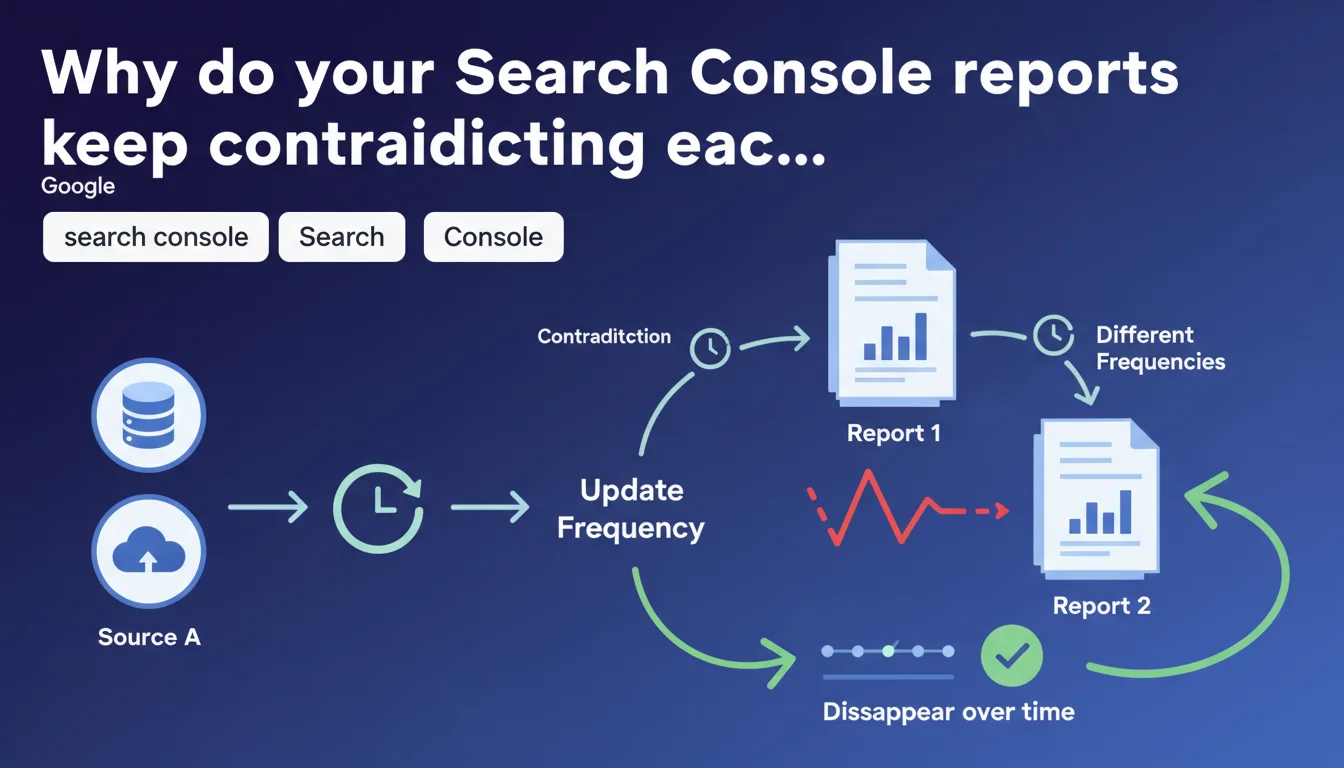
Google confirms that different Search Console reports pull from separate data sources and update at varying frequencies. These lags create temporary inconsistencies between tools, but these contradictions eventually disappear over time. In practice: stop panicking when the numbers don't match.
What you need to understand
Why does Search Console display contradictory data?
Each Search Console tool doesn't pull from the same database. The performance report, URL inspection, coverage report, and page experience report all operate with different sources and asynchronous update cycles.
Concretely? A page can appear indexed in the URL inspection tool but be missing from the performance report. Or the opposite: impressions show up in your statistics while the page is flagged as an error elsewhere.
Are these inconsistencies a bug worth reporting?
No. Google states it clearly: these lags are normal and temporary. The different systems synchronize at their own pace, and the gaps eventually close.
The problem is that Google doesn't specify typical timelines or the conditions that prolong these inconsistencies. This ambiguity feeds anxiety among practitioners monitoring their migrations or technical fixes.
What are the key takeaways?
- Search Console reports use separate data sources and don't update simultaneously
- Contradictions between tools are expected and temporary, not anomalies
- These gaps usually disappear over time without manual intervention
- Google provides no specific timeline for resolving these inconsistencies
- Making SEO decisions based on a single report can lead to analytical errors
SEO Expert opinion
Is this statement consistent with real-world observations?
Yes, and it's actually a relief that Google officially acknowledges it. In the field, these contradictions are commonplace — especially after a migration, a large-scale rollout of fixes, or when launching a new section.
The issue is the complete lack of granularity. Google doesn't say which reports are authoritative, or which ones synchronize first. A practitioner who sees a page validated in URL inspection but still flagged as an error in the coverage report doesn't know if they should wait 24 hours or 3 weeks.
What nuances should be added to this claim?
[To verify]: Google claims these inconsistencies "generally disappear over time", but never defines what "time" means. On sites with low crawl frequency, these gaps can persist for weeks, even months.
Another critical point: some contradictions never resolve. When a page is blocked by robots.txt but still shows impressions in performance data, that's not a temporary lag — it's a signal that Google cached this URL before the block and continues serving it in certain contexts.
When should you still be concerned?
If an inconsistency persists beyond 2-3 weeks on a daily-crawled site, that's a warning sign. It can indicate a structural problem: orphaned pagination, URLs canonicalized to non-existent pages, or conflicts between sitemaps and robot directives.
Practical impact and recommendations
What should you actually do when facing these contradictions?
First, don't panic. If you just fixed a technical error or submitted a new sitemap, wait at least 48-72 hours before concluding it's not working.
Then document everything. Take screenshots of different reports with timestamps. This lets you track progress and see if an inconsistency resolves or stalls. Your server logs remain your source of truth: if Googlebot actually crawls your pages and gets a 200, everything else is just a matter of propagation time.
What mistakes should you absolutely avoid?
Don't repeatedly submit your URLs for indexing via the inspection tool. It doesn't fix any report synchronization issues — in fact, it can exhaust your priority crawl quota and dilute the tool's effectiveness.
Another trap: bulk recrawling your site by artificially modifying last-modified dates in your XML sitemap. Google detects these manipulations and may slow its crawl in response. If a page is technically correct, Google will eventually crawl it — forcing the issue is counterproductive.
How do you verify your analysis is reliable?
- Always cross-reference at least 3 sources: URL inspection, coverage report, server logs
- Wait a minimum of 72 hours after a technical fix before concluding it failed
- Document inconsistencies with timestamped screenshots to track their evolution
- Verify in your server logs that Googlebot actually accesses the affected pages
- Never rely solely on the performance report to validate indexation
- If a contradiction persists beyond 3 weeks on an active site, look for a structural problem
❓ Frequently Asked Questions
Combien de temps faut-il attendre avant qu'une incohérence entre rapports Search Console se résorbe ?
Quel rapport Search Console est le plus fiable pour vérifier l'indexation ?
Puis-je soumettre mes URLs plusieurs fois pour accélérer la synchronisation ?
Une page peut-elle générer des impressions même si elle apparaît en erreur dans le rapport de couverture ?
Comment savoir si une incohérence est normale ou révèle un vrai problème technique ?
🎥 From the same video 14
Other SEO insights extracted from this same Google Search Central video · published on 05/03/2026
🎥 Watch the full video on YouTube →
💬 Comments (0)
Be the first to comment.