
Official statement
Other statements from this video 1 ▾
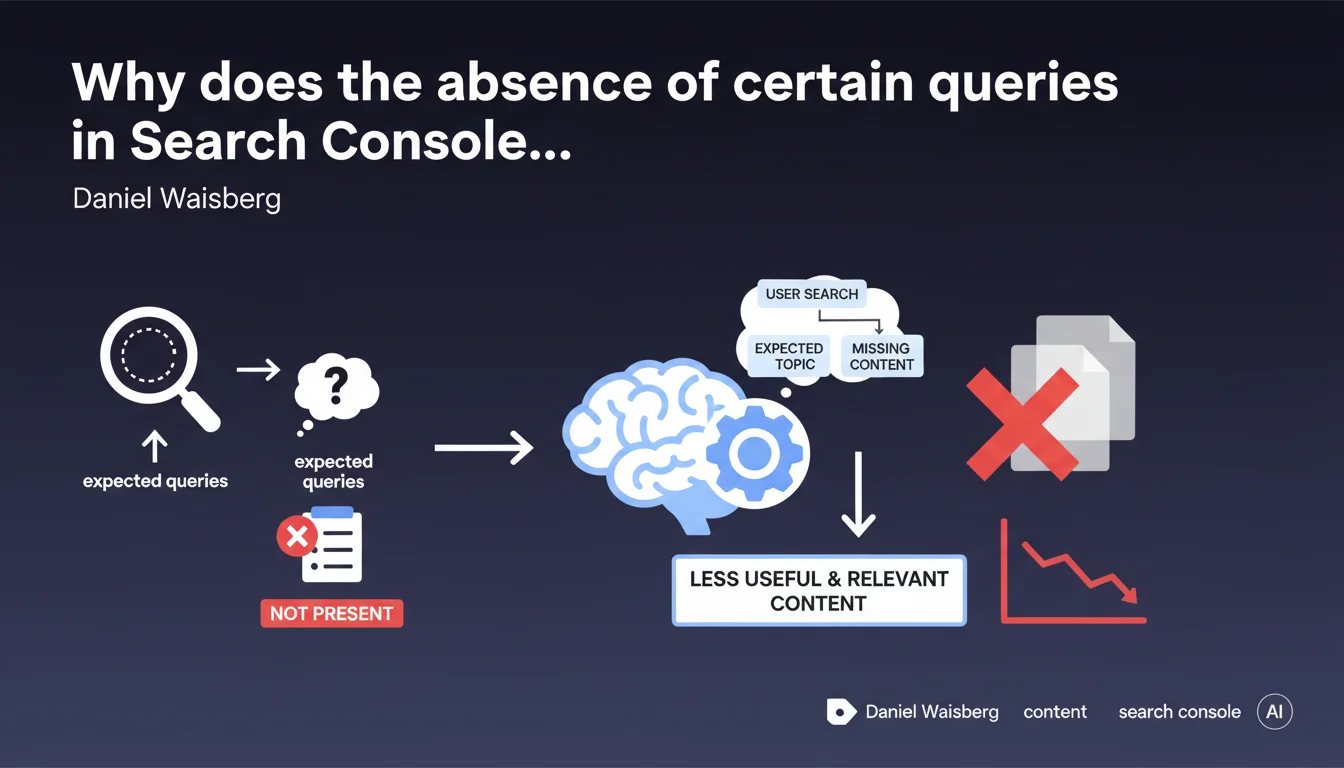
Google is crystal clear: if queries you're targeting don't appear in Search Console, your content probably isn't relevant or useful enough for those terms. It's a direct signal that your editorial strategy is missing the mark. Lack of visibility isn't a technical issue—it's a fundamental problem.
What you need to understand
What does this absence of queries in your data really mean?
When you audit Search Console and notice that strategic queries for your business don't appear anywhere, the natural reaction is to look for a technical problem. Blocked crawl? Indexation failure? Manual penalty?
Google cuts through the noise: if those queries aren't appearing, it's simply because your site doesn't offer enough relevant content on those topics. No visibility = no value detected by the algorithm.
How does Google determine if content is "relevant enough"?
The statement stays deliberately vague about exact criteria. We know Google analyzes content semantics, depth, structure, and user signals. But the threshold for "enough"? No precise metric.
Concretely, if you publish 300 words on a complex topic while your competitors produce 2,000 with real data, examples, and diagrams—you won't pass the minimum relevance filter.
Does this mean you need to produce more content at all costs?
No. Google isn't saying "write more," it's saying be more useful. Shallow content, even if lengthy, won't generate any visibility on demanding queries.
The absence of queries is a symptom of lack of value, not a volume problem. If your search intent is misunderstood, if your editorial angle misses the mark, you can publish 50 pages without ever appearing on your target terms.
- Absence of queries in Search Console = signal that Google doesn't detect sufficient value on these topics
- It's generally not a technical issue, but a fundamental editorial problem
- Google provides no precise threshold for "minimum relevance"—everything is relative to competition
- Producing more content is pointless if it remains superficial or off-topic
SEO Expert opinion
Is this statement consistent with real-world observations?
Yes, absolutely. We see it all the time: sites targeting competitive queries with shallow content generate no impressions. Even if indexed, even without penalties.
Google doesn't block these pages—it simply ignores them because they offer nothing more than the 10 results already ranked. The algorithm filters, and mediocre content doesn't pass the visibility threshold.
What nuances should we add to this claim?
First nuance: some ultra-niche queries might never appear in Search Console simply because nobody searches for them. That's not a content problem—it's a zero search volume problem.
Second nuance: in hyper-competitive markets, even objectively very good content can take months to appear on certain queries. Initial absence doesn't necessarily mean your content is poor—just that it hasn't yet built enough trust signals (backlinks, traffic, engagement).
Third point: Google doesn't say "your content is bad," it says it's not useful enough. That distinction matters. Content can be solid but insufficiently differentiated to emerge against established competitors. [To verify]: Google never specifies at what point content shifts from "not relevant enough" to "relevant enough."
In which cases does this rule not apply?
If your site is very new (less than 3 months old), the absence of queries may simply reflect initial lack of crawl and domain trust. Patience required.
If you're targeting queries with zero search volume, Search Console will never display them, even if your content is excellent. That's not a failure signal—it's just that nobody searches for it.
Practical impact and recommendations
What should you do concretely if strategic queries are missing?
First step: verify these queries have actual search volume. Use Google Keyword Planner, Semrush, Ahrefs—if volume is zero, don't bother.
Second step: analyze the top 10 results ranking for those queries. How deep? What format? Which editorial angles? If your content is half the length, less structured, with no data or concrete examples, you've found your answer.
Third step: overhaul or enhance your existing pages. Add missing sections, case studies, internal FAQs, schemas. Goal: become the best possible answer to the search intent.
What mistakes should you absolutely avoid?
Don't fall into the keyword stuffing trap. Google says "relevant content," not "content crammed with exact keyword variations." Over-optimization kills readability and user signals.
Avoid creating 10 different pages to target 10 variations of the same query. If intent is identical, one solid page will outperform internal cannibalization.
Don't overlook off-page signals. Content can be excellent—if it has no backlinks and your competitors have hundreds, it'll stay invisible. Relevance alone isn't always enough—trust matters too.
How do you verify your strategy is working?
After optimizations, wait 4 to 6 weeks minimum. Google needs time to recrawl, re-evaluate, and reposition.
Monitor Search Console evolution: if target queries start appearing, even in position 50, that's a good sign. You're on Google's radar. Keep strengthening content and external signals.
- Verify actual search volume for missing queries (no volume = no possible visibility)
- Analyze the top 10 results to understand Google's expectations on those queries
- Enrich or overhaul existing content to reach a higher relevance level
- Avoid over-optimization and internal cannibalization (1 intent = 1 page)
- Strengthen off-page signals (backlinks, mentions) alongside content
- Allow 4 to 6 weeks before judging optimization effectiveness
❓ Frequently Asked Questions
Combien de temps faut-il attendre avant qu'une requête apparaisse dans Search Console après publication ?
Est-ce qu'une absence de requêtes peut être due à un problème d'indexation plutôt qu'à un manque de pertinence ?
Faut-il créer une page par variation de requête ou regrouper plusieurs intentions sur une seule page ?
Peut-on apparaître sur une requête sans jamais l'avoir mentionnée explicitement dans le contenu ?
Est-ce que des backlinks peuvent compenser un contenu peu pertinent ?
🎥 From the same video 1
Other SEO insights extracted from this same Google Search Central video · published on 10/03/2026
🎥 Watch the full video on YouTube →
💬 Comments (0)
Be the first to comment.