
Official statement
What you need to understand
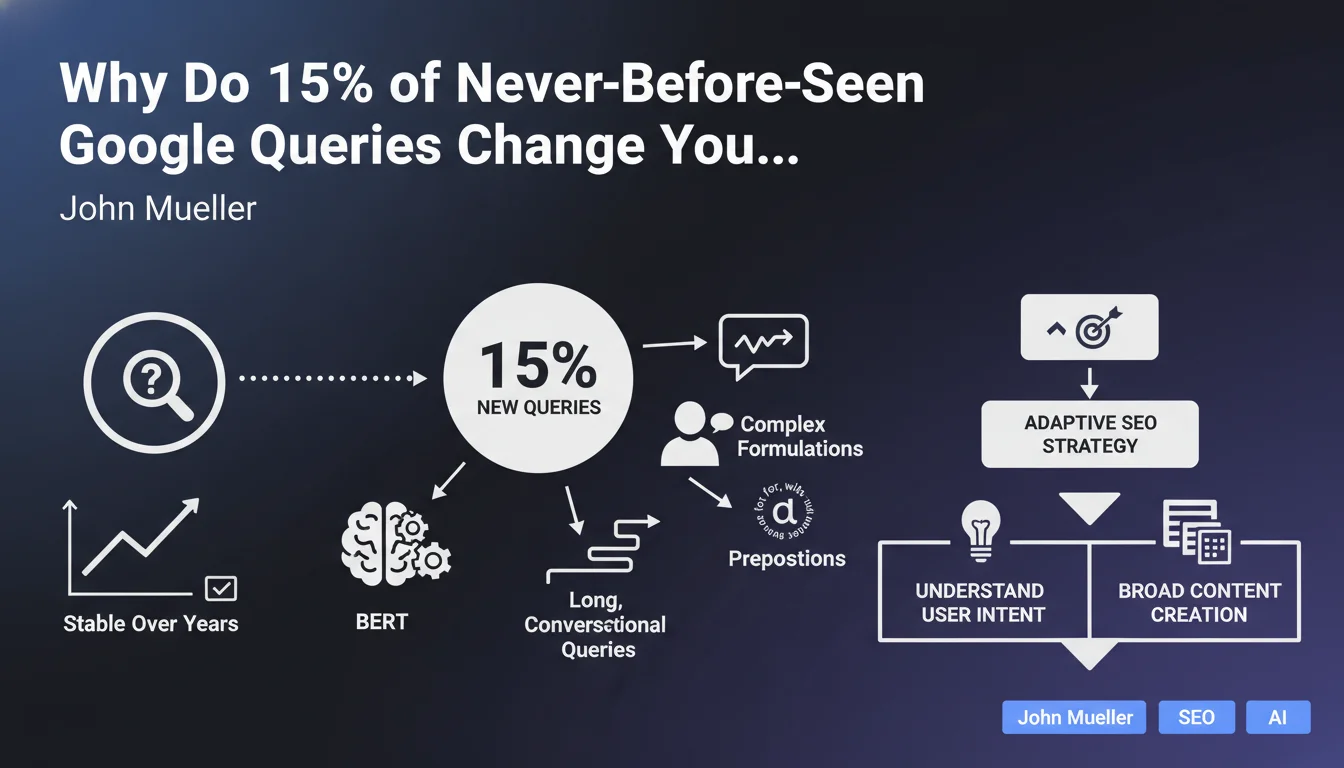
Google processes billions of queries every day, and despite the rise of artificial intelligence, 15% of them are completely new. This figure, stable over time, reveals a crucial reality: internet users constantly formulate new questions that no one has ever asked before.
To handle these unpredictable queries, Google has developed advanced technologies like BERT that allow it to understand context and linguistic nuances. The algorithm can now grasp the importance of prepositions and conversational formulations to match these new queries with existing content.
This capability demonstrates that the web ecosystem remains dynamic and constantly evolving. Users regularly search for new information, ask more complex and natural questions, which has direct implications for your content strategy.
- 15% of never-before-seen queries represent billions of daily searches impossible to anticipate
- BERT and NLP technologies enable Google to understand never-seen-before formulations
- Long, conversational queries are better understood through context processing
- Search intent takes precedence over exact keywords
- A permanently evolving ecosystem requires continuous adaptation
SEO Expert opinion
This statement confirms what SEO practitioners have been observing for years: the long tail is no longer just a theory but a major operational reality. Optimization for exact keywords is gradually becoming obsolete in favor of a holistic semantic approach.
However, an important nuance is necessary: if Google can understand never-before-seen queries, this doesn't mean it will create non-existent content. The algorithm makes connections with relevant existing content. Your role therefore remains to produce sufficiently rich and structured content to be eligible for these semantic matchings.
Sites that focus only on high-volume keywords miss a considerable opportunity. Never-before-seen queries often represent highly qualified search intents, with users having specific needs and potentially a better conversion rate.
Practical impact and recommendations
- Abandon the "one keyword = one page" approach in favor of comprehensive thematic coverage per topic
- Create in-depth content that addresses all facets of a subject, even questions no one has asked yet
- Adopt natural, conversational language in your content rather than keyword over-optimization
- Structure your content with clear subheadings that correspond to different possible search intents
- Integrate extensive FAQs that anticipate complex questions and their natural variations
- Prioritize E-E-A-T expertise to demonstrate your authority on a subject and cover complex angles
- Use structured data to help Google understand the context and relationships between your content
- Develop semantic silos where pages mutually reinforce each other on a theme
- Write for humans first, answering questions as you would verbally
- Don't neglect the long tail: it represents the majority of these 15% of never-before-seen queries
In summary: This revelation confirms that your SEO strategy must evolve toward a holistic semantic approach. Forget hunting for exact keywords and focus on comprehensive thematic coverage.
The complexity of this transformation should not be underestimated. Restructuring a content architecture, developing coherent semantic silos, and implementing an editorial strategy based on intent rather than search volumes require specialized expertise. These changes simultaneously affect editorial strategy, technical architecture, and in-depth semantic analysis of your sector. For effective implementation of these recommendations and a complete overhaul of your SEO approach, support from a specialized agency can save you valuable time and avoid costly mistakes in this transition to semantic SEO.
💬 Comments (0)
Be the first to comment.