
Official statement
What you need to understand
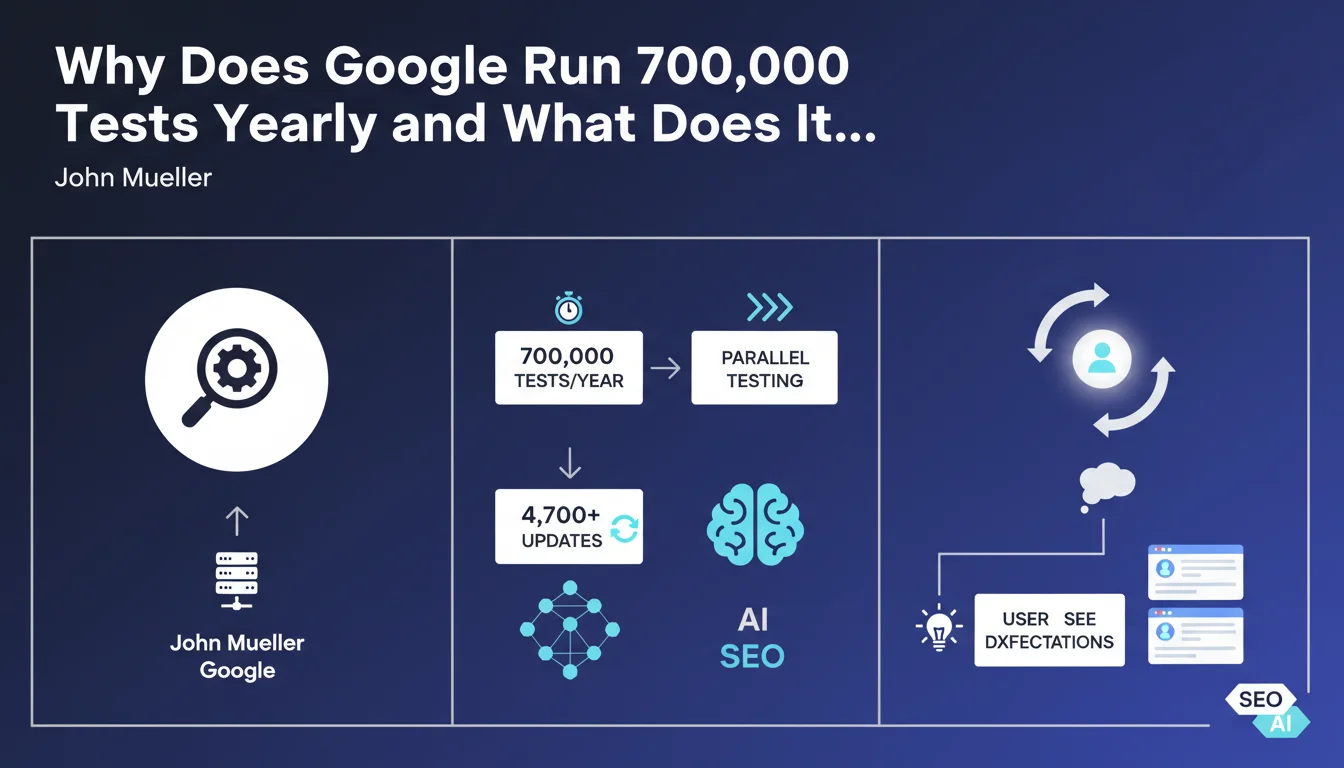
Google conducts over 700,000 annual tests, which translates into approximately 4,700 concrete algorithm updates each year. This represents an average of 13 search engine modifications per day.
This statement reveals that many tests are conducted simultaneously, which explains why search results can vary from one user to another. Users therefore involuntarily participate in constant A/B testing.
John Mueller clarifies that these permanent changes are not intended to complicate the work of SEO professionals, but to meet the ever-increasing expectations of users regarding the relevance and quality of results.
- 13 updates per day on average modify how Google works
- Results can vary between users due to parallel testing
- The objective remains end-user satisfaction, not SEO complication
- These variations explain the daily ranking fluctuations observed
SEO Expert opinion
This statement confirms what SEO practitioners observe daily: rankings fluctuate constantly, even without modifying their site. With 13 changes per day, it becomes impossible to attribute a ranking variation to a specific adjustment.
What needs to be nuanced is that not all these tests have the same impact. The majority are micro-adjustments that affect very specific queries or restricted user segments. Major updates (Core Updates) remain rare and announced.
The claim that these tests aim to satisfy users is consistent with Google's philosophy. However, in practice, this means that your SEO strategy must also be user-centered rather than seeking to manipulate the algorithm.
Practical impact and recommendations
- Adopt a long-term vision: Don't panic over daily ranking fluctuations, they are part of the permanent testing process
- Analyze trends over a minimum of 30 days: Avoid decisions based on weekly variations that may result from temporary tests
- Diversify your traffic sources: Constant result volatility makes exclusive dependence on organic traffic dangerous
- Prioritize real user experience: Loading time, intuitive navigation, quality content aligned with search intent
- Measure your engagement metrics: Bounce rate, time on site, pages per session - these signals guide Google's decisions
- Create genuinely useful content: The 700,000 tests aim to detect and reward real added value for users
- Document your modifications: Keep a log of changes made to isolate what truly works in the long term
- Avoid opportunistic optimizations: Techniques that exploit temporary loopholes will be quickly neutralized by a subsequent test
In summary: The stability of your SEO strategy must contrast with the instability of the algorithm. Focus on solid fundamentals rather than frantic optimization.
Faced with this growing complexity and the 13 daily algorithm adjustments, maintaining a coherent and effective SEO strategy requires sharp expertise and constant monitoring. These optimizations often require in-depth data analysis and a fine understanding of algorithmic evolutions. For many businesses, relying on a specialized SEO agency provides personalized support and continuous strategic monitoring, thus ensuring optimal adaptation to the search engine's ongoing evolutions.
💬 Comments (0)
Be the first to comment.