
Official statement
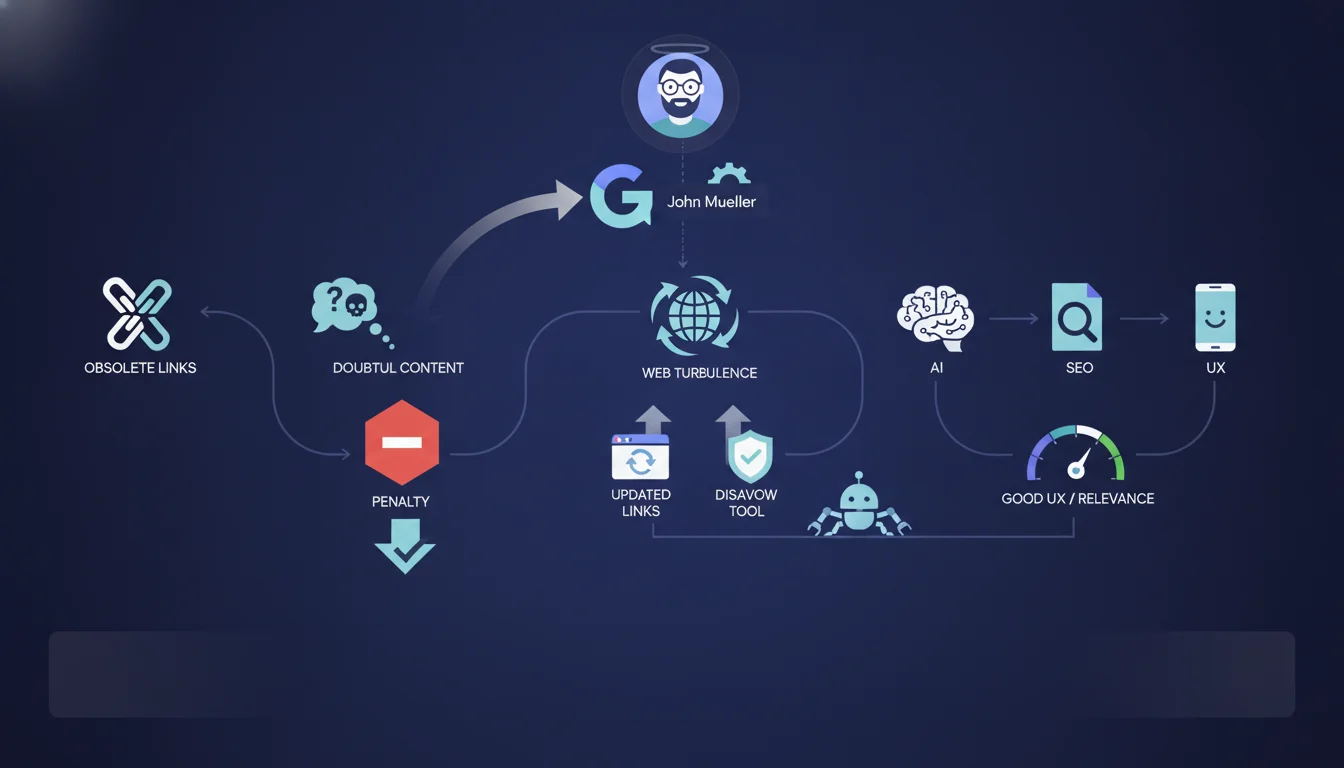
Mueller claims that Google does not penalize outgoing links pointing to sites that have changed ownership or now host questionable content. The web is constantly evolving, and algorithms take this into account. The real concern is about sites whose entire content has become outdated, not just a few isolated broken links.
What you need to understand
Why does Google tolerate links to acquired domains?
Mueller's statement on Reddit starts from a concrete case: a webmaster worries about outgoing links published several years ago to a domain that has since changed hands and now hosts spam. Google's response is pragmatic.
Search engines know that the web is in perpetual motion. Domains are sold, acquired, abandoned, or hijacked every day. Penalizing a site for every problematic outgoing link would mean punishing the entire old web. Google has clearly chosen a more lenient approach: these links do not trigger an automatic penalty.
What’s the difference between a few broken links and an obsolete site?
Mueller introduces a nuance that changes everything. If the entirety of your content has become outdated, you shift into a different category of problem. It's no longer a matter of technical maintenance but of overall relevance.
A site that hasn't been updated since 2015 and accumulates dozens of outgoing links to acquired domains signals abandonment to Google. In this case, the problem isn’t the links themselves, but the general signal of obsolescence they reinforce.
How does Google distinguish between the two situations?
Google likely analyzes several cross signals: freshness of remaining content, rate of broken or redirected links, user engagement, number of recent updates. An old article with 2-3 outdated links in the middle of 15 valid links poses no issue.
In contrast, an entire site with 50% of broken or spammy outgoing links presents the image of a garden left to grow wild. This is not a manual penalty aimed at the links; it's a gradual devaluation related to a loss of relevance.
- Google does not sanction isolated outgoing links to acquired or transformed sites
- The issue arises when the entire site signals obsolescence
- Algorithms cross-verify multiple indicators to assess overall freshness
- It's better to keep links updated, but it's not a critical urgency if the rest of the site is active
- The distinction lies in the proportion and context, not on an absolute threshold
SEO Expert opinion
Does this tolerance really apply to all types of links?
Let’s be honest: Mueller's statement remains vague on quantitative thresholds. At what point do outdated links push you into the danger zone? He provides no numbers. [To verify] on actual sites with different ratios.
Field experience shows that the context of the link matters greatly. An old editorial link in a historical in-depth article will be treated differently than a link in a resource page meant to be maintained. Google likely assesses the initial intent of the link and its nature.
What should you do if the pointed domain now hosts illegal or dangerous content?
Mueller says that Google does not penalize, but he only refers to classic spam or change of ownership. A domain that becomes a conduit for malware or hosts illegal content may trigger other protective mechanisms.
In this specific case, even if Google does not penalize your site, Safe Browsing may display a warning to users who click. Your reputation takes a hit even without a direct SEO penalty. Mueller’s recommendation to keep links updated makes perfect sense here.
How do you interpret the concept of a site becoming obsolete as a whole?
Mueller mentions general obsolescence without providing precise criteria. A site can be old and still relevant if its subject matter is timeless. Age alone is not a negative factor.
The issue arises when abandonment signals accumulate: no updates for years, high bounce rates, short session durations, outdated technologies (Flash, non-HTTPS protocols), mass broken links. Google cross-verifies these indicators to assess whether a site still deserves to be served to users. [To verify] how much weight Google assigns to each signal in this overall evaluation.
Practical impact and recommendations
Should you launch a complete audit of all your outgoing links?
The answer depends on the overall state of your site. If you regularly publish fresh content and your old pages are still being accessed, a massive audit is not a priority. Focus on strategic high-traffic pages.
On the other hand, if your site has been accumulating years of content without maintenance, targeted cleanup can send a positive signal of taking charge. Prioritize the pages that still generate organic traffic or conversions.
How can you identify the outgoing links that really pose a problem?
Use Screaming Frog or a similar crawler to extract all your outgoing links, then check the HTTP response codes. 404, 410, or multiple redirects are easy to spot. For acquired domains, manually check a sample of the pointed domains.
Prioritize resource pages, evergreen guides, and pillar content. These pages last a long time and accumulate SEO value. A broken link or one pointing to a dubious site causes more damage there than in a blog post from 2012 that no longer generates traffic.
What strategy should you adopt to keep your links updated without spending hours on it?
Automate the detection of broken links with tools like Ahrefs, Semrush, or WordPress plugins. Set up monthly alerts instead of massive quarterly audits. Fix issues as they arise.
For links to acquired domains, it's more complex. It's not entirely automatable. Reserve this work for strategic content during their annual updates. If an article needs refreshing, use that opportunity to check its outgoing links.
- Crawl your site to extract all outgoing links with their HTTP codes
- Prioritize high organic traffic pages and pillar content
- Manually check a sample of pointed domains to detect acquisitions
- Automate the monitoring of 404s with monthly alerts
- Fix broken links during planned content updates
- Do not remove a historical contextual link just because it is outdated; replace it or add an editorial note
💬 Comments (0)
Be the first to comment.