
Official statement
What you need to understand
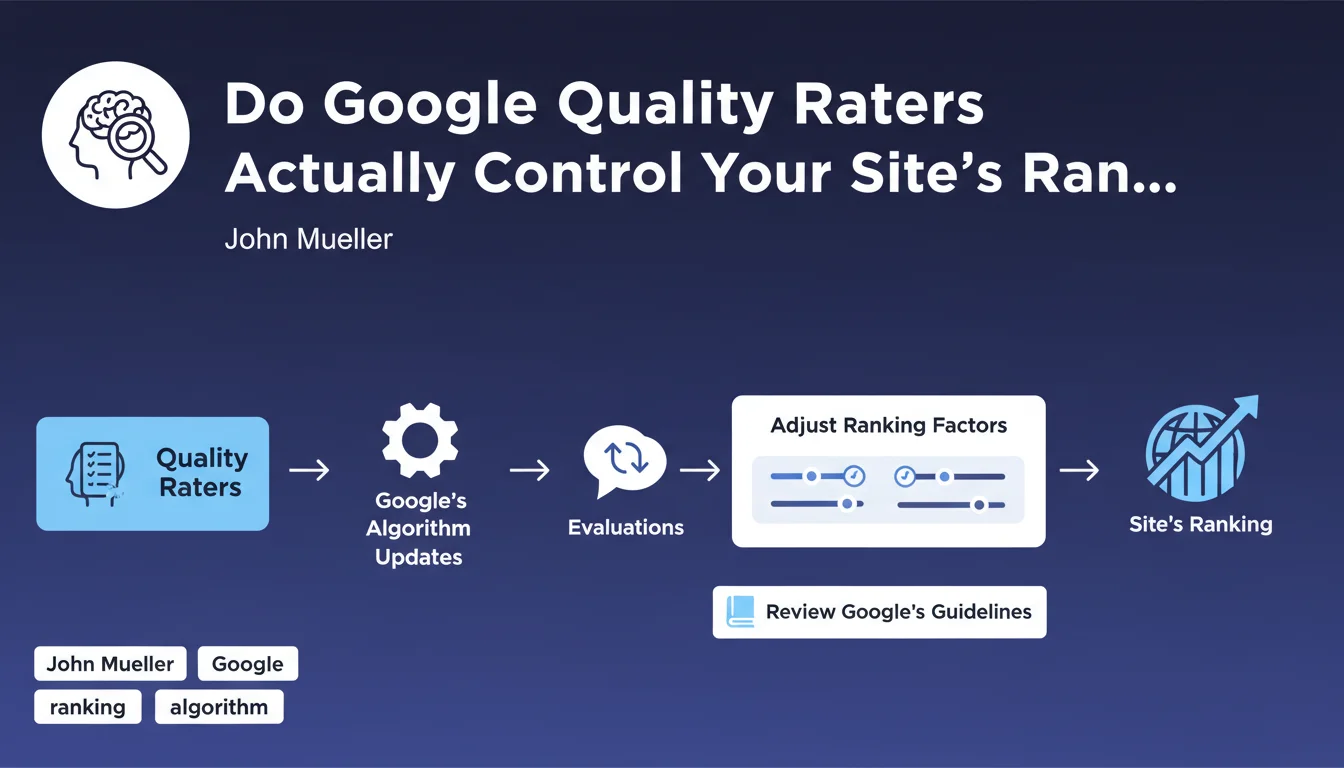
Quality raters are human evaluators employed by Google to assess the relevance and quality of search results. Contrary to a common misconception, they don't directly modify the positions of your site in search results.
Their role is to evaluate the effectiveness of algorithmic updates before and after deployment. They use the Search Quality Rater Guidelines, a reference document that details what Google considers quality content.
These evaluations serve to validate and refine the ranking factors of the algorithm. If quality raters identify that an update isn't producing the expected results, Google engineers adjust the algorithm accordingly.
- Quality raters have no direct power over the ranking of individual sites
- They evaluate the overall relevance of results according to defined criteria
- The Quality Rater Guidelines reveal the quality criteria valued by Google
- These guidelines constitute a valuable roadmap for SEO professionals
- Understanding these guidelines allows you to anticipate algorithmic evolutions
SEO Expert opinion
This clarification from John Mueller is perfectly consistent with what we observe in the field. Many SEO practitioners mistakenly fear that a quality rater will "penalize" their site, when the process is actually much more indirect and systemic.
The most underestimated aspect of this statement concerns the importance of the Quality Rater Guidelines. These public documents contain strategic information about the concepts of E-E-A-T (Experience, Expertise, Authoritativeness, Trustworthiness), helpful content, and user satisfaction. Sites that align their content strategy with these principles consistently benefit from better resilience against updates.
Warning: Don't fall into the trap of over-optimizing for quality raters. The goal remains to satisfy real users, not to impress evaluators. The guidelines serve as a compass, not a mechanical checklist to apply blindly.
In certain sensitive sectors like health or finance (YMYL - Your Money Your Life), alignment with the Quality Rater Guidelines becomes critical. Standards are significantly higher there and evaluations more scrutinized.
Practical impact and recommendations
- Download and study the Search Quality Rater Guidelines in their entirety to understand Google's criteria
- Audit your content according to E-E-A-T criteria: demonstrated experience, visible expertise, recognized authority, established trust
- Identify YMYL pages on your site and prioritize strengthening their credibility signals (qualified authors, sources, references)
- Improve expertise signals: detailed author biographies, credentials, concrete evidence of experience
- Don't attempt to optimize for hypothetical quality raters who might visit your site - they probably never will
- Focus on real user experience: query satisfaction, information clarity, ease of navigation
- Document your content creation processes to demonstrate the seriousness and methodology of your approach
- Monitor major algorithmic updates which typically follow evaluation phases by quality raters
Quality raters are indirect quality indicators that guide the evolution of the algorithm. Rather than trying to target them, use their guidelines as a strategic reference framework to elevate the overall quality of your content.
Compliance with E-E-A-T principles and optimization according to the Quality Rater Guidelines represent a substantial undertaking that requires in-depth expertise and a long-term strategic vision. These optimizations often affect the information architecture, editorial governance, and trust signals of your entire digital ecosystem. For organizations wishing to conduct this transformation in a structured manner, support from a specialized SEO agency provides access to proven methodology and significantly accelerates the achievement of measurable results.
💬 Comments (0)
Be the first to comment.