
Official statement
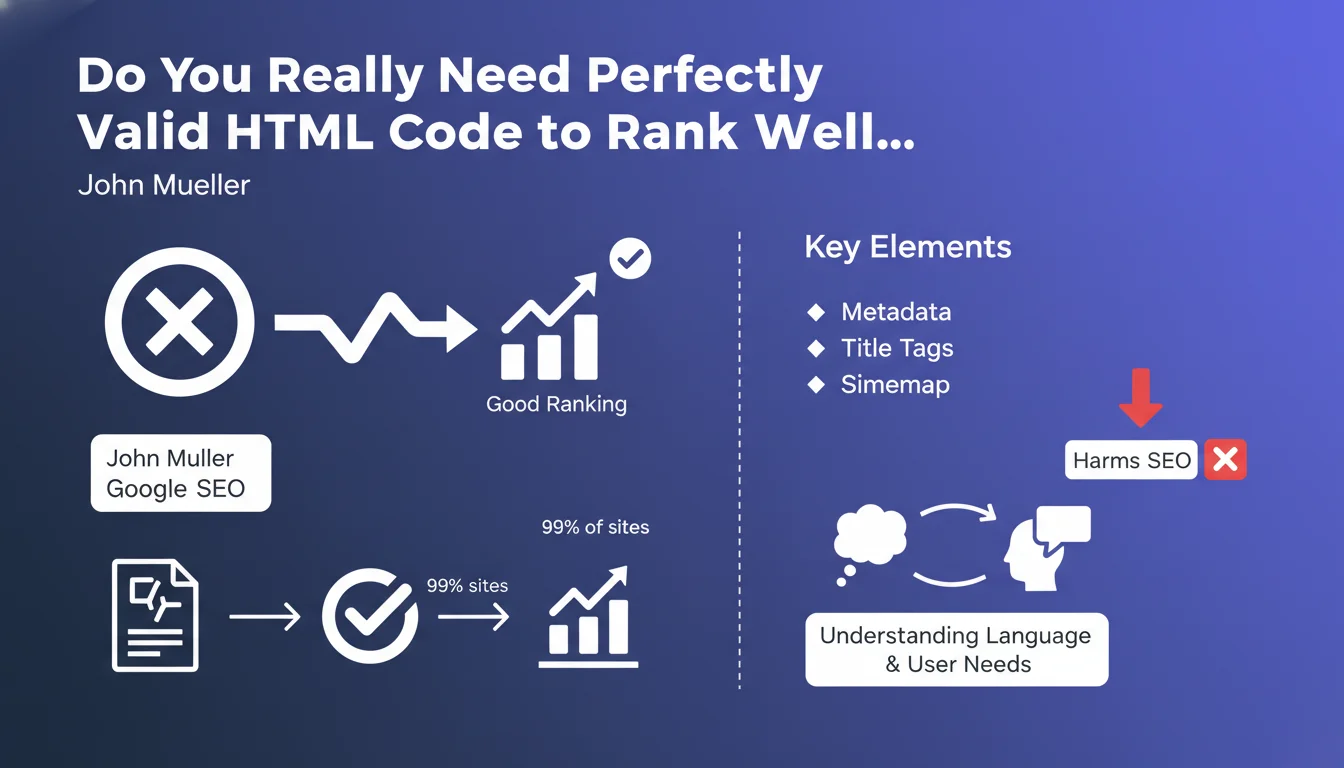
Only key elements like metadata need to be correctly coded, as errors at this level can harm SEO. SEO isn't limited to technical aspects: understanding the language and needs of users is often more decisive. Finally, good Core Web Vitals scores or the use of JavaScript alone don't guarantee good rankings: it all depends on the quality of the content and its accessibility.
What you need to understand
This statement from Google challenges a deeply rooted belief in the SEO community: W3C validation of HTML code is not a decisive ranking factor. According to Google engineers, the vast majority of well-positioned sites have HTML code errors.
Concretely, this means that Google's robots are designed to be tolerant of code imperfections. They know how to interpret imperfect HTML and extract the information necessary for indexing, even in the presence of syntax errors or unclosed tags.
However, this tolerance has its limits. Google specifies that certain structural elements must remain correctly coded, particularly metadata that plays a crucial role in search engines' understanding of content.
- HTML perfection is not required for good SEO
- Critical metadata (title, meta description, structured data) must be correctly implemented
- Content and user intent take precedence over technical code cleanliness
- Core Web Vitals and JavaScript alone are not enough to guarantee good rankings
- Content quality and accessibility remain the determining factors
SEO Expert opinion
This position from Google indeed corresponds to what I observe daily in SEO audits. Many leading sites in their queries have dozens, even hundreds of HTML validation errors, with no visible impact on their rankings.
However, this statement needs nuancing: while minor HTML errors are tolerated, certain structural errors can have indirect consequences. For example, poorly formed HTML can prevent the correct rendering of essential content, harm mobile accessibility, or block the extraction of structured data.
The real question is therefore not "is my HTML 100% valid?" but rather "do my HTML errors prevent Google from understanding and accessing my content?". Clean code remains an indicator of overall quality and facilitates long-term maintenance.
Practical impact and recommendations
Following this clarification from Google, here's how to adjust your technical optimization priorities to maximize your effectiveness:
- Stop wasting time correcting all minor W3C validation errors (unclosed tags, obsolete attributes, etc.)
- Focus on critical metadata: verify that your title tags, meta descriptions, and structured data are correctly implemented
- Test the actual accessibility of your content with Google tools (Search Console, Mobile-Friendly Test, Rich Results Test)
- Prioritize user experience: code that correctly displays content is better than perfect but unreadable code
- Audit structural elements: canonical, hreflang, robots meta, heading hierarchy tags
- Invest in content quality and its relevance rather than in syntactic perfection
- Monitor Core Web Vitals but understand that they are just one factor among others
- Ensure that JavaScript doesn't prevent the indexing of essential content
In summary: redirect your time and resource budget toward what actually impacts user experience and Google's understanding of your content, rather than toward formal code validation.
Prioritizing technical optimizations requires sharp expertise to distinguish critical corrections from superficial adjustments. Faced with the growing complexity of ranking criteria, many professionals choose to collaborate with a specialized SEO agency capable of quickly identifying high-impact levers and avoiding time-consuming optimizations with low return on investment.
💬 Comments (0)
Be the first to comment.