
Official statement
Other statements from this video 9 ▾
- □ Is Google really ignoring your meta tags placed in the <body>?
- □ Does Google really ignore canonical tags placed in the <body>? Here's why it matters.
- □ Are hreflang tags really ignored by Google when placed in the <body>?
- □ Why does modifying canonicals with JavaScript create contradictory signals that confuse Google?
- □ Should you really optimize preloading hints for Googlebot?
- □ Is HTML5 semantic markup really useless for SEO?
- □ Does web performance really improve your organic search rankings?
- □ Does Google really parse HTML the same way browsers do?
- □ Why does Googlebot ignore your resource preloading hints?
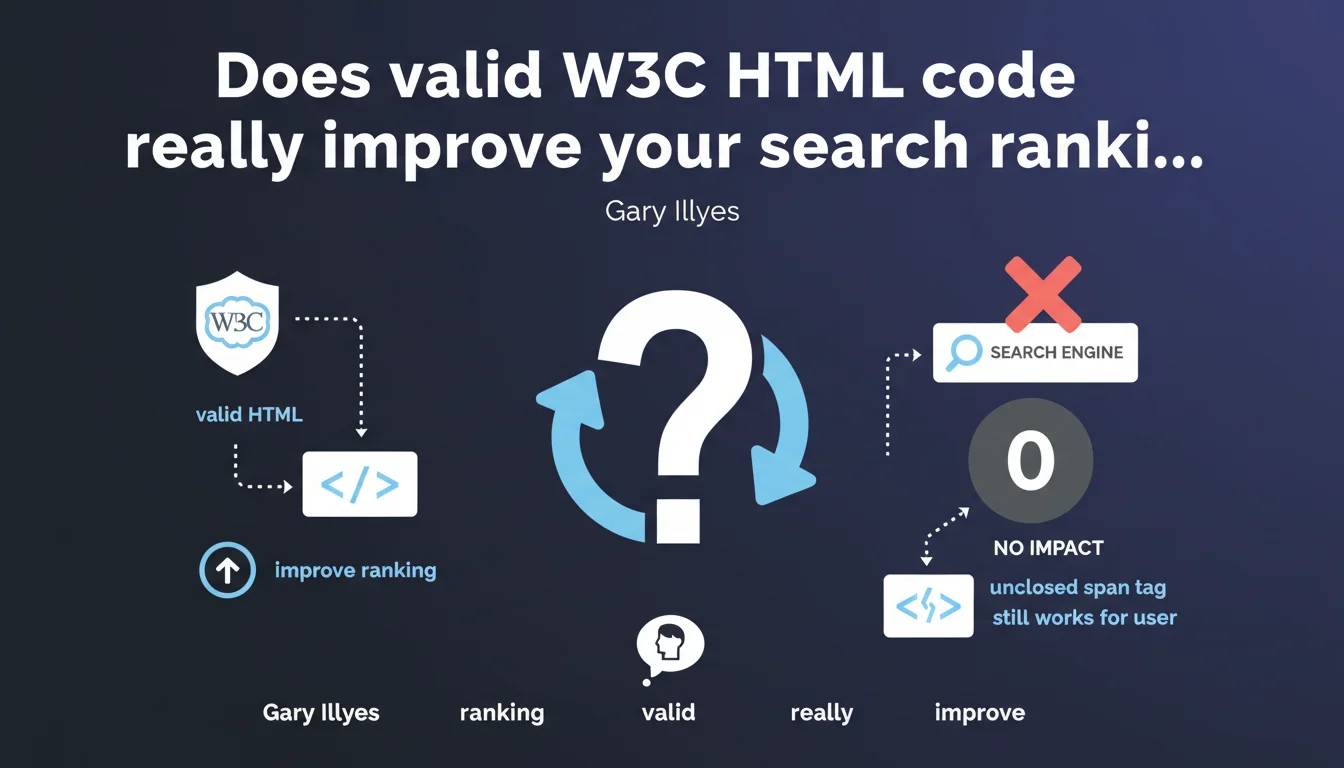
Google provides no ranking bonus for HTML code that strictly conforms to the W3C validator. A minor error like an unclosed tag technically invalidates the code without impacting user experience or SEO. As long as HTML remains functional and exploitable by search engines, strict compliance is not a ranking criterion.
What you need to understand
Why doesn't Google value W3C validity?
Google's position is pragmatic: strict technical validity according to the W3C validator does not guarantee better user experience. An unclosed <span> tag formally invalidates the HTML document, but it doesn't prevent the browser from displaying the page correctly.
Search engines have developed an HTML error tolerance comparable to that of modern browsers. Their goal is to understand content and structure, not to penalize developers for technical details that don't affect the end user.
What really matters to Google?
What counts is that the HTML is exploitable and consistent. Google must be able to identify headings, paragraphs, links, images — in short, understand the content hierarchy. If your markup allows this reading, you're in the clear.
Illyes' statement mentions "unless you do something really stupid." Concretely: completely broken HTML that prevents content parsing, critical tags poorly closed that distort the structure, or errors that block rendering for Googlebot.
Is W3C validation completely useless?
No. It remains an indicator of code quality and facilitates maintenance, especially on complex sites. Clean code reduces the risk of cross-browser display bugs and simplifies developers' work.
But in terms of pure SEO, it brings no direct ranking gain. It's a web development best practice, not a ranking factor.
- Google does not penalize minor HTML validation errors
- No ranking bonus is awarded for code strictly compliant with W3C
- What matters: HTML that is functional and exploitable by search engines
- Google's error tolerance is comparable to that of modern browsers
- W3C validation remains useful for code quality and maintenance, not for direct SEO
SEO Expert opinion
Is this statement consistent with real-world observations?
Yes, completely. For years, SEO professionals have observed that sites with hundreds of W3C validation errors rank perfectly, while sites with "perfect HTML" struggle to take off. The correlation between W3C validity and ranking is non-existent.
Major e-commerce sites like Amazon or eBay accumulate validation errors without harming their visibility. Google has always prioritized intent and user experience over formal code rigor.
Where does Illyes draw the line between "acceptable" and "really stupid"?
That's where it gets tricky. The statement remains deliberately vague about what constitutes a critical error. [To verify]: Google does not publish an exhaustive list of HTML errors blocking crawl or indexation.
In practice, errors that cause problems are those that break semantic structure: poorly closed <head> or <body> tags, impossible nestings like <div> within <span> that distort the DOM, or inline JavaScript that is poorly escaped and corrupts parsing.
Does W3C validation have an indirect impact on SEO?
Potentially. Clean code facilitates implementation of advanced SEO features: dynamic meta tags, structured data, Core Web Vitals optimizations. Chaotic HTML slows down these projects and multiplies bugs.
Moreover, some HTML errors degrade performance (heavier parsing, unnecessary reflows) or accessibility — two signals that Google values indirectly. But again, it's the impact on the user that counts, not compliance itself.
Practical impact and recommendations
Should we abandon HTML validation in SEO audits?
No. Simply, don't treat it as a critical priority. When conducting an audit, validating HTML via W3C or other tools remains relevant for detecting structural anomalies, but a list of 50 warnings doesn't justify an urgent correction sprint.
Focus first on errors that impact rendering, crawling, or indexation. Everything else is secondary.
Which HTML errors actually deserve to be fixed?
Those that break the content hierarchy: multiple disordered <h1> tags, poorly nested heading tags, missing or inconsistent <header>/<main>/<footer> structure.
Errors that harm metadata parsing: poorly formed canonical or hreflang tags, duplicate or conflicting meta tags. And of course, anything that degrades Core Web Vitals: images without declared dimensions (CLS), blocking scripts placed incorrectly.
How do you prioritize HTML corrections for SEO?
Apply a simple filter: does this error have a visible impact on user experience or crawling? If yes, fix it. If no, document and move on.
- Verify that Googlebot can parse the main content (test via Search Console or rendering tool)
- Ensure the heading hierarchy is coherent (unique H1, logical H2/H3)
- Check that critical SEO tags (canonical, hreflang, meta robots) are syntactically correct
- Test mobile rendering: some HTML errors cause mobile-specific bugs
- Validate the syntax of structured data (JSON-LD, Microdata) — zero tolerance here
- Prioritize corrections that improve accessibility and performance (indirect SEO impact)
- Ignore W3C warnings that are purely cosmetic with no user impact
❓ Frequently Asked Questions
Une balise non fermée peut-elle empêcher l'indexation d'une page ?
Dois-je corriger toutes les erreurs remontées par le validateur W3C ?
Le HTML5 sémantique (header, main, footer) aide-t-il le SEO ?
Les données structurées sont-elles concernées par cette tolérance aux erreurs ?
Un site avec du code HTML propre rank-t-il mieux qu'un concurrent au code sale ?
🎥 From the same video 9
Other SEO insights extracted from this same Google Search Central video · published on 26/02/2026
🎥 Watch the full video on YouTube →
💬 Comments (0)
Be the first to comment.