
Official statement
Other statements from this video 9 ▾
- □ Why is measuring your SEO performance without a solid baseline completely pointless?
- □ Should you really obsess over ranking #1 at all costs in SEO?
- □ Is SEO really a never-ending process, or can you achieve lasting results with one-off optimizations?
- □ Is your CTR in Search Console really revealing the true performance of your content?
- □ Why does Google insist on the complete funnel Search Console + Analytics approach?
- □ Should you really be leveraging unanswered questions to generate SEO content?
- □ Why aren't your most clicked pages aligned with your content strategy?
- □ Could your traffic metrics be hiding untapped business opportunities right under your nose?
- □ Should you really be factoring seasonality into your SEO strategy?
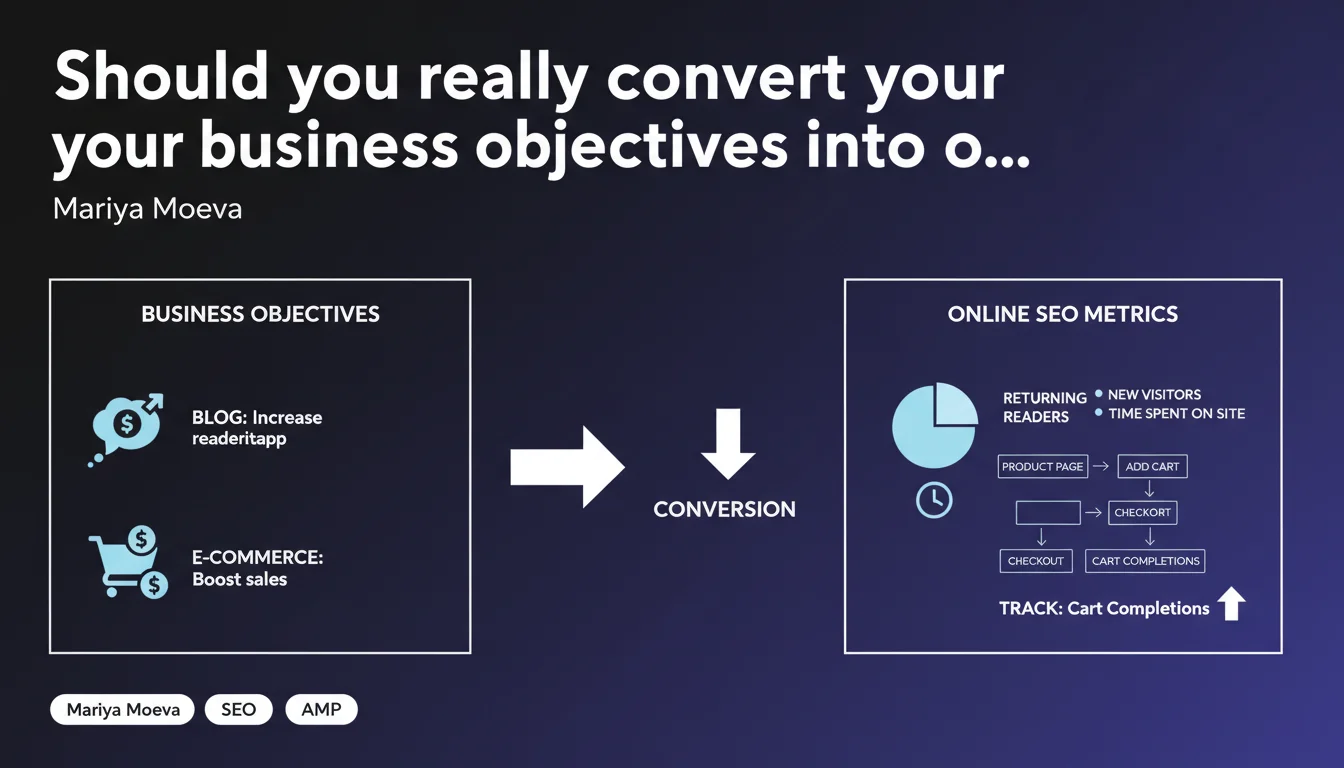
Google recommends converting concrete commercial objectives into measurable metrics tailored to your site type. A blog should track the ratio of returning versus new visitors and time spent on site, while an e-commerce platform should prioritize cart completions rather than physical sales. This approach aligns SEO strategy with real business results.
What you need to understand
Why does Google insist on this conversion of business objectives?
This statement from Mariya Moeva reflects a pragmatic vision: SEO doesn't exist in a vacuum. A site that performs well in rankings but fails to convert its business objectives is a strategic failure.
Google suggests that each business model requires specific indicators. A blog measures success through engagement (time spent, return rate), while an e-commerce platform must focus on the purchase journey rather than metrics disconnected from the online experience.
What metrics truly align with business objectives?
For a blog or media site, relevant KPIs include the percentage of returning visitors (loyalty indicator), average time on site (engagement depth), and bounce rate by content type. These indicators reveal whether content generates real value.
For an e-commerce site, Google explicitly recommends tracking cart completions rather than physical sales. Why? Because the final sale may depend on offline factors (return policy, product quality), whereas the online checkout funnel directly reflects user experience and site efficiency.
How does this approach influence SEO strategy?
Aligning SEO metrics with business objectives transforms how you evaluate success. Instead of celebrating an organic traffic spike, you ask: does this traffic convert the defined objective?
This logic requires segmenting data by page type, search intent, and channel. Informational content on an e-commerce site shouldn't be judged on direct conversions, but on its ability to initiate a customer journey.
- Each site type requires distinct KPIs aligned with its business model
- Metrics should reflect the online experience, not necessarily the final business result
- SEO becomes a measurable lever when connected to concrete business indicators
- Segmenting data by intent and content type is essential for meaningful analysis
SEO Expert opinion
Is this recommendation truly practical?
Yes, but with a significant caveat: not all sites have the analytics tools necessary to measure these metrics precisely. A basic WordPress.com personal blog won't have access to the same data as an e-commerce platform with advanced tracking.
Google's advice remains sound in principle — it's undeniable that SEO must serve measurable objectives. However, implementation requires solid technical infrastructure. E-commerce sites that don't track cart abandonment by traffic source miss critical insights.
Why does Google mention "physical sales" for e-commerce?
This phrasing is curious. An e-commerce site sells online by definition — so why contrast "cart completions" with "physical sales"?
[To verify] This is likely a translation error or contextual issue. The underlying idea is clear: focus on what happens on your site (adding to cart, order validation) rather than the final outcome, which may be affected by external factors (logistics, product quality, customer service).
What risks does this approach carry?
The main pitfall: optimizing for intermediate metrics without looking at final results. A site can show excellent cart completion rates but high post-order cancellation rates if the overall experience is disappointing.
Another risk observed in practice — some SEO professionals focus so heavily on engagement (time spent, page views) that they create labyrinthine user journeys. A user spending 10 minutes on a site because they can't find what they're looking for isn't a success.
Practical impact and recommendations
How do you define the right metrics for your site?
Start by identifying your primary business objective. For a media site: generate loyal audience that returns and consumes content in depth. For e-commerce: maximize conversions while minimizing friction in the checkout funnel.
Next, translate this objective into measurable indicators in your analytics tool. Use custom events to track critical actions — adding to cart, clicking a main CTA, downloading a resource, newsletter signup.
What mistakes should you avoid when tracking business metrics?
The classic error: relying solely on global metrics without segmentation. Total organic traffic tells you nothing if you don't separate informational visitors (top of funnel) from transactional visitors (bottom of funnel).
Another common pitfall — measuring indicators without an associated action plan. If your return rate is low, what concrete action follows? Improving related content? Strengthening your newsletter? Enhancing internal linking? A metric without an optimization lever is useless.
Concretely, what should you implement?
Configure custom objectives in Google Analytics 4 (or your tracking tool) that reflect your business goals. For a blog: "complete reading" event (90% scroll), "time spent > 2 minutes", "visit 3+ pages". For e-commerce: "add to cart", "begin checkout", "order completion".
Then create audience segments based on traffic source. Compare organic traffic performance versus paid versus direct on these business metrics — not just on volume.
- Identify 3 to 5 key metrics directly tied to your business model
- Configure custom events in GA4 to track these specific actions
- Segment your analysis by traffic source and by page type
- Establish internal benchmarks and track their monthly evolution
- Create dedicated dashboards that cross SEO metrics (rankings, traffic) with business metrics
- Document observed correlations between SEO improvements and impact on business KPIs
❓ Frequently Asked Questions
Pourquoi privilégier les complétions de panier plutôt que les ventes finales pour un e-commerce ?
Quelles métriques suivre pour un blog ou un média en ligne ?
Comment mesurer l'impact SEO réel si on se concentre sur des métriques business ?
Peut-on appliquer cette logique à tous les types de sites ?
🎥 From the same video 9
Other SEO insights extracted from this same Google Search Central video · published on 19/04/2022
🎥 Watch the full video on YouTube →
💬 Comments (0)
Be the first to comment.