
Official statement
Other statements from this video 9 ▾
- □ Faut-il vraiment traduire ses objectifs business en métriques en ligne pour réussir son SEO ?
- □ Pourquoi mesurer vos performances SEO sans baseline solide est-il inutile ?
- □ Faut-il vraiment viser la première position à tout prix en SEO ?
- □ Faut-il vraiment considérer le SEO comme un processus continu ou peut-on se contenter d'optimisations ponctuelles ?
- □ Pourquoi le CTR dans Search Console révèle-t-il vraiment la performance de vos contenus ?
- □ Pourquoi Google insiste-t-il sur le funnel complet Search Console + Analytics ?
- □ Faut-il vraiment exploiter les questions non répondues pour générer du contenu SEO ?
- □ Comment les métriques de trafic peuvent-elles révéler de nouvelles opportunités business ?
- □ Faut-il vraiment intégrer la saisonnalité dans votre stratégie SEO ?
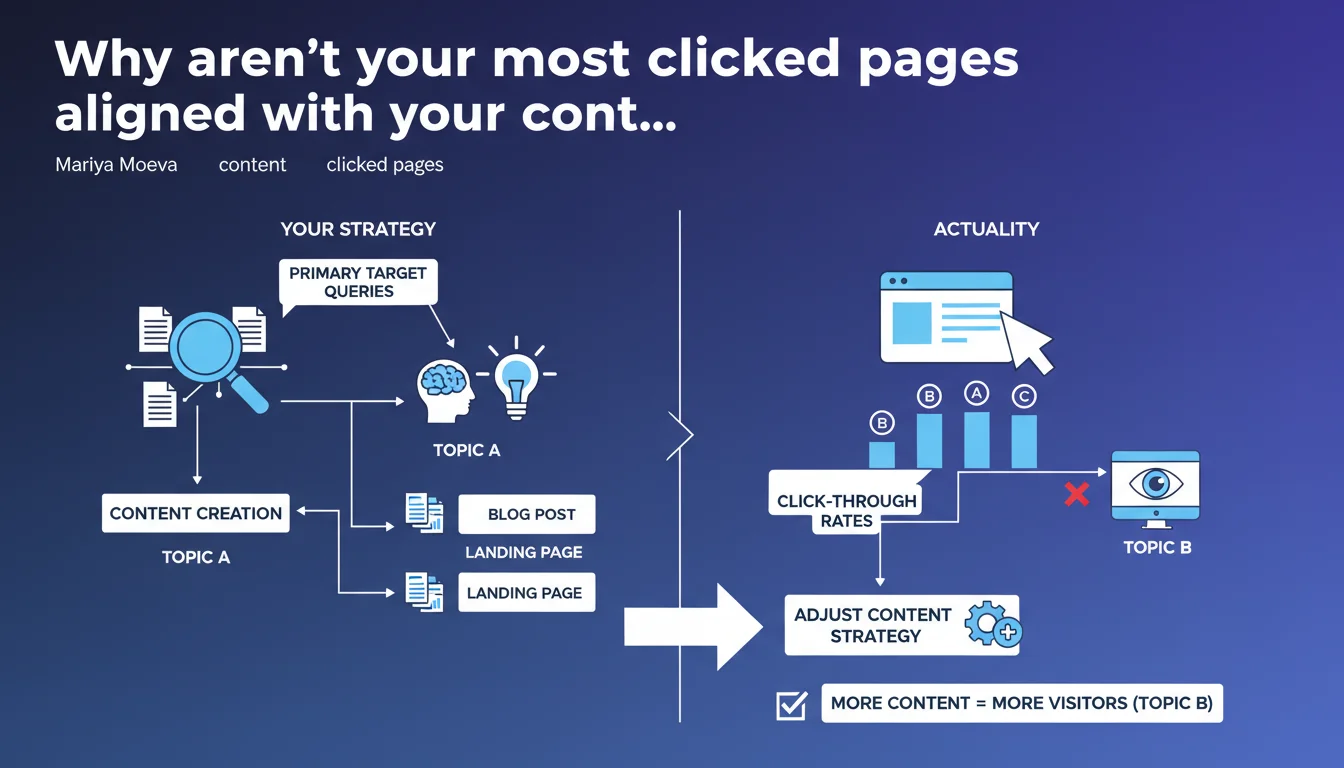
Google recommends analyzing the gap between your primary target queries and the pages that actually drive traffic. If your highest CTRs are concentrated on topics different from your core strategy, it's a signal to pivot and produce more content that genuinely attracts visitors.
What you need to understand
What does this gap between intention and performance really mean?
Mariya Moeva's statement points to a frequent misalignment: you're optimizing for certain strategic keywords, but users are massively clicking on other pages. This phenomenon often reveals either a misunderstanding of actual search behavior or an overestimation of certain search volumes.
The analysis of click-through rate by page in Search Console then becomes an indicator of relevance — not just ranking. A well-ranked page with a low CTR doesn't attract traffic. Conversely, a page with an unusually high CTR reveals an untapped user need.
How does Google measure this strategic alignment?
Google doesn't measure it directly — that's your job. Search Console shows you impressions, positions, and CTR by query and URL. If your product category pages generate 60% of traffic while you're heavily investing in editorial content that caps out at 15%, you have an allocation problem.
The underlying message: stop producing what you think is useful and focus on what users actually want. Click metrics are a vote — ignore them at your peril.
What interpretation pitfalls should you avoid?
A high CTR doesn't necessarily mean high conversion. A page can attract informational clicks without generating business. Conversely, some transactional queries have naturally low CTRs but convert better.
Another bias: comparing pages with radically different impression volumes. A 12% CTR on 50 monthly impressions doesn't justify a strategic pivot. You need to cross-reference volume, CTR, and intent.
- Analyze regularly the gap between targeted queries and high-performing pages
- Identify topic areas that naturally generate more clicks
- Don't confuse high CTR with business relevance
- Prioritize volume: a gap of 10 clicks/month isn't significant
- Cross-reference with conversions: a click isn't a sale
SEO Expert opinion
Is this recommendation really as straightforward as it sounds?
No. The idea seems obvious — produce what works — but it raises a strategic vision question. If you systematically pivot toward topics with the best clicks, you risk drifting toward high-attraction but low-value-add content. Basic tutorials often generate more CTR than expert content without serving your premium positioning.
Another point: Google doesn't specify the observation period needed. Content can take 6 months to perform. Abandoning an editorial direction too quickly because initial CTRs are low could sabotage a long-term investment. [To verify]: what data threshold should be considered significant?
In what cases doesn't this rule apply?
If your business model depends on low-volume, high-value queries (complex B2B, technical niches), blindly following CTR will push you toward generalist content with no ROI. An M&A consulting firm has no interest in producing mass-market content about "how to value a company" even if it clicks better.
Similarly, some industries need to maintain editorial presence on institutional topics that don't click well — compliance, legal, CSR. CTR isn't the only metric that matters.
Are there risks to over-optimizing for CTR?
Absolutely. Chasing CTR can lead to disguised clickbait — sensational titles that generate clicks but catastrophic bounce rates. Google also measures post-click behavior. If your high-CTR pages show poor dwell time and little internal navigation, you're sending a negative signal.
Another pitfall: concentrating all content production on 2-3 high-performing topics while neglecting overall semantic coverage. You create a dangerous dependency — an algorithm update or shift in user behavior on these topics, and your entire traffic collapses.
Practical impact and recommendations
How do you concretely identify this gap in Search Console?
Go to Performance > Search results. Add a page-level segmentation, then sort by CTR in descending order. Compare this list with your strategic pages (those you actively create content for or regularly optimize).
Export data for at least 6 rolling months to avoid seasonal bias. Cross-reference with your business goals: do high-CTR pages generate conversions, leads, engagement? If not, you're attracting the wrong traffic.
What mistakes should you avoid when adjusting your strategy?
Don't pivot on a whim. A temporary CTR spike (news, buzz, seasonality) doesn't justify an editorial overhaul. Wait to see a confirmed trend over several months.
Also avoid cannibalizing your own pages. If a secondary page outperforms a pillar page, the solution isn't necessarily to create 10 similar pages. Maybe you need to strengthen the pillar page, adjust its intent, review your internal linking.
What should you concretely do if the gap is confirmed?
First, audit the queries that generate CTR. Is there a common pattern? Informational, transactional, local intent? Analyze the SERP features: if these queries trigger featured snippets, PAA, or images, your content must adapt.
Next, test targeted content production on these topics. No need to overhaul everything — validate first with 3-5 pieces of content and measure impact over 3 months. If traffic and conversions follow, scale up.
- Export Search Console data for minimum 6 months
- Segment by page and sort by CTR in descending order
- Cross-reference with business objectives (conversions, leads, engagement)
- Identify patterns in high-CTR queries
- Analyze associated SERP features
- Test targeted content production before major pivoting
- Measure impact over 3 months before scaling
- Don't neglect overall semantic coverage
❓ Frequently Asked Questions
Quel seuil de CTR considérer comme « élevé » pour justifier un pivot de stratégie ?
Dois-je abandonner mes contenus stratégiques si leur CTR est faible ?
Comment différencier un pic temporaire d'une tendance durable dans les CTR ?
Le CTR a-t-il un impact direct sur le positionnement Google ?
Faut-il privilégier les pages à fort CTR même si elles génèrent peu de conversions ?
🎥 From the same video 9
Other SEO insights extracted from this same Google Search Central video · published on 19/04/2022
🎥 Watch the full video on YouTube →
💬 Comments (0)
Be the first to comment.