
Official statement
Other statements from this video 9 ▾
- □ Should you really convert your business objectives into online metrics to succeed with SEO?
- □ Why is measuring your SEO performance without a solid baseline completely pointless?
- □ Should you really obsess over ranking #1 at all costs in SEO?
- □ Is SEO really a never-ending process, or can you achieve lasting results with one-off optimizations?
- □ Is your CTR in Search Console really revealing the true performance of your content?
- □ Why does Google insist on the complete funnel Search Console + Analytics approach?
- □ Should you really be leveraging unanswered questions to generate SEO content?
- □ Why aren't your most clicked pages aligned with your content strategy?
- □ Could your traffic metrics be hiding untapped business opportunities right under your nose?
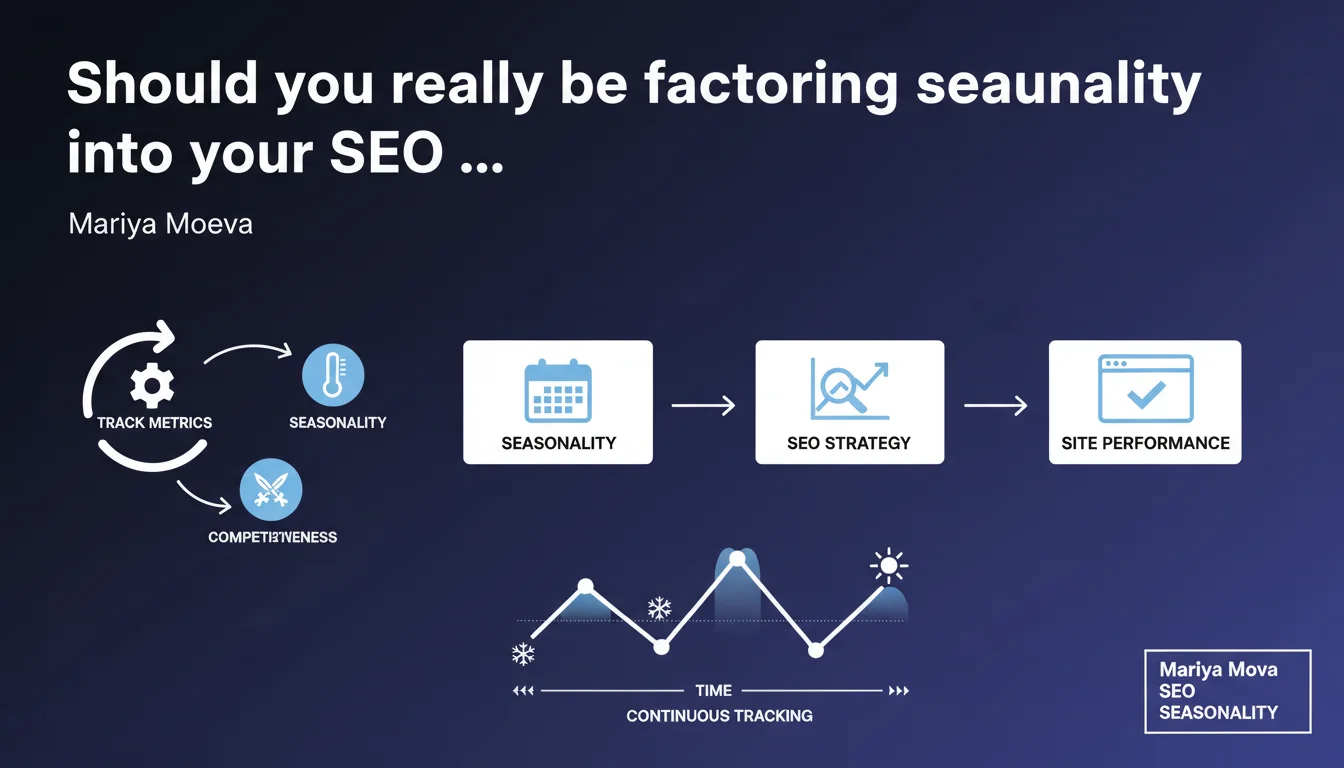
Google reminds us that tracking SEO metrics without contextualizing seasonality and sector competitiveness completely skews your analysis. It's basic advice that points to a real-world problem: too many decision-makers panic at normal traffic fluctuations. The real question isn't whether to monitor these factors, but how to isolate them in your reports so you don't make poor decisions.
What you need to understand
Why does Google insist on these contextual factors?
This statement seems obvious, almost trivial. Yet it targets a recurring problem: hasty interpretation of traffic fluctuations. Google likely observes that many webmasters attribute to penalties or algorithm bugs what are simply predictable cycles.
Seasonality impacts virtually every sector — even B2B experiences slowdowns in August or late December. Ignoring these cycles leads to wrong conclusions about your optimization effectiveness. A toy e-commerce site that loses 40% of traffic in February doesn't necessarily have an SEO problem.
What exactly does Google mean by "sector competitiveness"?
Here, Google stays intentionally vague. We assume it refers to the number of active competitors, their level of SEO investment, and the velocity of content updates in your niche. A "competitive" sector requires more effort to maintain rankings.
Concretely? If you're in finance or healthcare, your competitors publish daily, optimize aggressively, and have substantial budgets. Comparing your performance to an artisanal niche site makes no sense. The relevant benchmark must be within-sector.
Which metrics should you monitor to "continuously track"?
Google doesn't specify which metrics — surprise. We can reasonably assume they mean organic traffic, average positions, click-through rates, and potentially organic conversions. But the real challenge isn't monitoring, it's contextualizing.
Search Console offers period-to-period comparisons, but doesn't automatically distinguish seasonal variations from structural issues. You need to segment data by month/quarter/year to identify recurring patterns.
- Monitoring is not analyzing — you must interpret variations within their temporal and competitive context
- Seasonality doesn't just affect retail — almost all sectors have cycles, even subtle ones
- Comparing your performance only to your own history can mask gradual erosion if your entire sector is taking off
- Standard analytics tools don't automatically contextualize — you must build your own benchmarks
SEO Expert opinion
Is this statement really useful or just common sense?
Let's be honest: it's common sense. Any experienced SEO practitioner already factors these in. The problem is Google states the obvious without providing concrete methodology to isolate these variables. How do you precisely quantify the impact of competitiveness versus an algorithm update? No answer here. [To verify]
What strikes me is that Google publishes this generic advice rather than precise guidelines on how their own tools could better present contextualized data. Search Console could integrate sector benchmarks or seasonality alerts — they don't.
What nuances should you add to this rule?
Seasonality doesn't excuse everything. I've seen sites lose 60% of traffic in "slow periods" and blame seasonality when they'd actually been outranked by a competitor who published a definitive guide. Analytical laziness often hides behind seasonal excuses.
Second nuance: a sector's competitiveness evolves quickly. A quiet market can explode in months if a major player enters or a trend emerges. Your competitiveness analysis must be dynamic, not a snapshot from six months ago.
In what cases doesn't this rule apply?
News or breaking news sites don't really have classic seasonality. Their traffic depends on unpredictable events. Monitoring seasonal patterns here would be counterproductive — better to analyze reactivity and the ability to capture interest spikes.
Very small sites (
Practical impact and recommendations
How do you isolate seasonality from real performance drops?
First step: build a historical reference over at least two years. Export your Search Console data by month, identify recurrences. Is December always weak? Note it. Does May always spike? Factor it into your forecasts.
Second step: always compare a period to the same period the previous year, not the previous month. Comparing January to December in retail is absurd. Compare January Year N to January Year N-1 to measure real growth.
Third step: segment your analysis by query type. Some are seasonal ("Christmas gifts"), others aren't ("enterprise CRM"). Mixing them in one global report obscures everything. Separate your analysis to pinpoint exactly where variations occur.
How do you concretely assess your sector's competitiveness?
Use tools like SEMrush or Ahrefs to track the number of active domains on your main keywords, your competitors' publishing frequency, and their backlink evolution. If you see 5 serious new competitors in three months, the sector is hardening.
Also monitor SERPs directly. If results change frequently, Google is testing and competition is driving rotation. A stable top 10 for months indicates a less dynamic market — or overwhelming domination you'll struggle to break.
Don't forget indirect signals: higher CPC in Ads, visible increases in competitor content marketing budgets on LinkedIn, SEO hiring at competitors. All this signals increasing competitive intensity that will impact your organic results.
What errors should you avoid when tracking these metrics?
Classic mistake: overreacting to a one-time dip. One slow week isn't a trend. Wait at least three weeks of continuous decline before panicking, and first check if there's an external event (school holidays, major news diverting attention).
Another trap: comparing apples to oranges. Don't compare your performance to generic "e-commerce" benchmarks if you sell ultra-niche products. Find direct competitors and build your own benchmark. Public case studies are often biased toward success stories.
- Build a data history spanning at least 24 months to identify seasonal patterns
- Set up alerts for significant variations (>15-20%) rather than every fluctuation
- Segment your reports by query type (seasonal vs. evergreen)
- Always compare year-over-year, never month-to-month without context
- Track competitor activity with dedicated tools (new entrants, publishing frequency, backlinks)
- Document external events (algorithm updates, sector news) in a shared calendar
- Automate data collection to avoid gaps in your history
- Set up personalized sector benchmarks, not generic averages
❓ Frequently Asked Questions
Comment savoir si une baisse de trafic est saisonnière ou liée à un problème SEO ?
Quels secteurs sont les plus affectés par la saisonnalité en SEO ?
Comment mesurer concrètement la compétitivité de mon secteur ?
Dois-je adapter ma stratégie SEO en fonction de la saisonnalité ?
Google Search Console intègre-t-il des outils pour contextualiser la saisonnalité ?
🎥 From the same video 9
Other SEO insights extracted from this same Google Search Central video · published on 19/04/2022
🎥 Watch the full video on YouTube →
💬 Comments (0)
Be the first to comment.