
Official statement
Other statements from this video 9 ▾
- □ Should you really convert your business objectives into online metrics to succeed with SEO?
- □ Why is measuring your SEO performance without a solid baseline completely pointless?
- □ Should you really obsess over ranking #1 at all costs in SEO?
- □ Is SEO really a never-ending process, or can you achieve lasting results with one-off optimizations?
- □ Is your CTR in Search Console really revealing the true performance of your content?
- □ Why does Google insist on the complete funnel Search Console + Analytics approach?
- □ Should you really be leveraging unanswered questions to generate SEO content?
- □ Why aren't your most clicked pages aligned with your content strategy?
- □ Should you really be factoring seasonality into your SEO strategy?
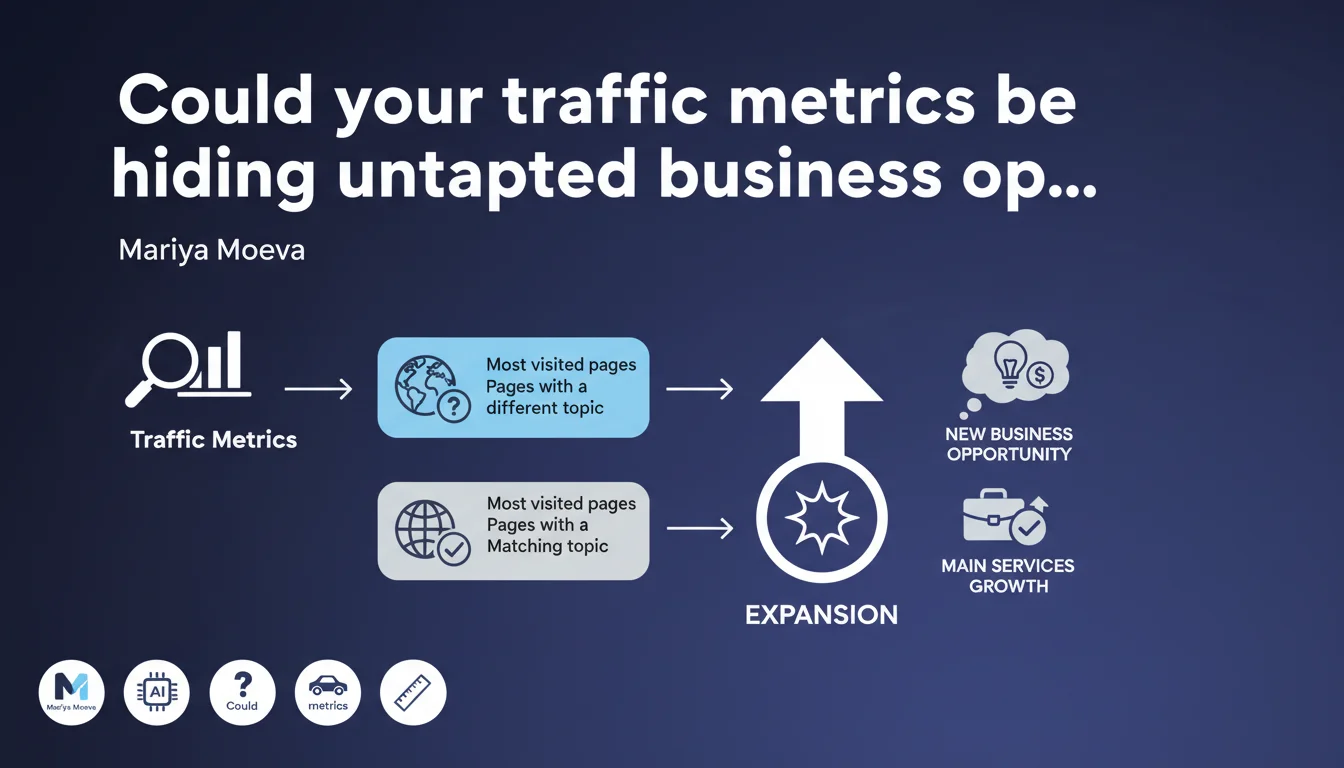
Google suggests analyzing your most visited pages: if they focus on topics different from your main services, this is potentially a signal of an unexploited commercial opportunity. The idea is to expand your offering in the direction that your visitors are already naturally gravitating toward.
What you need to understand
What's the logic behind Google's recommendation here?
Google is inviting you to observe actual user behavior rather than remaining locked into a predefined product strategy. If your most visited pages don't match your main services, it means your audience is looking for something else — and they're finding it with you.
This statement fits into a data-driven approach: traffic metrics become a tool for strategic monitoring, not just an SEO dashboard.
How does this approach differ from standard SEO analysis?
Typically, you optimize pages that already generate business. Here, Google suggests the opposite: pivot your commercial offering based on demand signals captured by your organic traffic.
It's an inversion of the traditional model "I create a service, then I push it through SEO". The logic becomes: "I detect massive interest, then I develop the corresponding service".
- High-traffic, non-monetized pages reveal unexploited search intentions
- Organic traffic becomes a predictive indicator of commercial potential
- Google implicitly encourages aligning editorial content with commercial offerings
- This approach requires crossing analytics with business intelligence
SEO Expert opinion
Is this statement consistent with what we observe in the field?
Absolutely. We regularly see sites generating massive traffic on blog pages or guides without ever converting that audience into revenue. The problem? No associated service, no adapted conversion funnel.
Let's be honest: this recommendation is nothing revolutionary. It's sound business sense applied to SEO. But it has the merit of formalizing an approach that few companies actually implement — due to lack of vision or adaptability.
What nuances should we add to this claim?
First point: high traffic doesn't automatically mean a profitable opportunity. A page may attract massive traffic because it answers a broad informational query, with no purchase intent behind it. You need to cross traffic volume with monetization potential.
Second nuance — and this is where it gets tricky. This approach assumes an organizational agility that many companies don't possess. Pivoting a service offering requires resources, time, sometimes complete restructuring. It's not just a simple SEO tweak.
In what cases does this rule not apply?
If your site generates traffic on topics outside your core business, the opportunity may be a mirage. Typical example: a furniture e-commerce site that attracts traffic on general décor guides. Expanding into interior design consulting? Maybe. But this assumes a complete shift in business model.
Another case: pages with high traffic but low margins. If the detected opportunity corresponds to an ultra-competitive market or low profitability, sometimes it's better to stay focused on your core business. [To be verified] systematically through competitive analysis and market research before committing.
Practical impact and recommendations
How do you concretely identify these opportunities in your data?
Start by extracting your top 50 most visited pages over the last 12 months (Google Analytics or Search Console). Categorize them by topic and compare with your main services. If a gap appears, dig deeper.
Then analyze the queries driving traffic to these pages: are they informational, navigational, transactional? If you detect strong commercial intent without a corresponding offer, you've found a lead.
- Export your top pages by sessions and pageviews (GA4 or Universal Analytics)
- Categorize each page: editorial content, main service, secondary service, off-topic
- Identify overrepresented themes in traffic but underrepresented in your offering
- Cross-reference with conversion data: do these pages generate leads or sales despite lack of offer?
- Analyze the long-tail queries associated with them to refine real demand
- Test monetization via a pilot landing page before any product development
What mistakes should you avoid in this process?
Don't confuse traffic volume with business opportunity. A viral page on a trending topic can generate millions of visits without any conversion potential. Always validate profitability before pivoting.
Also avoid scattering your resources by chasing too many opportunities simultaneously. Better to develop solid offerings in one strong theme than spread thin across five different areas.
What if your organization isn't equipped for this type of analysis?
This approach requires hybrid skills: technical SEO, advanced analytics, business intelligence, and strategic vision. Few internal teams master this entire chain.
❓ Frequently Asked Questions
Comment différencier un pic de trafic temporaire d'une vraie opportunité business ?
Faut-il créer un nouveau service ou adapter l'offre existante quand on détecte une opportunité ?
Ces pages à fort trafic doivent-elles être monétisées directement ou servir de porte d'entrée ?
Quelle métrique privilégier : sessions, pages vues ou temps passé sur la page ?
Comment éviter de cannibaliser mes services principaux en développant une nouvelle offre ?
🎥 From the same video 9
Other SEO insights extracted from this same Google Search Central video · published on 19/04/2022
🎥 Watch the full video on YouTube →
💬 Comments (0)
Be the first to comment.