
Official statement
Other statements from this video 9 ▾
- □ Should you really convert your business objectives into online metrics to succeed with SEO?
- □ Why is measuring your SEO performance without a solid baseline completely pointless?
- □ Should you really obsess over ranking #1 at all costs in SEO?
- □ Is SEO really a never-ending process, or can you achieve lasting results with one-off optimizations?
- □ Is your CTR in Search Console really revealing the true performance of your content?
- □ Why does Google insist on the complete funnel Search Console + Analytics approach?
- □ Why aren't your most clicked pages aligned with your content strategy?
- □ Could your traffic metrics be hiding untapped business opportunities right under your nose?
- □ Should you really be factoring seasonality into your SEO strategy?
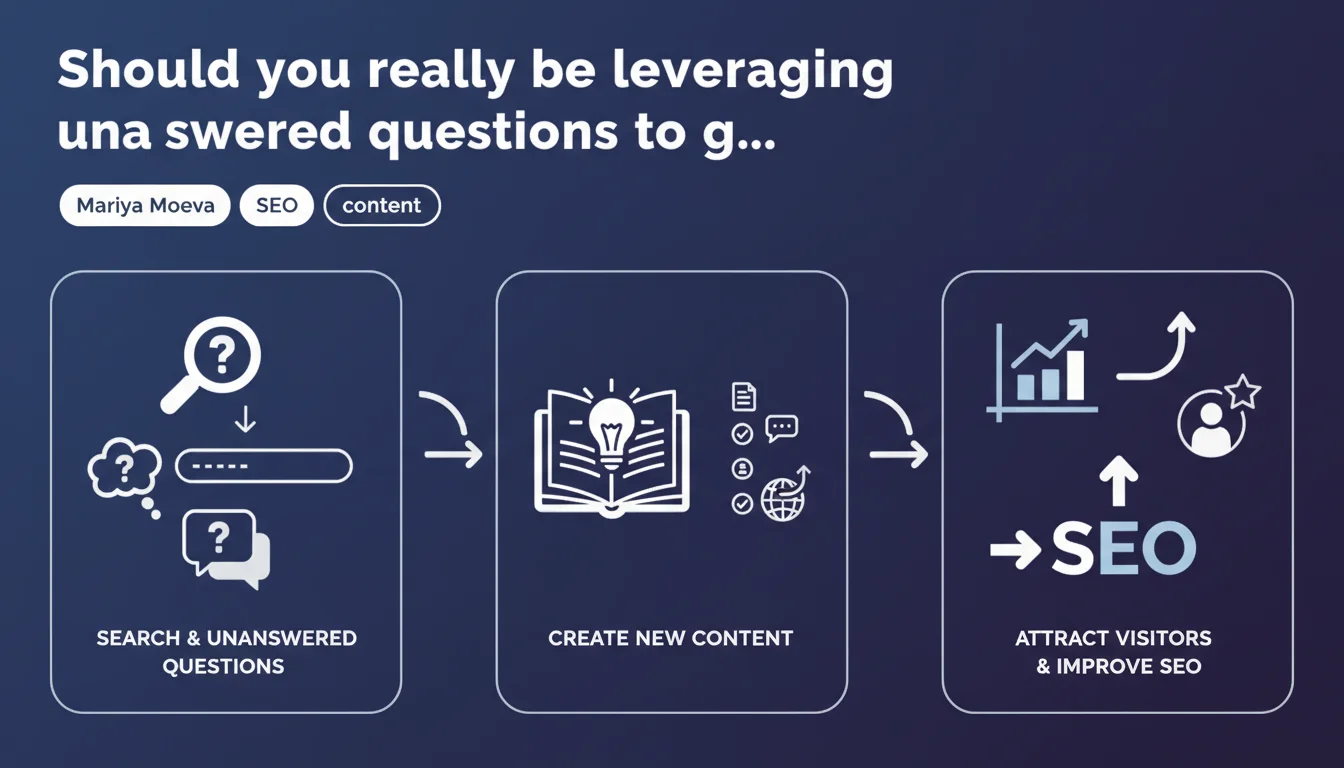
Google suggests identifying questions that users ask but don't get direct answers to, then creating content to address them. The idea: target underserved search intent to attract new visitors. An approach that seems obvious, but its effectiveness depends entirely on your ability to detect these real opportunities.
What you need to understand
What exactly does "unanswered question" mean in this context?
Google is referring here to queries where current SERPs don't provide a direct or satisfactory answer. These aren't keywords with zero results — those barely exist anymore. Rather, these are questions where users must dig through multiple pages, compile scattered information, or only get partial answers.
The challenge? Identify these informational gray zones where competition is weak or answer quality is poor. If you create precise, comprehensive content on these topics, you increase your chances of being favored by an algorithm seeking to satisfy search intent.
How do you identify these famous unanswered questions?
Google provides no specific tool in this statement. In practice, you can cross-reference Google Search Console (queries with impressions but low CTR), People Also Ask, specialized forums, Reddit, or third-party tools that analyze semantic gaps in your niche.
The principle remains classic: search for long-tail queries with low volume but strong intent, where currently ranked pages only address the surface. Let's be honest — this isn't a methodological revolution, but Google is formalizing a practice already embedded in effective SEO strategies.
Why is Google emphasizing this strategy now?
Because the algorithm increasingly values contextual relevance and a site's ability to cover a topic exhaustively. Creating content around neglected questions expands your semantic footprint and can strengthen your topical authority.
Google also wants content creators to go beyond simple generic keywords and answer real needs, even niche ones. This aligns with the logic of the Helpful Content Update: prioritizing sites that deliver genuine added value.
- Unanswered questions = queries where current SERPs don't fully satisfy search intent
- Identifying these opportunities requires analyzing GSC, PAA, forums, and semantic tools
- Google values sites that cover their topic exhaustively and usefully
- This approach aligns with topical authority strategy and helpful content
SEO Expert opinion
Is this recommendation truly actionable in practice?
Yes, but with a major caveat: identifying an "unanswered" question isn't straightforward. Google provides no KPI to measure this concept. How do you objectively know if a question isn't being handled properly? CTR alone isn't enough — it can be low for many other reasons (competing featured snippet, zero-click, etc.).
In the field, this approach works mainly in technical or B2B niches where users seek precise answers that generic content doesn't provide. However, in ultra-competitive sectors (health, finance, e-commerce), every question has already been covered from every angle. [To verify]: real impact on traffic will depend heavily on your sector.
What are the limitations of this strategy?
First limitation: creating content for ultra-specific questions can generate very little volume. If you target only extreme long-tail queries, you risk dispersing efforts for mediocre ROI. You need to find the right balance between specificity and traffic potential.
Second limitation — and this is rarely mentioned: Google may decide a question doesn't need organic results if a featured snippet or AI answer (SGE) suffices. In that case, creating ultra-detailed content won't earn you clicks. The zero-click risk is real.
Does this approach align with real-world observations?
Yes, broadly. Sites that cover sub-topics ignored by competitors often gain topical authority and see improved overall performance. This is consistent with what we've observed since several Core Updates: Google favors sites demonstrating complete expertise.
But — and this is critical — this strategy doesn't replace fundamentals. If your site suffers from technical issues, toxic backlinks, or weak architecture, adding niche content won't solve anything. Google's statement remains valid, but it's directed at already-solid sites seeking to refine their editorial strategy.
Practical impact and recommendations
How do you concretely identify these content opportunities?
Start with Google Search Console: filter for queries with 10+ impressions but CTR < 2%. These are potentially questions where your page appears but doesn't convince — either because it doesn't answer well enough or because a competitor owns the position zero.
Next, leverage specialized forums and communities: Reddit, Quora, Facebook groups, Discord. Look for recurring questions without satisfying answers from a simple Google search. These insights often outweigh any paid tool.
Finally, analyze the People Also Ask sections of your best-ranking pages. If these PAA point to other sites, that's a clear signal: Google thinks your page doesn't cover these related aspects. Create content to fill these gaps.
What editorial structure should you adopt for this type of content?
Don't create 50 separate pages for 50 micro-questions. Prefer a hub & spoke structure: one comprehensive pillar page on the main topic, with dedicated sections for related questions. Then create satellite articles for complex questions deserving in-depth treatment.
Use FAQ structured data with Schema.org to facilitate featured snippet display. Google loves direct, well-marked answers. If the question is simple, 2-3 sentences may suffice — but always expand with context to avoid thin content.
What mistakes must you absolutely avoid?
First mistake: creating content on questions without verifying real intent. A question asked on a forum may be an isolated case, not a search trend. Always validate potential volume, even if small, before investing time.
Second mistake: neglecting answer quality. Google wants useful answers, not filler. If your content merely rewrites existing material elsewhere, you'll gain nothing. Provide hard data, concrete examples, screenshots — real tangible value.
Third mistake: forgetting internal linking. These new pages must integrate into your existing architecture to benefit from internal PageRank. An orphaned page, even well-optimized, will struggle to rank.
- Analyze GSC to identify queries with impressions but low CTR
- Explore forums and communities to detect recurring unanswered questions
- Leverage People Also Ask from well-ranking competitor pages
- Adopt a hub & spoke architecture to structure content
- Integrate Schema FAQ to maximize featured snippet chances
- Systematically validate intent and volume before creating
- Strengthen internal linking to distribute PageRank
❓ Frequently Asked Questions
Comment savoir si une question est vraiment « non répondue » par les résultats actuels ?
Faut-il créer une page par question ou regrouper plusieurs questions ?
Cette stratégie fonctionne-t-elle dans tous les secteurs ?
Quel volume de recherche minimum viser pour qu'une question mérite du contenu ?
Google valorise-t-il vraiment ce type de contenu ou est-ce du marketing ?
🎥 From the same video 9
Other SEO insights extracted from this same Google Search Central video · published on 19/04/2022
🎥 Watch the full video on YouTube →
💬 Comments (0)
Be the first to comment.