
Official statement
Other statements from this video 9 ▾
- □ Should you really convert your business objectives into online metrics to succeed with SEO?
- □ Why is measuring your SEO performance without a solid baseline completely pointless?
- □ Is SEO really a never-ending process, or can you achieve lasting results with one-off optimizations?
- □ Is your CTR in Search Console really revealing the true performance of your content?
- □ Why does Google insist on the complete funnel Search Console + Analytics approach?
- □ Should you really be leveraging unanswered questions to generate SEO content?
- □ Why aren't your most clicked pages aligned with your content strategy?
- □ Could your traffic metrics be hiding untapped business opportunities right under your nose?
- □ Should you really be factoring seasonality into your SEO strategy?
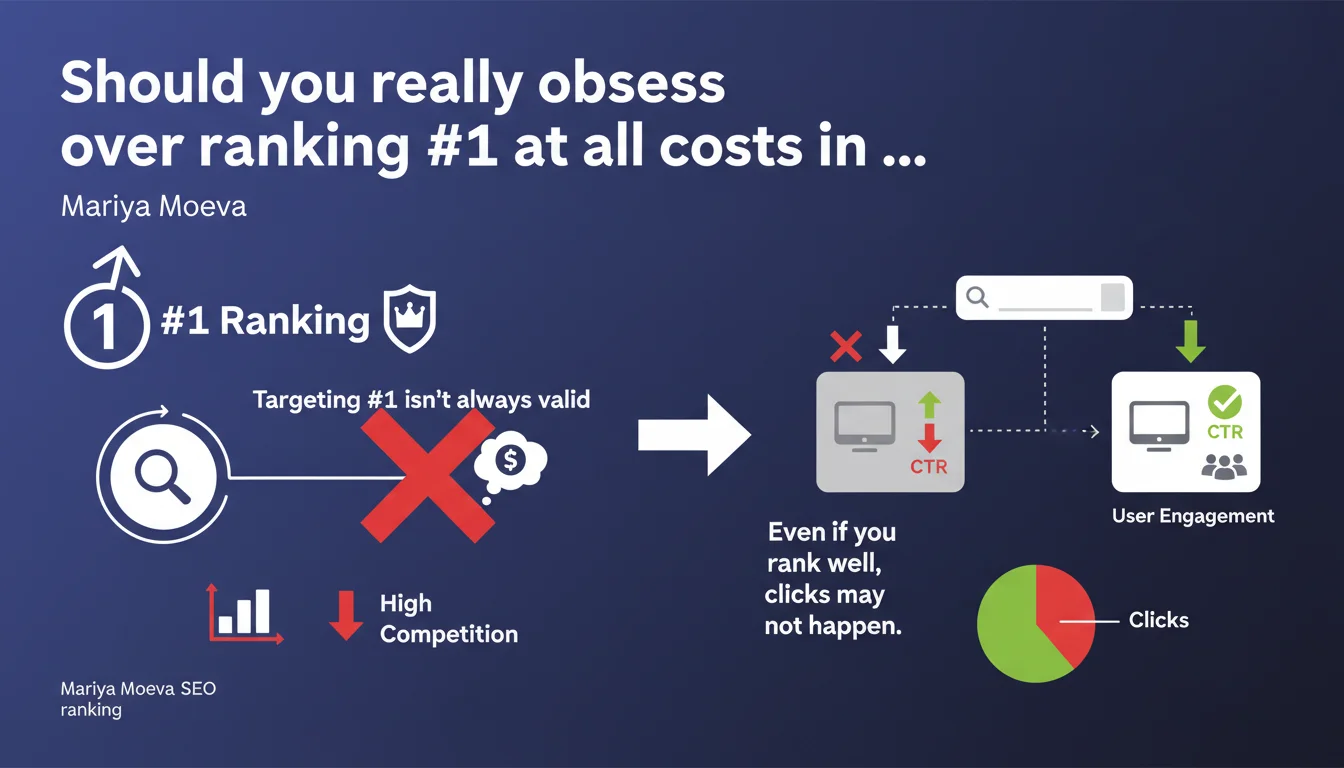
Google claims that systematically targeting the #1 position isn't always relevant, especially in highly competitive sectors. Even at the top of rankings, nothing guarantees clicks — what matters is the alignment between search intent and the displayed result.
What you need to understand
Why is Google questioning the obsession with the #1 position?
This statement shatters a persistent myth: the #1 position wouldn't necessarily be the ultimate goal in all contexts. Google implicitly acknowledges that in certain ultra-competitive sectors, the investment required to reach this position may not be worth it.
The second point is even more interesting: even when well-ranked, the click-through rate (CTR) is never guaranteed. Featured snippets, People Also Ask boxes, enriched results, and ads consume an ever-growing share of organic clicks — even in the first position.
What really determines clicks at high positions?
Google's phrasing remains deliberately vague. It implies that perceived relevance in the SERP takes precedence over pure ranking. Title, meta description, structured data, visual display — everything that shapes how your result appears matters just as much, if not more, than the position itself.
This aligns with how SERPs have evolved: in 2023-2025, on certain commercial queries, the first organic result is pushed below the fold. Being #1 under these conditions doesn't deliver the same impact it did five years ago.
What alternative does Google implicitly suggest?
The statement doesn't outline any alternative strategy — and that's precisely the problem. [To verify] Google provides no concrete indicators to help you evaluate whether chasing #1 is worth it in your specific context.
The logical implication would be to prioritize qualified traffic and conversions over raw ranking. But without data on CTR by position and SERP type, this recommendation remains abstract.
- The #1 ranking isn't always the most profitable objective, especially when facing overwhelming competition or SERPs saturated with features
- Organic CTR depends as much on result appearance as it does on absolute position
- Google provides no objective criteria to evaluate whether chasing first place is worth your investment in your case
- Search intent and conversion should take priority over ranking as a vanity metric
SEO Expert opinion
Does this statement actually reflect real-world observations?
Yes and no. Real-world data confirms that the CTR of the first organic result has dropped significantly on queries with strong commercial intent. Recent studies show it ranges between 20% and 35% depending on the SERP, whereas we used to see 40-50% a decade ago.
But — and here's where it gets awkward — this erosion is largely caused by Google's own features. Featured snippets, Google Shopping blocks, Local Pack, videos... all devices that capture clicks before the #1 result. Recommending you stop chasing that position while simultaneously cannibalizing organic traffic is pretty bold.
What nuances should be added to this claim?
The statement implies that viable alternatives exist, but it doesn't explain what they are. Concretely? If you're targeting transactional queries, the #1 position remains often the only one that generates exploitable traffic volume — even with eroded CTR.
For informational queries, on the other hand, capturing the featured snippet or People Also Ask can actually deliver more value than a simple blue link at #1. But Google clarifies none of this. [To verify] The lack of segmentation by query type makes this statement difficult to act on.
What doesn't Google say in this statement?
The elephant in the room: Google never explicitly admits that the drop in organic CTR at high positions is directly tied to the multiplication of Google-owned elements in SERPs. It's convenient to recommend not chasing #1 when you've yourself drained that position of value on certain queries.
Second omission: no mention of alternative metrics to monitor. If ranking isn't the goal, what is? Google could have suggested prioritizing conversion rate, engagement time, customer return — but no. The statement stays surface-level.
Practical impact and recommendations
How do you determine if chasing #1 is worth it in your case?
Analyze your GSC data query by query. Identify keywords where you rank in positions 2-5 and compare their CTR with those where you're #1. If the gap is marginal, the investment to climb probably isn't justified.
Segment by SERP type: a query with featured snippet, People Also Ask, and Local Pack is completely different from a standard SERP with 10 blue links. Use tools like SEMrush or Ahrefs to identify the composition of target SERPs before prioritizing your efforts.
What strategic alternatives should you focus on?
If competition is too fierce on your main keywords, pivot toward less competitive long-tail variations. Individual volume is lower, but cumulative traffic and conversion rates are often better.
Work on optimizing your visual presence in SERPs: structured data (FAQ, HowTo, Product), enhance title and meta tags to maximize CTR even in positions 2-3. Sometimes a well-crafted title at #3 beats a generic one at #1.
What mistakes should you avoid after hearing this?
Don't swing to the opposite extreme: abandon all ranking ambitions just because Google downplays the #1 position. On most queries, positions 1-3 still capture 60-75% of total organic traffic. The distribution has simply shifted.
Also avoid generalizing this recommendation across your entire strategy. Certain strategic queries justify massive investment to reach and defend first position — especially those that convert best and where the SERP remains relatively clean.
- Export your GSC data and calculate average CTR by position for your strategic queries
- Identify queries where the SERP is saturated with Google features (featured snippets, People Also Ask, ads) — these are low-ROI targets for #1
- Prioritize keywords where you rank in positions 4-10 and the SERP is "clean" — the potential gain is maximum
- Test title and meta tag optimization on already well-ranked pages to improve CTR without changing position
- Implement relevant structured data to capture additional visual space in SERPs
- Analyze conversion rate by position: if #3 converts as well as #1, the effort to climb may not be justified
- Monitor the evolution of target SERP composition with SERP features tracking tools
❓ Frequently Asked Questions
Le CTR de la position #1 a-t-il vraiment baissé ces dernières années ?
Faut-il complètement abandonner l'objectif de première position ?
Quelles métriques suivre si le rang n'est plus l'objectif principal ?
Comment optimiser pour le CTR plutôt que pour le rang pur ?
Cette recommandation s'applique-t-elle aussi aux requêtes de marque ?
🎥 From the same video 9
Other SEO insights extracted from this same Google Search Central video · published on 19/04/2022
🎥 Watch the full video on YouTube →
💬 Comments (0)
Be the first to comment.