
Official statement
Other statements from this video 9 ▾
- □ Should you really convert your business objectives into online metrics to succeed with SEO?
- □ Why is measuring your SEO performance without a solid baseline completely pointless?
- □ Should you really obsess over ranking #1 at all costs in SEO?
- □ Is SEO really a never-ending process, or can you achieve lasting results with one-off optimizations?
- □ Is your CTR in Search Console really revealing the true performance of your content?
- □ Should you really be leveraging unanswered questions to generate SEO content?
- □ Why aren't your most clicked pages aligned with your content strategy?
- □ Could your traffic metrics be hiding untapped business opportunities right under your nose?
- □ Should you really be factoring seasonality into your SEO strategy?
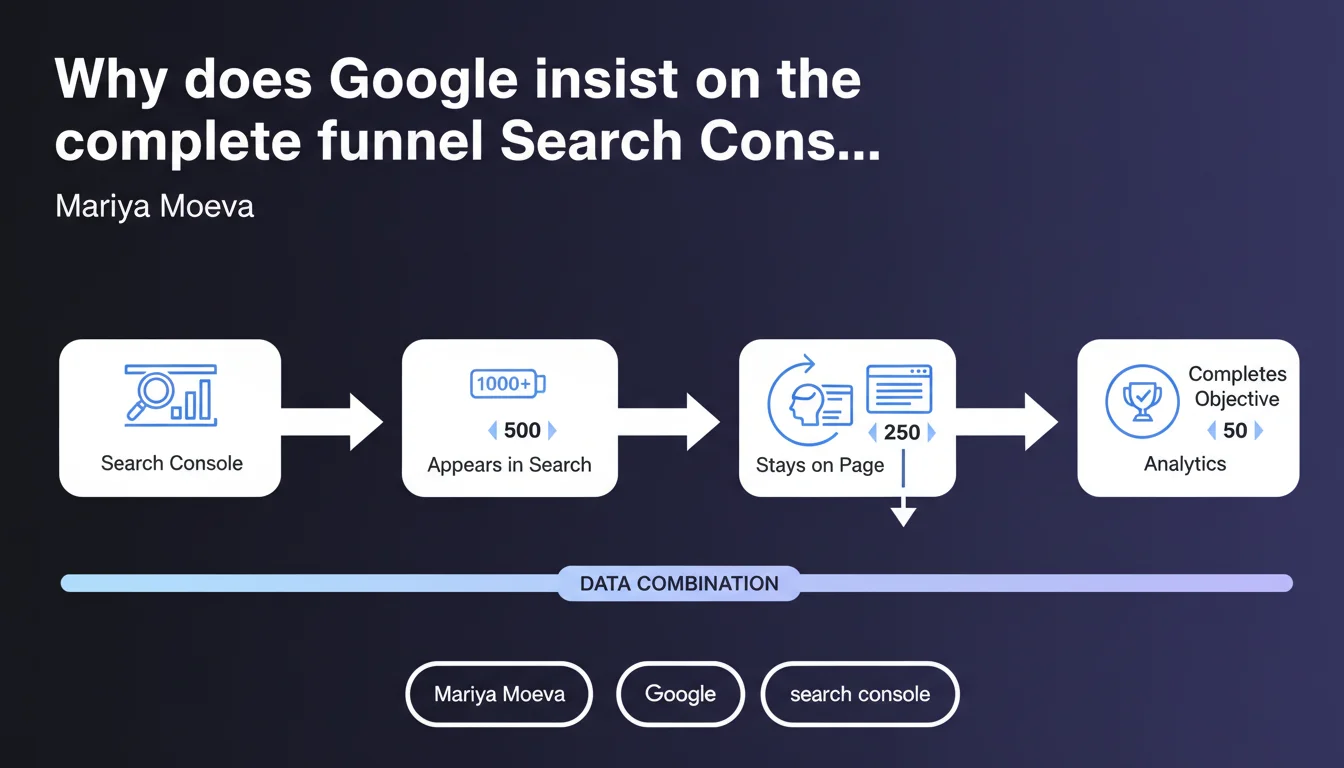
Google recommends tracing a complete funnel combining Search Console and Analytics: impressions → clicks → engagement → conversions. The objective: identify leakage points between visibility, traffic, and actual performance. This approach allows you to diagnose whether your problems stem from positioning, CTR, on-site experience, or content quality.
What you need to understand
Why is Google talking about "combined funnel" now?
Google reminds us of a principle that many SEO professionals forget: visibility in the SERPs guarantees nothing. A site can display millions of impressions and generate zero results if nobody clicks, or if visitors bounce immediately.
The combined Search Console + Analytics funnel forces you to look at the complete chain: how many times you appear, how many click, how many stay, how many convert. It's a framework for understanding where the problem lies — and avoiding treating a symptom rather than the root cause.
What specific data should you cross-reference?
From Search Console: impressions, clicks, CTR, average position by query, page, device. From Analytics: engagement rate, session duration, pages per session, conversion events.
The idea isn't to multiply dashboards for the sake of it. It's about spotting breaks in the chain: low CTR despite good ranking? Title/meta problem. High traffic but terrible engagement rate? Gap between promise (snippet) and reality (content).
What's different from a typical analysis approach?
Nothing revolutionary technically. But Google is pointing out a frequent mistake: analyzing Search Console and Analytics in separate silos. Many SEO professionals optimize for traffic without ever checking if that traffic produces results.
The combined funnel imposes end-to-end logic. If your impressions are exploding but conversions are stagnating, you know you need to dig beyond pure SEO — UX, content, offer, conversion path.
- The complete funnel = impressions → clicks → engagement → conversions
- Search Console + Analytics = two tools, one analysis
- Each funnel stage reveals a different type of problem
- A site can be well-ranked and completely ineffective commercially
- The goal: identify leakage points and prioritize initiatives
SEO Expert opinion
Is this statement consistent with observed practices?
Yes, and it's actually common sense. The problem is that many SEO teams are evaluated solely on organic traffic. Result: we optimize for KPIs visible in Search Console, without ever checking if that traffic serves a purpose.
Google is reminding us here of an obvious principle that the market tends to forget: good SEO is not measured in impressions or clicks, but in business impact. If you generate 100,000 visits per month with a 0.01% conversion rate, your SEO is worthless.
What nuances should be considered?
The statement remains vague on one crucial point: how to define "the defined objective"? Not all sites have a clear transactional conversion. For a media site, what constitutes success — time spent, page views, newsletter signups?
Google provides no thresholds, no benchmarks. [To verify]: how should you interpret an "acceptable" engagement rate by industry? A B2B site with long sales cycles will have completely different metrics than an e-commerce site.
Another nuance: combined analysis of Search Console + Analytics assumes both tools are properly configured and linked. Many sites have tracking issues, poorly parameterized Analytics filters, incomplete data. If your source data is flawed, your funnel is worthless.
In what cases does this approach show its limitations?
For sites with complex user journeys — multiple sessions before conversion, multi-device, indirect attribution. The linear funnel Search Console → Analytics → conversion is too simplistic to capture the reality of some businesses.
Example: a user discovers your site via Google, leaves, returns three days later through a direct URL, converts. Search Console will tell you "1 impression, 1 click" but won't see the conversion. Analytics will show the conversion but attribute it to direct. The combined funnel remains an approximation.
Practical impact and recommendations
What should you do concretely to implement this funnel?
First, link Search Console and Analytics if you haven't already. Then, clearly define what "goal achieved" means for your site — purchase, lead, signup, time spent, page views.
Build a tracking sheet with the following stages: impressions (Search Console) → clicks (Search Console) → sessions (Analytics) → engagement (Analytics) → conversions (Analytics). Segment by query type, landing page, device.
What mistakes should you absolutely avoid?
Don't compare apples and oranges. Search Console and Analytics data never match perfectly — tracking gaps, scope differences, reporting delays. Accept a margin of error.
Also avoid drowning in data. The funnel's purpose is to identify obvious breaks, not track every micro-variation. If your CTR is poor, you don't need a 47-dimension pivot table to figure it out.
How do you verify your funnel is properly configured?
Test with a specific query or page. Take an important landing page, verify its impressions/clicks in Search Console, compare with organic traffic in Analytics, check engagement rate and conversions.
If the figures are consistent (even if not identical to decimal places), your funnel is usable. If you have 50% discrepancies between Search Console and Analytics, review your tracking setup before going further.
- Link Search Console and Google Analytics through property settings
- Define clear conversion goals/events in Analytics
- Create a combined report impressions → clicks → engagement → conversions
- Segment by query type (brand / non-brand, transactional / informational)
- Identify pages with high traffic but low engagement = gap between promise/content
- Find pages with good engagement but low traffic = untapped SEO opportunities
- Check data consistency between both tools (acceptable discrepancies < 20%)
- Automate tracking with Google Sheet or Data Studio/Looker Studio
❓ Frequently Asked Questions
Pourquoi Search Console et Analytics ne montrent-ils jamais les mêmes chiffres de trafic ?
Quel outil utiliser pour combiner les données Search Console et Analytics ?
Comment définir un bon taux d'engagement selon le secteur ?
Le funnel combiné fonctionne-t-il pour les sites avec des conversions offline ?
Faut-il segmenter le funnel par type de requête ?
🎥 From the same video 9
Other SEO insights extracted from this same Google Search Central video · published on 19/04/2022
🎥 Watch the full video on YouTube →
💬 Comments (0)
Be the first to comment.