
Official statement
Other statements from this video 9 ▾
- □ Should you really convert your business objectives into online metrics to succeed with SEO?
- □ Should you really obsess over ranking #1 at all costs in SEO?
- □ Is SEO really a never-ending process, or can you achieve lasting results with one-off optimizations?
- □ Is your CTR in Search Console really revealing the true performance of your content?
- □ Why does Google insist on the complete funnel Search Console + Analytics approach?
- □ Should you really be leveraging unanswered questions to generate SEO content?
- □ Why aren't your most clicked pages aligned with your content strategy?
- □ Could your traffic metrics be hiding untapped business opportunities right under your nose?
- □ Should you really be factoring seasonality into your SEO strategy?
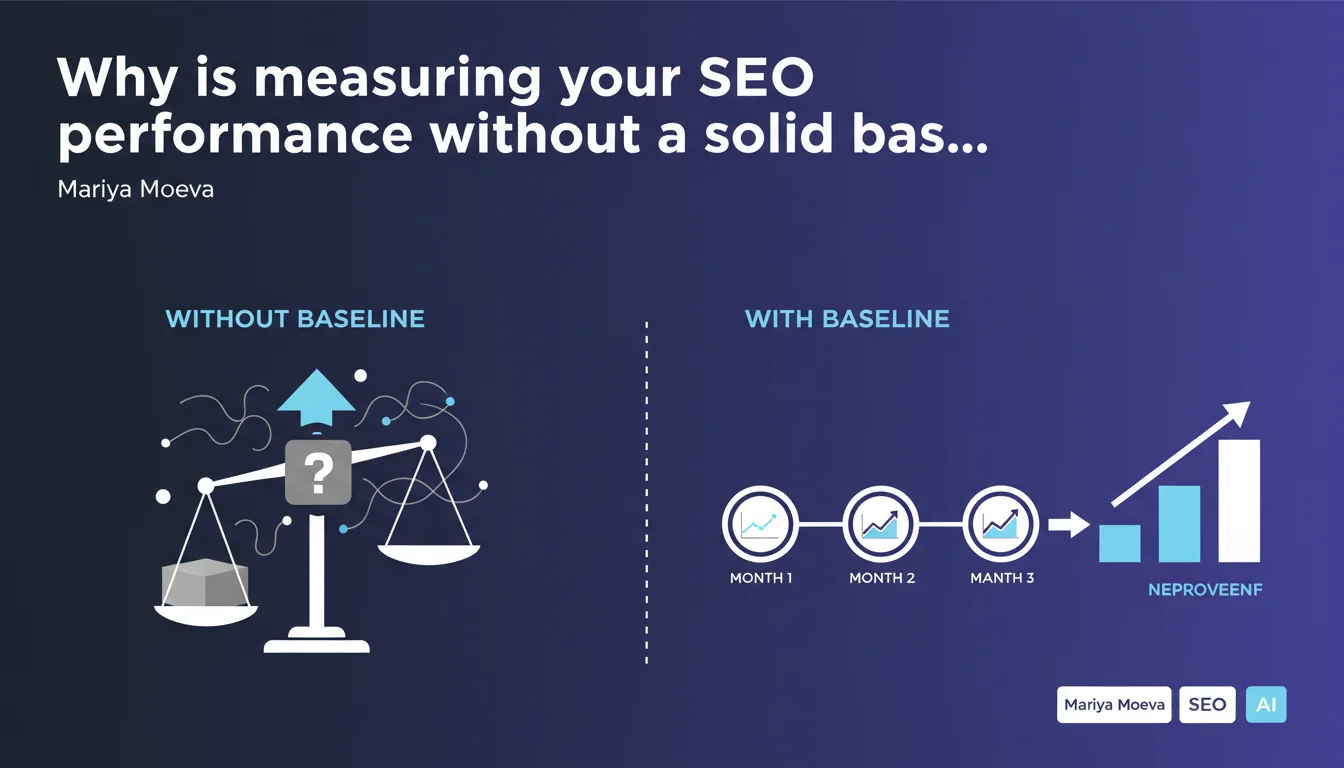
Google recommends tracking your SEO metrics over several months before drawing conclusions about the impact of your actions. Without established reference data, it's impossible to objectively measure improvements. This approach requires patience in a field where many expect immediate results.
What you need to understand
Why does Google insist so much on this concept of baseline?
Google starts from a simple observation: too many SEO professionals compare incomparable data. Measuring the impact of an optimization without a prior benchmark is like evaluating an athlete's progress without timing their initial performances. Performance baseline refers to the set of metrics observed before any intervention — organic traffic, average positions, conversion rates, loading times, etc.
The problem? Natural fluctuations in organic traffic are numerous: seasonality, external events, minor algorithm changes, competition. Without reference data over several months, it's impossible to distinguish the real effect of your actions from the surrounding statistical noise.
How long does it take to obtain reliable data?
Google mentions "a few months" without being more specific. In practice, three months is an absolute minimum to smooth out weekly variations and capture at least a partial seasonal cycle. Six months provides a more robust view, especially for sites with marked seasonality.
This duration also allows you to absorb the propagation delays inherent in SEO: crawl time, indexing, authority reassessment, gradual position updates. A change implemented today may not produce measurable effects for 4 to 8 weeks later.
Which metrics should you include in your baseline?
There's no point in just looking at overall traffic. A complete baseline integrates several dimensions:
- Organic traffic volume by channel (desktop/mobile), by page type (priority landing pages, categories, blog)
- Average positions and visibility on strategic keywords — not just overall averages that say nothing meaningful
- Organic conversion rates by segment, to avoid celebrating traffic that doesn't convert
- Technical metrics (Core Web Vitals, crawl rate, crawl budget consumed) if your optimizations touch these aspects
- Competitive context: share of voice, SERP evolution, arrival or departure of direct competitors
SEO Expert opinion
Does this recommendation really match what we observe in the field?
Yes, and it's actually one of the rare Google statements that perfectly reflects real-world practice. SEO projects that fail to demonstrate their ROI often do so because they lack a properly established baseline. The result: confusion between correlation and causality, hasty conclusions, budgets cut prematurely.
The nuance that Google doesn't explain well enough is the difference between technical baseline and business baseline. You can perfectly well measure the impact of a technical optimization (improvement in loading time, correction of 404 errors) in a few weeks via Search Console reports. But evaluating the overall business impact — qualified traffic, conversions, revenue — truly does require several months of perspective.
In what cases does this rule become impractical?
Let's be honest: not all business contexts allow you to wait "a few months." A site undergoing a complete redesign, a product launch, a migration — these situations require you to act quickly, baseline or not.
In these cases, the solution is to segment your analysis. Establish a partial baseline on what's immediately measurable (partial historical data, competitive benchmarking, estimates) and explicitly document the limitations of your comparisons. A flawed baseline that you acknowledge is better than no baseline at all.
What should you do if your historical data is unusable?
Common scenario: you inherit a poorly tracked site, with undocumented domain changes, broken Analytics tracking, incomplete Search Console data. It's impossible to build a reliable baseline retroactively.
The only valid approach: start from scratch. Set a clear starting point (date of takeover, after audit), document the initial state with available tools (even if imperfect), and accept that your first weeks/months will be devoted to building this missing baseline. [To verify]: Google provides no guidance on how to handle these "baseline reconstruction" situations — we're on our own.
Practical impact and recommendations
How do you establish a usable baseline concretely?
First step: define your critical metrics based on your business objectives. There's no point tracking 50 KPIs — focus on 5 to 8 indicators maximum, those that directly impact your revenue or strategic conversions.
Second step: set up a centralized dashboard (Google Analytics 4 + Search Console + ranking tool + CRM data if relevant). The challenge? Capture data before any intervention, with enough granularity to detect significant variations. Weekly minimum, daily if your traffic volume allows.
The third step, often overlooked: document the external context. What business events, parallel marketing campaigns, competitive changes can skew your reading? A major advertising launch, a commercial operation, a price change — all of this biases your comparisons if not recorded.
What mistakes should you absolutely avoid?
Classic mistake: comparing non-comparable periods. Measuring your December performance (e-commerce peak season) against February (post-holiday low) tells you nothing about the effectiveness of your optimizations — just that seasonality exists.
Another pitfall: ignoring segments. A global "entire site" baseline often masks contradictory evolutions: some sections progress while others regress. Systematically segment by page type, by search intent, by topic.
Finally, the fatal mistake: never updating your baseline. Markets evolve, competition changes, algorithms transform. A baseline frozen for 18 months has no predictive value anymore. Plan for a quarterly refresh minimum.
What should you do right now if you don't have a baseline?
Don't panic — but act fast. Here's the immediate checklist:
- Connect Search Console and Analytics 4 if not already done, verify that tracking is clean
- Export your available historical data (even if partial) and store it in a durable format (CSV, Google Sheets, BigQuery)
- Define 5-8 critical metrics aligned with your real business objectives
- Set up a centralized dashboard to track these metrics at least weekly
- Document the current context: technical state of the site, marketing campaigns in progress, planned business events
- Block time in your calendar for monthly review of this data to detect emerging trends
- Wait a minimum of 3 months before concluding anything about the impact of your actions — patience is mandatory
❓ Frequently Asked Questions
Combien de temps minimum faut-il tracker avant d'avoir une baseline fiable ?
Peut-on établir une baseline avec moins de trois mois de données ?
Que faire si un changement d'algorithme bouleverse ma baseline en cours de mesure ?
Quelles métriques sont prioritaires dans une baseline SEO e-commerce ?
Comment comparer mes performances si mon tracking Analytics a été cassé puis réparé ?
🎥 From the same video 9
Other SEO insights extracted from this same Google Search Central video · published on 19/04/2022
🎥 Watch the full video on YouTube →
💬 Comments (0)
Be the first to comment.