
Official statement
Other statements from this video 9 ▾
- □ Should you really convert your business objectives into online metrics to succeed with SEO?
- □ Why is measuring your SEO performance without a solid baseline completely pointless?
- □ Should you really obsess over ranking #1 at all costs in SEO?
- □ Is your CTR in Search Console really revealing the true performance of your content?
- □ Why does Google insist on the complete funnel Search Console + Analytics approach?
- □ Should you really be leveraging unanswered questions to generate SEO content?
- □ Why aren't your most clicked pages aligned with your content strategy?
- □ Could your traffic metrics be hiding untapped business opportunities right under your nose?
- □ Should you really be factoring seasonality into your SEO strategy?
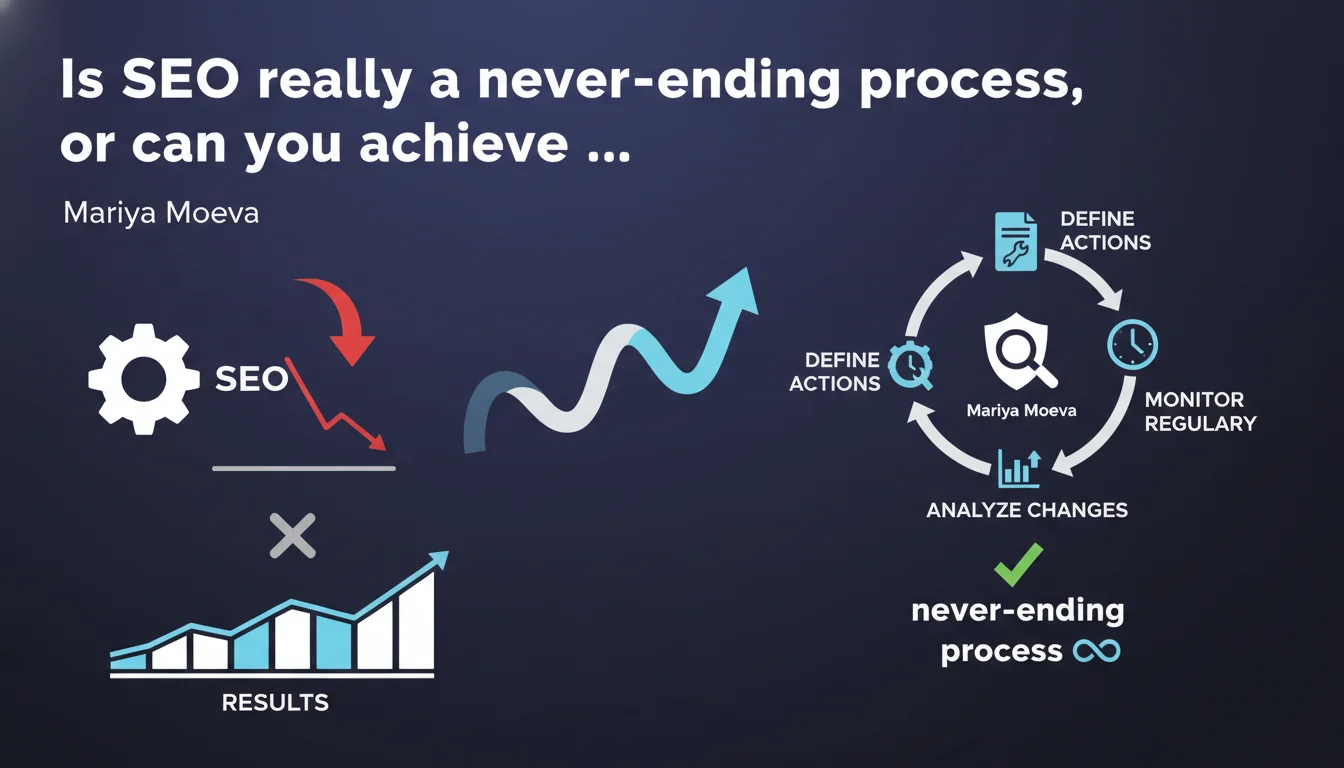
Google confirms that SEO optimization cannot be treated as a one-time project with a clear beginning and end. You must define precise metrics, monitor their evolution regularly, and analyze both improvements and declines to maintain and enhance your rankings.
What you need to understand
Why does Google emphasize the concept of continuous process?
Mariya Moeva's statement reflects a reality that many websites still ignore: Google's algorithm evolves constantly, just as competition and user behavior do. A well-optimized site today can lose ground tomorrow without intervention.
What Google is saying concretely is that it's not enough to fix technical errors, add title tags, and consider the work done. Natural search optimization requires regular monitoring and continuous adjustments based on real data.
What does "improving specific metrics" mean in practical terms?
Google is asking you here to move away from a vague approach to SEO and adopt a data-driven logic. It's not about optimizing "the website" in a general sense, but targeting measurable KPIs: organic click-through rates, average positions on strategic queries, crawl rate, Core Web Vitals, navigation depth.
This approach requires setting measurable objectives for each action undertaken — and that's where many teams still working on gut feeling struggle.
Why analyze both improvements and declines?
Because a metric that drops with no apparent reason can signal an undetected technical problem, an algorithmic penalty, or rising competition. Google reminds us here that defensive SEO is just as important as offensive SEO.
Too many sites celebrate traffic increases without investigating declines — which often contain the most valuable insights for understanding how the algorithm responds to your changes.
- SEO is never "finished" — it's a permanent iterative process
- Every action must be linked to a measurable metric tracked over time
- You must monitor changes in both directions: progress AND regression
- Long-term organizational commitment is necessary, not just a one-off project
- SEO results should be analyzed with the same rigor as any other marketing channel
SEO Expert opinion
Does this statement truly reflect what we see in practice?
Absolutely — and this is precisely what distinguishes sites gaining ground from those stagnating. SEO projects treated as one-time projects with an end date consistently lose to those integrating a culture of continuous optimization.
I regularly observe sites that invested heavily in an audit and technical fixes, then abandoned all monitoring for months. Result: initial gains gradually erode without anyone understanding why. The competition, meanwhile, hasn't stopped optimizing.
What nuances should be applied to this vision?
Be careful not to confuse "continuous process" with "full-time activity at maximum intensity." Depending on site maturity and industry, monitoring intensity can vary. An e-commerce site with thousands of products requires near-daily monitoring. A B2B brochure website can manage with weekly or bi-weekly reviews.
What Google doesn't specify — and unfortunately — is what monitoring frequency is optimal depending on site types. [To verify] There's no official standard, just field best practices. Personally, I recommend at minimum a weekly check of critical metrics and in-depth monthly analysis.
In what cases could this approach become counterproductive?
When it leads to over-optimization or changes too frequently. I've seen teams modify content every three days in reaction to minor ranking fluctuations — creating instability that harms more than helps.
The trap is falling into hyperactivity without strategy. Google says "continuous process," not "permanent frantic changes." You must allow time for modifications to produce their effects before implementing new ones. A delay of 4 to 8 weeks is often necessary to measure the real impact of significant change.
Practical impact and recommendations
What do you need to implement concretely to apply this approach?
Start by defining your priority metrics based on your business objectives. For e-commerce: traffic on strategic categories, organic conversion rate, positions on transactional queries. For a media site: impressions, CTR, organic session duration.
Next, set up an automated monitoring system that alerts you to significant variations. Google Search Console, combined with a tool like Screaming Frog for technical crawling and a rank tracker, makes up the minimal trio. The key is being able to correlate evolutions across different data sources.
What mistakes should you avoid?
Don't fall into the vanity reporting trap — tracking 50 metrics where 45 serve no purpose. Focus on 5 to 10 truly actionable KPIs. A metric that never leads to a decision is useless.
Another common mistake: analyzing data without temporal context. A drop in organic traffic in January can be seasonal and normal in some industries. You must compare with the same periods from previous years, not just the previous month.
How do you verify that your SEO process is truly continuous and effective?
Ask yourself these questions: do you have a calendar of planned SEO actions for the next three months? Do you know exactly which metric each action aims to improve? Do you systematically analyze the impact of your modifications 4 to 8 weeks after deployment?
If you answer no to any of these, you're still in one-off logic disguised as continuous process. A true iterative SEO process involves: planning → execution → measurement → analysis → adjustment → planning, in a loop.
- Define 5-10 priority SEO KPIs aligned with your business objectives
- Set up a centralized dashboard combining GSC, Analytics, and crawl data
- Program automatic alerts on significant variations (±15% minimum)
- Establish a weekly review schedule for critical metrics
- Conduct in-depth monthly analysis with documentation of actions taken
- Wait 4-8 weeks before measuring the real impact of a significant modification
- Systematically compare data year-over-year to identify seasonal trends
- Document each SEO action with date, targeted metric, and observed result
❓ Frequently Asked Questions
Quelle est la fréquence minimale de suivi pour un site e-commerce moyen ?
Faut-il attendre avant de modifier à nouveau un élément récemment optimisé ?
Comment distinguer une fluctuation normale d'un vrai problème SEO ?
Peut-on automatiser entièrement le monitoring SEO ?
Cette approche continue est-elle valable pour tous les types de sites ?
🎥 From the same video 9
Other SEO insights extracted from this same Google Search Central video · published on 19/04/2022
🎥 Watch the full video on YouTube →
💬 Comments (0)
Be the first to comment.