
Official statement
What you need to understand
Why Does Google Place So Much Importance on Publication and Modification Dates?
Google seeks to provide users with the most relevant and up-to-date information possible. Publication and modification dates are signals that help the algorithm assess content freshness.
However, Google has found that many sites manipulate these dates artificially, simply by adding "2024" to the title without actually modifying the content. This practice is considered date spam and harms the user experience.
What Qualifies as a "Significant" Modification According to Google's Criteria?
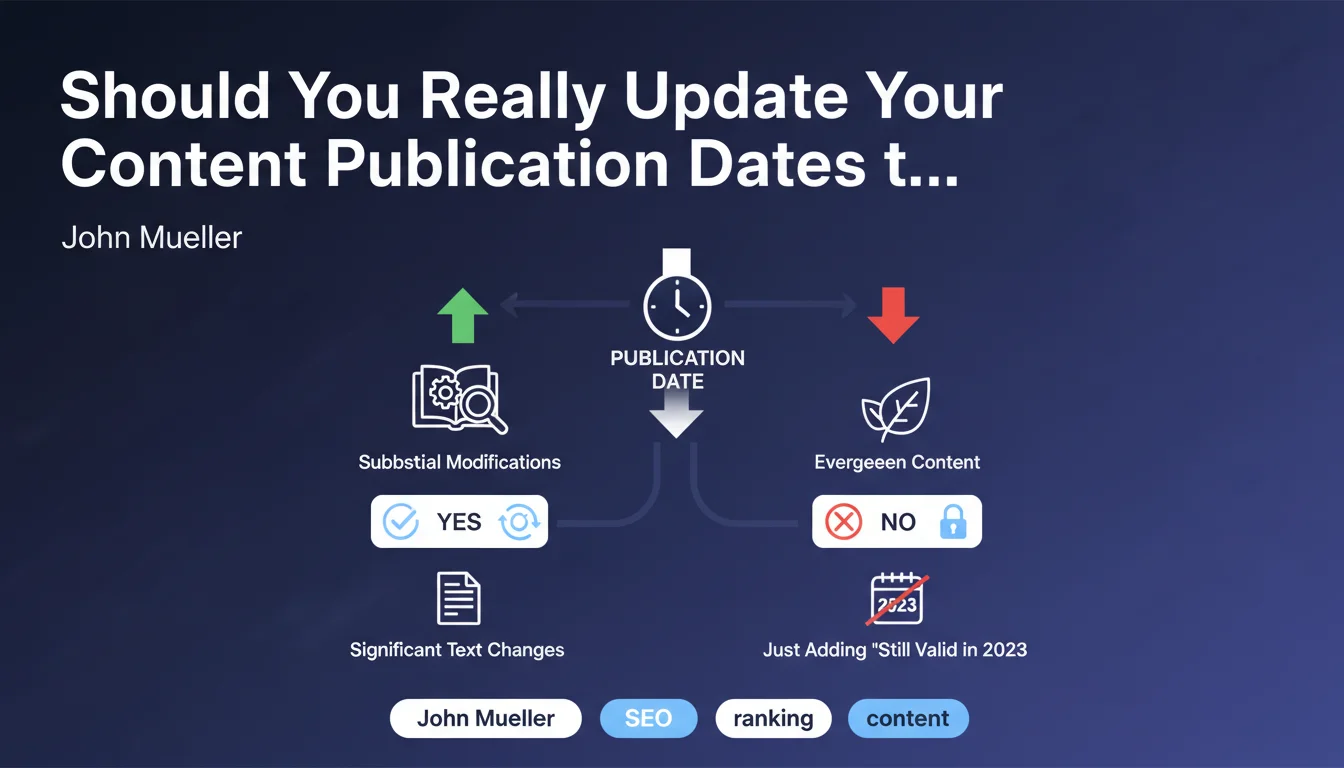
A significant modification involves a substantial overhaul of the content: adding entire sections, updating numerical data, integrating new factual information, or rewriting important paragraphs.
Conversely, correcting a few spelling mistakes, simply adding a sentence mentioning the current year, or superficially modifying the introduction does not constitute an update justifying a date change.
When Does Evergreen Content Not Require Any Date Change?
Evergreen or timeless content (conceptual guides, definitions, foundational tutorials) retains its value over time. If the information remains accurate and relevant, there's no reason to modify the date.
Forcing a date refresh on this type of content without actual modification is counterproductive and can be perceived as an attempt at manipulation.
- Content freshness is a quality signal for Google, but only when it's legitimate
- Artificially modifying dates without substantial updates is considered spam
- Evergreen content doesn't need to be dated annually if it remains valid
- Two distinct dates (publication and modification) offer more transparency and context
SEO Expert opinion
Is This Statement Consistent with Practices Observed in the Field?
Absolutely. Tests conducted over several years show that Google has become particularly effective at detecting artificial updates. Sites that systematically modify their dates without real content changes often see their performance stagnate or decline.
Conversely, sites that maintain a rigorous editorial policy with substantial and documented updates benefit from better algorithmic treatment. Transparency pays off.
What Important Nuances Should Be Added to This Recommendation?
The definition of "significant modification" varies depending on the type of content and industry sector. For a news article, adding a recent development may justify a new date. For a technical guide, a more substantial overhaul is needed.
Certain sectors like finance, law, or healthcare require more frequent updates due to regulatory changes. In these cases, precisely documenting the changes made becomes crucial.
What Is the Real Risk of Updating Dates Without Substantial Modifications?
The main risk is a loss of algorithmic credibility. Google may classify your site in the "freshness spam" category and generally reduce the trust given to your date signals.
This particularly affects queries sensitive to freshness (news, comparisons, prices). Paradoxically, you lose the advantage you were trying to gain by manipulating dates.
Practical impact and recommendations
What Should You Actually Do to Properly Manage Your Content Dates?
Establish a clear editorial policy defining what constitutes a major update, minor update, or simple correction. Document each significant modification with a visible changelog or version history.
Implement schema.org structured data with distinct datePublished and dateModified properties. Display both dates visibly for the user, ideally with a mention of the type of modification made.
For content requiring regular updates, create a tracking system that automatically identifies content needing revision based on age, industry changes, or newly available data.
What Critical Mistakes Should You Absolutely Avoid?
Never change the date simply by adding the current year to the title or introduction. This practice is immediately identifiable by Google and your users, damaging your reputation.
Avoid automatic date updates via scripts or plugins that modify the date with each crawler visit. Google easily detects these technical manipulations.
Don't delete the original publication date in favor of a recent modification date. This practice can be perceived as an attempt to hide the content's age, which raises suspicions.
- Define clear criteria for what constitutes a "significant update" in your context
- Implement datePublished and dateModified in Article or BlogPosting structured data
- Display both dates visibly for the user (not just in the code)
- Create a changelog or version history for frequently updated content
- Train the editorial team on best practices for content updates
- Regularly audit content to identify what actually needs revision
- Avoid any automatic date modification systems
- Prioritize quality and substance of updates over their frequency
💬 Comments (0)
Be the first to comment.