
Official statement
What you need to understand
What exactly does Google recommend regarding HTML sitemaps?
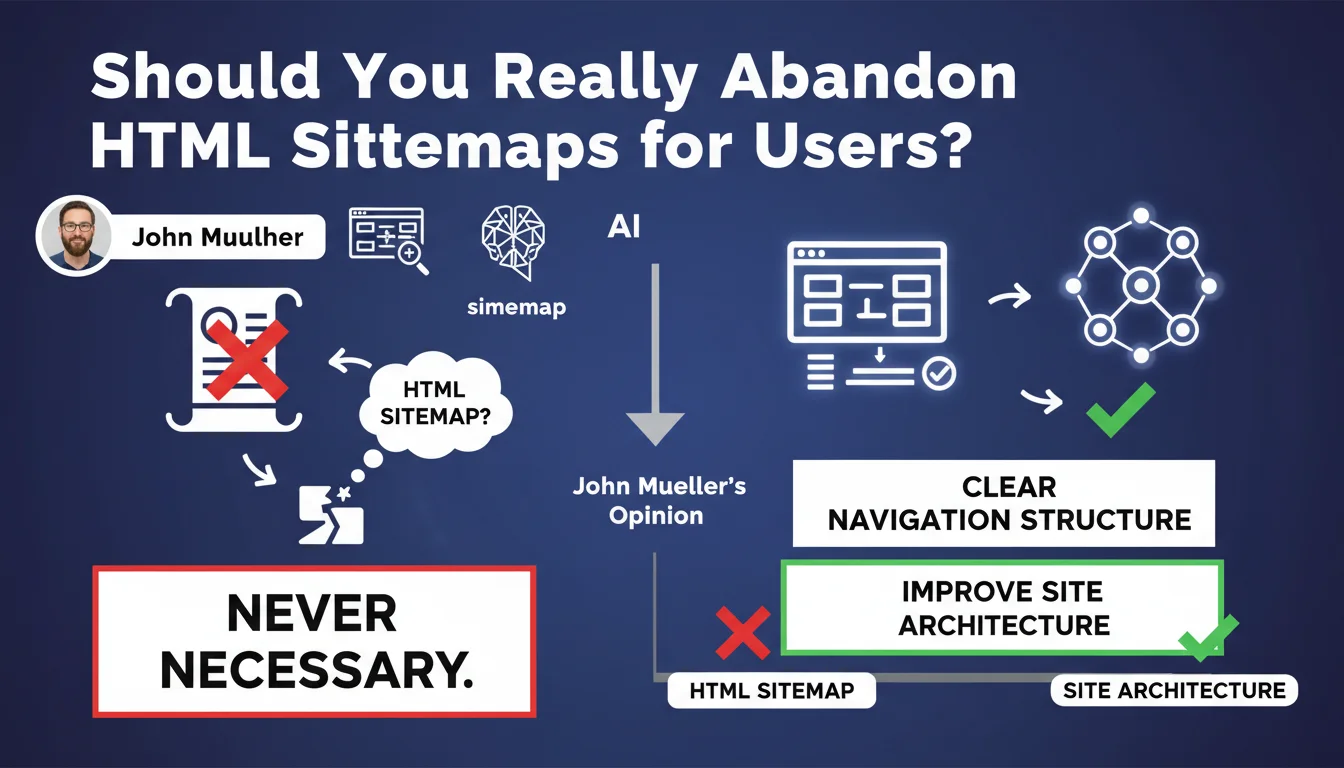
Google takes a firm stance on HTML sitemaps intended for visitors. According to this official statement, these pages listing all the URLs of a site should never be necessary.
The recommendation is clear: rather than creating an HTML sitemap as a crutch, you should invest that time in improving the site's architecture and navigation. The underlying idea is that a well-designed site doesn't need this additional page.
What's the difference between HTML sitemaps and XML sitemaps?
The HTML sitemap is a web page visible to users, typically accessible via a link in the footer. It lists the main pages of the site in a hierarchical manner to help human navigation.
The XML sitemap is a technical file intended for search engine robots. It facilitates the discovery and indexation of pages by Google. The latter remains essential according to all SEO experts.
Why is Google issuing this recommendation now?
This position reflects Google's consistent philosophy: prioritizing natural user experience rather than technical workaround solutions.
Google encourages webmasters to design sites with intuitive and accessible navigation, where every important page is reachable within a few clicks from the homepage, without requiring a dedicated index page.
- HTML sitemaps are considered a symptom of architectural problems
- Google prefers that sites invest in clear and logical navigation
- XML sitemaps remain essential for crawling and indexation
- This recommendation aims to improve overall user experience
SEO Expert opinion
Does this statement apply to all types of websites?
While the theory is attractive, the reality on the ground is quite different. E-commerce sites with thousands of products, media sites with extensive archives, or complex platforms have specific constraints.
For small brochure sites with 10 to 50 pages, Google's recommendation is indeed relevant. But for medium to large-sized sites, HTML sitemaps can have real utility, particularly for deep internal linking.
What are the real SEO benefits of an HTML sitemap?
Beyond user experience, HTML sitemaps offer technical advantages for SEO. They create internal links to all important pages, improve crawl budget by facilitating URL discovery, and can help deep pages get indexed.
In practice, many high-performing SEO sites maintain their HTML sitemap, particularly in competitive sectors. The key lies in balance: having good architecture AND a complementary HTML sitemap if necessary.
In which cases does an HTML sitemap remain relevant?
For sites with complex or evolving structures (portals, marketplaces, classified ad sites), HTML sitemaps can serve as a safety net. They ensure that all important sections receive internal PageRank.
Sites undergoing redesign or migration can also temporarily benefit from an HTML sitemap to ensure new pages are properly discovered. It's also useful for sites with lots of dynamically generated content.
Practical impact and recommendations
What should you actually do with your current HTML sitemap?
Don't delete your existing HTML sitemap without thorough analysis of your architecture. Start by auditing the depth of your pages: are all your important URLs accessible within 3 clicks maximum from the homepage?
Check in Google Search Console whether certain pages are discovered only via your HTML sitemap. Use a crawler like Screaming Frog to identify orphan pages that depend solely on this sitemap to be crawled.
How can you improve architecture to reduce dependence on HTML sitemaps?
Optimize your main navigation menu by including the most important categories. Create contextual links in your content to strategic pages to strengthen natural internal linking.
Implement a related links system (similar products, related articles) to create alternative navigation paths. Add clear breadcrumbs and use the footer intelligently to point to key sections.
What mistakes should you avoid in this transition?
Never abandon your XML sitemap, which remains fundamental for indexation. Don't abruptly remove your HTML sitemap without verifying the potential impact on crawling your deep pages.
Avoid creating menu over-optimization by placing too many links, which would dilute PageRank and harm user experience. The goal is simplicity and intuitiveness, not technical complexity.
- Audit the crawl depth of all your important pages
- Check in Search Console which pages depend on the HTML sitemap
- Optimize your primary and secondary navigation before any deletion
- Strengthen contextual internal linking within your content
- Implement breadcrumbs and relevant related links
- Keep the HTML sitemap if your site exceeds 500 complex pages
- Always maintain an up-to-date XML sitemap submitted to Google
- Monitor crawl evolution after any architectural changes
Google's recommendation is idealistic but not universal. For simple small sites, indeed focus on clear architecture without an HTML sitemap. For complex sites, keep the HTML sitemap as a complement to good navigation.
The essential thing is to prioritize user experience while maintaining a pragmatic approach according to your context. A well-architected site with intuitive navigation remains the goal, but HTML sitemaps can coexist with this ambition.
These architecture and internal linking optimizations require deep technical expertise and a fine understanding of crawl mechanics. Given the complexity of these decisions and potential risks to your visibility, support from a specialized SEO agency can prove valuable in developing a tailored strategy adapted to your specific context.
💬 Comments (0)
Be the first to comment.