
Official statement
Other statements from this video 22 ▾
- □ Why doesn't Google Search Console's average position reflect a theoretical ranking but actual display results instead?
- □ Can you really afford to wait for an unstable ranking to stabilize on its own?
- □ Does boosting your SEO really require producing more content?
- □ Does the location of your XML sitemap really affect crawl efficiency?
- □ Should you really use the URL inspection tool to index a brand new website?
- □ How long does it really take to see your new backlinks in Google Search Console?
- □ Why do Search Console and Analytics data never really match up?
- □ Is Google Search Console really collecting all the data from your massive e-commerce site?
- □ Should you really prefer noindex over disallow to control indexation in Google?
- □ Can out-of-stock product pages really trigger soft 404 errors in Google's eyes?
- □ Do Google's testing tools really crawl in real-time or do they rely on cached data?
- □ Why does Google deprioritize crawling low-effort aggregator sites?
- □ Does Google really count clicks on rich results the same way as organic clicks?
- □ Does the order of links in your HTML code really affect Google's crawl priority?
- □ Should you really avoid URLs with parameters for SEO?
- □ Why does robots.txt prevent Google from crawling your pages but still allow them to be indexed?
- □ Are out-of-stock products hurting your e-commerce site's overall search rankings?
- □ Does partial duplicate content really hurt your search rankings?
- □ Does Google really ignore your canonical tags when it decides pages are too similar?
- □ Does Google really use just one signal to choose which URL to canonicalize among your duplicate content?
- □ Do brand mentions without backlinks actually help your SEO rankings?
- □ Why does a link without an indexed URL essentially do nothing for your SEO?
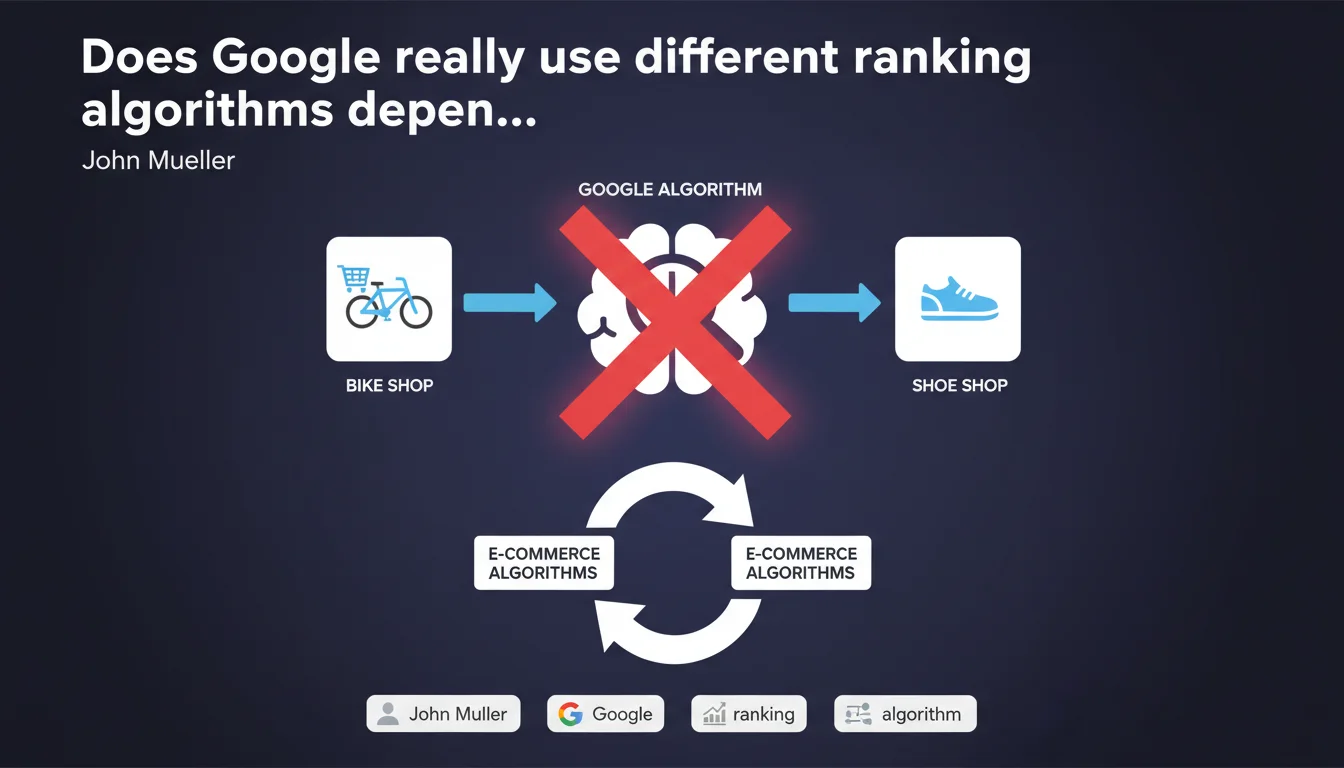
Google claims it doesn't have niche or industry-specific algorithms. An e-commerce bike shop is evaluated using the same fundamental criteria as a shoe store. Ranking signals remain universal, regardless of your industry.
What you need to understand
Why does Google claim there are no niche-specific algorithms?
Mueller's statement clarifies a persistent misconception: Google hasn't developed hundreds of distinct algorithms for each sector. The algorithmic core remains identical, whether we're talking about fashion, sports equipment, or industrial supplies.
Concretely? An e-commerce site is judged on universal criteria: content quality, user experience, domain authority, technical structure. No special treatment for bikes versus shoes.
Does this approach mean all sites are treated exactly the same way?
Important nuance: saying there are no niche-specific algorithms doesn't mean all sectors are evaluated identically. The weighting of signals can vary depending on the query context.
For example, for a transactional query ("buy road bike"), Google will prioritize specific e-commerce signals. For an informational medical query ("flu symptoms"), the signals of medical expertise (E-E-A-T) will weigh more heavily.
What mechanisms create the illusion of sector-specific algorithms?
What many mistake for distinct algorithms are actually contextual modules that activate based on search intent. Google applies dynamic filters and boosts based on signals present.
A YMYL site (Your Money Your Life) doesn't experience a different "health algorithm" — it's simply subject to increased requirements on certain existing signals like author authority and credibility.
- The core algorithm remains universal: relevance, quality, authority, user experience
- Signal weightings vary depending on query context and user intent
- Certain sectors (YMYL) face higher quality thresholds on the same criteria
- SERP features (rich snippets, knowledge panels) activate based on content nature, not sector-specific algorithms
SEO Expert opinion
Is this statement consistent with real-world observations?
Yes and no. In principle, it makes sense: developing hundreds of distinct algorithms would be a technical nightmare. Google maintains a modular system where components adapt to context.
But in practice, we clearly observe differentiated behaviors across sectors. E-commerce sites see their product pages indexed differently from informational blogs. News sites benefit from freshness mechanisms that other niches don't have. Is this really "the same algorithm"? It depends on what you mean by that.
What nuances should be added to this statement?
Mueller is simplifying — probably intentionally. There are specialized systems that only apply to certain content types: the news ranking system (Google News), spam detection algorithms for product reviews, reinforced YMYL filters.
Saying "no different algorithms" hides the reality: there's a common foundation, but specialized layers that stack depending on content type and query. [To verify]: how far does this uniformity really go? Google publishes no data on sector weightings.
In what cases is this rule clearly not applied?
Local searches are the blatant exception. A restaurant in Lyon and a hardware store in Lyon don't play by the same rules: Google Business Profile reviews, opening hours, geographic proximity weigh differently depending on category.
Similarly for YMYL entities: a financial advice site faces E-E-A-T constraints that a gardening blog doesn't encounter. If it's "the same algorithm", then the activation thresholds are radically different — which in practice amounts to almost the same as a distinct algorithm.
Practical impact and recommendations
What should you do concretely following this statement?
Don't waste time looking for miraculous sector-specific "hacks". Focus on universal fundamentals: solid technical architecture, quality content answering user intent, natural link profile, optimized user experience.
Instead, analyze how your sector interprets these fundamentals. "Quality content" for a B2B SaaS site rarely looks like that of a fashion boutique. Expertise is demonstrated differently depending on context.
What mistakes should you avoid in light of this information?
Stop searching for THE magic formula "special for e-commerce" or "special for real estate". These one-size-fits-all recipes ignore that each site has its own context: history, authority, competition, intent of targeted queries.
Also be wary of agencies selling you "secret techniques for your niche". If Google has no sector-specific algo, there's no sector-specific secret technique — just intelligent application of universal principles.
How should you adapt your SEO strategy accordingly?
Intelligent benchmarking: study what works with your direct competitors, but also with sites from other sectors facing similar challenges. An e-commerce bike store can learn from a camera equipment site about product page structuring.
Invest heavily in understanding your audience and their search intentions. That's where real differentiation happens, not in a hypothetical sector-specific algorithm.
- Audit technical fundamentals: crawlability, indexability, loading speed
- Map user intent for each targeted query group
- Analyze your site's E-E-A-T and identify weakness areas
- Study the content patterns that work in your sector without copying them blindly
- Build a natural and diversified link profile, adapted to your current authority
- Optimize user experience based on your audience's specific expectations
- Measure and iterate: SEO remains a continuous improvement process
❓ Frequently Asked Questions
Si Google n'a pas d'algorithme spécifique par niche, pourquoi certains secteurs semblent-ils plus difficiles à référencer ?
Les mises à jour d'algorithme affectent-elles certains secteurs plus que d'autres ?
Dois-je adapter ma stratégie de contenu différemment selon que je suis en B2B ou B2C ?
Les rich snippets et featured snippets sont-ils attribués différemment selon le secteur ?
Pourquoi les sites d'actualité semblent-ils bénéficier de règles différentes sur la fraîcheur du contenu ?
🎥 From the same video 22
Other SEO insights extracted from this same Google Search Central video · published on 28/03/2022
🎥 Watch the full video on YouTube →
💬 Comments (0)
Be the first to comment.