
Official statement
Other statements from this video 22 ▾
- □ Why doesn't Google Search Console's average position reflect a theoretical ranking but actual display results instead?
- □ Can you really afford to wait for an unstable ranking to stabilize on its own?
- □ Does the location of your XML sitemap really affect crawl efficiency?
- □ Should you really use the URL inspection tool to index a brand new website?
- □ How long does it really take to see your new backlinks in Google Search Console?
- □ Why do Search Console and Analytics data never really match up?
- □ Is Google Search Console really collecting all the data from your massive e-commerce site?
- □ Should you really prefer noindex over disallow to control indexation in Google?
- □ Can out-of-stock product pages really trigger soft 404 errors in Google's eyes?
- □ Do Google's testing tools really crawl in real-time or do they rely on cached data?
- □ Does Google really use different ranking algorithms depending on your industry?
- □ Why does Google deprioritize crawling low-effort aggregator sites?
- □ Does Google really count clicks on rich results the same way as organic clicks?
- □ Does the order of links in your HTML code really affect Google's crawl priority?
- □ Should you really avoid URLs with parameters for SEO?
- □ Why does robots.txt prevent Google from crawling your pages but still allow them to be indexed?
- □ Are out-of-stock products hurting your e-commerce site's overall search rankings?
- □ Does partial duplicate content really hurt your search rankings?
- □ Does Google really ignore your canonical tags when it decides pages are too similar?
- □ Does Google really use just one signal to choose which URL to canonicalize among your duplicate content?
- □ Do brand mentions without backlinks actually help your SEO rankings?
- □ Why does a link without an indexed URL essentially do nothing for your SEO?
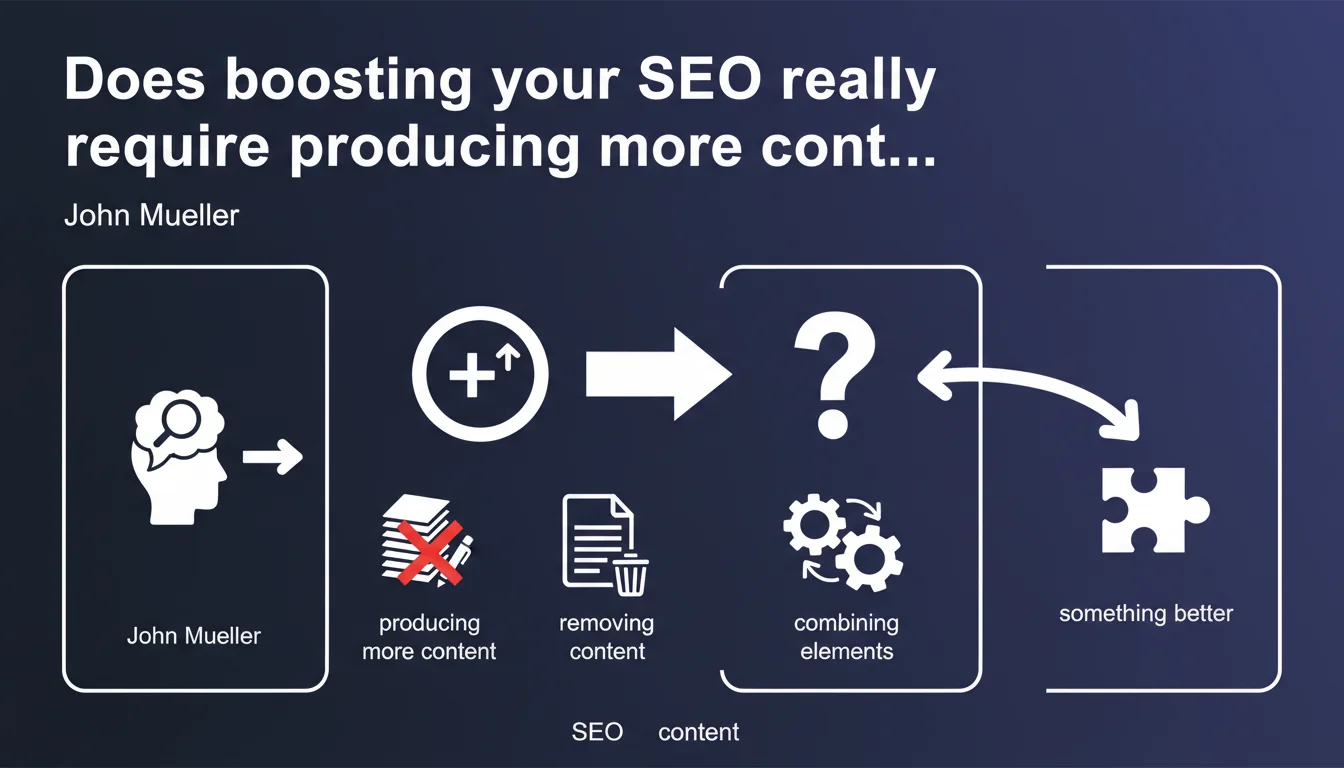
John Mueller reminds us that improving a website isn't solely about producing additional content. Removing weak pages, merging redundant content, or restructuring existing material can be far more effective than a race for volume.
What you need to understand
Why does Google keep pushing for content reduction?
Mueller's statement fits into a quality over quantity logic that Google has been emphasizing for years. The algorithm favors sites that demonstrate genuine expertise, not those that accumulate mediocre content just to inflate their indexed page count.
Multiplying weak pages — shallow articles, duplicate content, empty categories — dilutes the overall relevance of your site. By removing or consolidating these resources, you concentrate your crawl budget on what truly matters. The signal you send to Google becomes clearer.
What does it concretely mean to combine elements together?
It's about merging pages that cover similar or complementary topics into a single, more complete and better-structured resource. For example: three short articles on different aspects of the same subject can become one detailed and authoritative guide.
This approach improves user experience — fewer unnecessary clicks, greater depth — and strengthens your ranking on primary queries. Google values content that exhaustively answers search intent.
What's the risk of an "always produce more content" strategy?
Publishing indiscriminately often leads to creating thin content that adds no value whatsoever. It can even harm your site's overall performance if Google perceives a high proportion of low-quality pages.
Algorithm updates like the Helpful Content Update specifically target sites that publish mass-generated content without real expertise or utility. Better to have ten exceptional pages than fifty mediocre ones.
- Quality over quantity: Google prioritizes content that demonstrates expertise and depth
- Crawl budget optimization: fewer weak pages equals better allocation of crawl resources
- Strategic consolidation: merging related content strengthens topical authority
- Thin content risk: producing massively without added value can trigger algorithmic penalties
SEO Expert opinion
Is this statement consistent with real-world observations?
Yes — and it's actually one of the rare statements from Google that perfectly aligns with reality observed across thousands of audits. Sites that perform strategic content cleanup regularly see significant improvements, especially after major updates.
I've seen domains recover 40 to 60% of organic traffic after removing 30 to 50% of their weakest pages. The paradox is real: less content can generate more visibility. But be careful—it's not automatic—everything depends on the quality of what remains.
In what cases doesn't this rule apply?
On news sites or high-volume transactional platforms, the logic is different. A media outlet publishing daily needs freshness and volume — old content will naturally be archived or deindexed by Google.
Same for marketplaces or e-commerce sites with thousands of products: each product page has a reason to exist, even if its individual traffic is low. The danger here isn't volume but duplication and generic descriptions copied and pasted.
What nuance should we add to Mueller's advice?
Removing content isn't a one-size-fits-all solution to blindly apply. Some low-traffic content can be valuable long-tail entry points or serve specific user journeys. You need to analyze carefully before reaching for the axe.
Similarly, "combining elements" doesn't necessarily mean systematically merging. Sometimes it's better to restructure internal linking, improve individual content, or create thematic hubs with strong contextual links. [To verify]: Google never specifies the thresholds for "low quality" or the exact metrics to identify pages for removal.
Practical impact and recommendations
How do you identify content to remove or merge?
Start by extracting all your indexed URLs and cross-reference the data: organic traffic over 12 months, bounce rate, time on page, conversions, backlinks. Pages with zero traffic for 6+ months and zero backlinks are priority candidates for removal.
Use Search Console to identify pages marked "Discovered – currently not indexed" or "Crawled – currently not indexed." These are often signals that Google considers these resources low-priority. Ask yourself: why keep them?
What consolidation strategy should you adopt?
Identify clusters of content targeting similar search intents with poor individual performance. Merge them into a single enriched piece of content, then redirect the old URLs with 301s to the new consolidated page.
Make sure to preserve the best elements from each page: unique paragraphs, concrete examples, data and statistics. The resulting page should be significantly better than the sum of its parts. Update your internal linking to point to this new resource.
What mistakes should you avoid during content cleanup?
Never remove without analyzing backlinks — a ghost page might carry quality links you'd regret losing. Also verify conversions: some low-traffic pages convert exceptionally well on specific niches.
Avoid redirect chains or removals without 301s to a relevant alternative. Google may interpret this as a degraded user experience. Document every decision so you can measure impact post-cleanup.
- Extract all indexed URLs and cross-reference with GA4/Search Console data
- Identify pages with zero traffic, zero backlinks, zero conversions for 6+ months
- Find redundant or similar content candidates for merging
- Check backlink profile before any removal
- Implement relevant 301 redirects for each removed page
- Merge content while preserving the best elements from each source
- Update internal linking to reflect the new structure
- Monitor organic traffic and ranking changes for 3 months post-cleanup
❓ Frequently Asked Questions
Supprimer du contenu peut-il nuire au référencement ?
Comment savoir si deux contenus doivent être fusionnés ?
Faut-il attendre une mise à jour Google pour faire un nettoyage de contenu ?
Peut-on supprimer des pages qui ont des backlinks ?
Combien de temps faut-il pour voir les effets d'un nettoyage de contenu ?
🎥 From the same video 22
Other SEO insights extracted from this same Google Search Central video · published on 28/03/2022
🎥 Watch the full video on YouTube →
💬 Comments (0)
Be the first to comment.