
Official statement
Other statements from this video 22 ▾
- □ Why doesn't Google Search Console's average position reflect a theoretical ranking but actual display results instead?
- □ Can you really afford to wait for an unstable ranking to stabilize on its own?
- □ Does boosting your SEO really require producing more content?
- □ Does the location of your XML sitemap really affect crawl efficiency?
- □ Should you really use the URL inspection tool to index a brand new website?
- □ Why do Search Console and Analytics data never really match up?
- □ Is Google Search Console really collecting all the data from your massive e-commerce site?
- □ Should you really prefer noindex over disallow to control indexation in Google?
- □ Can out-of-stock product pages really trigger soft 404 errors in Google's eyes?
- □ Do Google's testing tools really crawl in real-time or do they rely on cached data?
- □ Does Google really use different ranking algorithms depending on your industry?
- □ Why does Google deprioritize crawling low-effort aggregator sites?
- □ Does Google really count clicks on rich results the same way as organic clicks?
- □ Does the order of links in your HTML code really affect Google's crawl priority?
- □ Should you really avoid URLs with parameters for SEO?
- □ Why does robots.txt prevent Google from crawling your pages but still allow them to be indexed?
- □ Are out-of-stock products hurting your e-commerce site's overall search rankings?
- □ Does partial duplicate content really hurt your search rankings?
- □ Does Google really ignore your canonical tags when it decides pages are too similar?
- □ Does Google really use just one signal to choose which URL to canonicalize among your duplicate content?
- □ Do brand mentions without backlinks actually help your SEO rankings?
- □ Why does a link without an indexed URL essentially do nothing for your SEO?
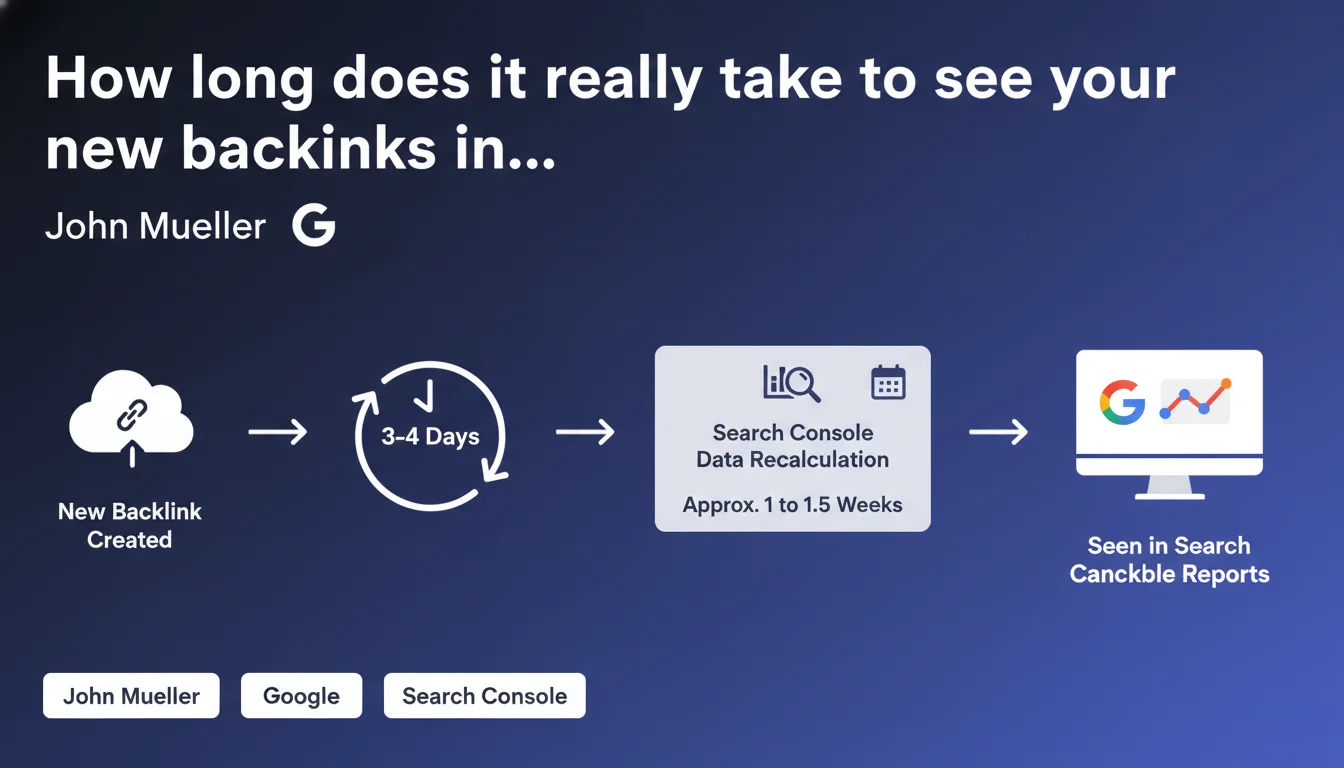
The links report in Google Search Console updates every week to week and a half — not in a few hours, and not over several months. Other GSC reports are recalculated every three to four days. This timing difference is crucial for tracking the impact of your link-building campaign.
What you need to understand
Why does the links report update more slowly than other reports?
Most Search Console reports (performance, coverage, Core Web Vitals) are refreshed every three to four days. It's fast, predictable, and allows you to track your site's progress with reasonable responsiveness.
The links report works differently. John Mueller clarifies that you should expect one to ten days to see new data appear. Why this gap? Because Google must crawl the pages pointing to your site, process those backlinks, validate them, and then aggregate them in the report. It's not just a calculation issue — it's a process that depends on the crawl budget allocated to third-party sites.
What does "one week to one and a half weeks" actually mean in practice?
Concretely? If you acquire a backlink today, don't expect to see it in GSC tomorrow morning. Or in three days. It will likely appear between the 7th and 12th day.
Some backlinks may take even longer if the source page is rarely crawled by Google. Conversely, a link from a frequently crawled site (e.g., news media) may appear faster. But the "one week to ten days" timeframe remains the reference for the majority of cases.
Are other GSC reports really up-to-date every three days?
Yes. The performance report (clicks, impressions, CTR, average position) is updated every two to three days. The same applies to the index coverage report. These timeframes are stable and consistent with what Google officially communicates.
The links report is therefore an exception in the Search Console ecosystem. It's not a bug — it's by design: backlink processing is heavier and less prioritized than search performance tracking.
- The links report updates in 7 to 10 days on average
- Other GSC reports are refreshed every 3–4 days
- A newly acquired backlink doesn't appear immediately, even if the page is indexed
- The delay also depends on the crawl budget allocated to the source site
- No GSC report is real-time — all have an irreducible delay
SEO Expert opinion
Is this statement consistent with what we observe in practice?
Overall, yes. Observations align with the timeframe announced by Mueller. In practice, most backlinks appear between 5 and 15 days after going live. But reality is more nuanced than this statement suggests.
Some links appear in three days, especially when they come from high-authority sites with frequent crawling. Others take three weeks or longer, particularly when coming from rarely crawled sites or deep pages. [To verify]: Google doesn't clarify whether this delay corresponds to when the link is discovered or when it's displayed in the report — and this distinction makes all the difference.
What are the practical limitations of this time window?
A one to ten day delay is too long for daily monitoring. If you're managing an active link-building campaign, you can't rely solely on GSC to validate that your backlinks are being counted. You need to supplement with third-party tools (Ahrefs, Majestic, Semrush) that have their own crawl databases and different timeframes.
Another limitation: this delay makes it difficult to measure immediate impact. You acquire 50 backlinks this week? You won't be able to correlate their effect on your rankings for at least 10 days — and that's assuming the algorithm counts them from discovery, which isn't guaranteed.
What should you do when a backlink still hasn't appeared after two weeks?
Several possible causes. The link could be nofollow (in which case it will never appear in the inbound links report). The page might not have been crawled by Google. Or the link is discovered but ignored in the report's aggregation — Google doesn't display every backlink it knows about.
Let's be honest: GSC only gives you a sample of your backlinks. It's not a complete inventory. If a quality link hasn't appeared after three weeks, first verify that it still exists, that it's dofollow, and that the source page is indexed. If everything checks out, simply assume Google chose not to display it in the report — that doesn't mean it's not being counted by the algorithm.
Practical impact and recommendations
How should you plan a link-building campaign with this delay in mind?
Build in a minimum 15-day buffer in your timeline. If you want to measure the impact of a backlink campaign on your rankings, wait at least two weeks after the links go live before drawing conclusions. And even then: this timeframe only covers the report appearance, not the actual SEO impact.
Don't rely solely on GSC to validate backlink acquisition. Use a third-party tool in parallel to verify that links are being crawled and indexed. This allows you to detect issues earlier: removed links, deindexed pages, nofollow attributes added after the fact.
What mistakes should you avoid when tracking backlinks?
Classic mistake: checking GSC every day hoping to see a newly acquired backlink appear. You're wasting your time. The report doesn't update continuously — it recalculates in weekly waves. Check it once a week, no more.
Another pitfall: assuming that a backlink's absence from GSC means it's not being counted. Google knows about far more backlinks than it displays. The links report is a representative sample, not a complete inventory. If you have 500 backlinks, GSC might show 300 — and that's normal.
What should you concretely do to optimize your backlink tracking?
First, stop treating GSC as your sole source of truth. Combine it with at least one third-party tool (Ahrefs, Majestic, Semrush) that crawls the web independently. These tools have different — often faster — detection timeframes and give you a more complete picture.
Next, document every acquired backlink in an external tracking spreadsheet: acquisition date, source URL, target URL, anchor text, attribute (dofollow/nofollow). That way, you don't depend on GSC to know whether a link still exists or has been modified.
- Check the GSC links report once per week, not every day
- Wait 10 to 15 days before considering a "missing" backlink truly problematic
- Use a third-party tool (Ahrefs, Majestic, Semrush) to complement your GSC view
- Create an external tracking spreadsheet to document every backlink acquired
- Regularly verify that existing backlinks are still in place and remain dofollow
- Only measure the SEO impact of a link-building campaign after 3 to 4 weeks minimum
❓ Frequently Asked Questions
Un backlink peut-il avoir un impact SEO avant d'apparaître dans la GSC ?
Pourquoi certains backlinks n'apparaissent jamais dans le rapport de liens ?
Les liens en nofollow apparaissent-ils dans le rapport de liens de la GSC ?
Peut-on accélérer l'apparition d'un backlink dans la GSC ?
Quelle est la différence entre le délai d'indexation d'une page et le délai d'apparition d'un backlink ?
🎥 From the same video 22
Other SEO insights extracted from this same Google Search Central video · published on 28/03/2022
🎥 Watch the full video on YouTube →
💬 Comments (0)
Be the first to comment.