
Official statement
Other statements from this video 22 ▾
- □ Why doesn't Google Search Console's average position reflect a theoretical ranking but actual display results instead?
- □ Can you really afford to wait for an unstable ranking to stabilize on its own?
- □ Does boosting your SEO really require producing more content?
- □ Does the location of your XML sitemap really affect crawl efficiency?
- □ Should you really use the URL inspection tool to index a brand new website?
- □ How long does it really take to see your new backlinks in Google Search Console?
- □ Why do Search Console and Analytics data never really match up?
- □ Is Google Search Console really collecting all the data from your massive e-commerce site?
- □ Should you really prefer noindex over disallow to control indexation in Google?
- □ Can out-of-stock product pages really trigger soft 404 errors in Google's eyes?
- □ Do Google's testing tools really crawl in real-time or do they rely on cached data?
- □ Does Google really use different ranking algorithms depending on your industry?
- □ Why does Google deprioritize crawling low-effort aggregator sites?
- □ Does Google really count clicks on rich results the same way as organic clicks?
- □ Does the order of links in your HTML code really affect Google's crawl priority?
- □ Should you really avoid URLs with parameters for SEO?
- □ Why does robots.txt prevent Google from crawling your pages but still allow them to be indexed?
- □ Are out-of-stock products hurting your e-commerce site's overall search rankings?
- □ Does partial duplicate content really hurt your search rankings?
- □ Does Google really ignore your canonical tags when it decides pages are too similar?
- □ Does Google really use just one signal to choose which URL to canonicalize among your duplicate content?
- □ Why does a link without an indexed URL essentially do nothing for your SEO?
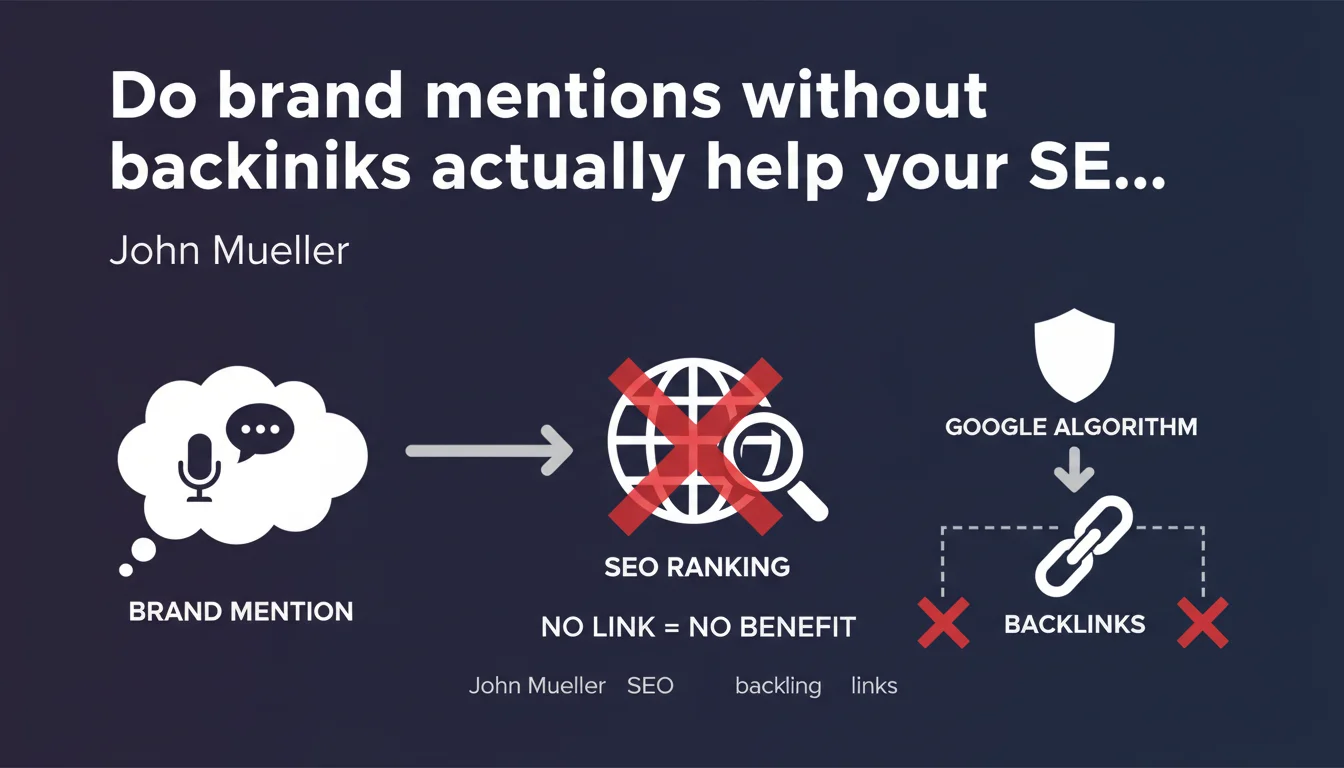
Google states that brand mentions without hyperlinks are not treated as ranking signals. If your domain name or brand appears somewhere without being clickable, it brings no direct value to your SEO according to Mueller. Only real links count.
What you need to understand
Why does Google insist that unlinked mentions have no value?
The SEO community has debated for years the potential impact of brand mentions — those brand citations without hyperlinks. The idea was compelling: if people talk about you, even without a link, Google might consider it a signal of notoriety.
John Mueller puts this speculation to rest. For Google, a link remains a clickable link with an <a href> tag. A simple text mention — even if it cites your domain name exactly — triggers no ranking algorithm related to PageRank or popularity signals.
What distinguishes a mention from a link in the algorithm's eyes?
Technically, a link is a node in the web graph — a connection exploitable by crawl bots and counted in popularity calculations. A text mention, even if it contains your URL spelled out in a paragraph, remains plain text.
Google won't magically transform "example.com" written in plain text within a paragraph into a signal equivalent to an <a href="https://example.com"> tag. The search engine analyzes links based on their HTML structure, not on the semantics of surrounding content.
What are the concrete implications for a link building strategy?
This statement refocuses priority on obtaining real backlinks. Campaigns that relied on generating brand visibility without requiring a hyperlink lose their SEO justification.
This doesn't mean mentions are useless — they can generate direct traffic, brand awareness, and even trigger brand searches. But from a strict algorithmic ranking perspective, they contribute nothing.
- A text mention without
<a href>is not counted as a link - There is no "half-value" for a non-clickable brand citation
- PR and brand awareness strategies remain relevant for other levers (traffic, conversion, brand searches)
- Traditional link building remains the only way to build authority through backlinks
SEO Expert opinion
Is this statement consistent with real-world observations?
Yes, and it aligns with empirical tests conducted by several independent consultants. Pure brand mention campaigns — without links — have never demonstrated measurable impact on organic rankings in controlled environments.
However, some ambiguous cases remain. Brand searches triggered by these mentions can indirectly influence CTR on SERPs, which may affect rankings through behavioral signals. But this mechanism is distinct from link evaluation.
What nuances should be applied to this categorical statement?
Google may not treat mentions as links, but it certainly uses them in other contexts. The Knowledge Graph, for example, relies on named entity detection to build its relational databases.
Repeated mentions of your brand on authoritative sites can reinforce your status as a recognized entity — which has nothing to do with PageRank, but can affect your visibility in rich snippets, knowledge panels, or Google Discover. [To verify]: the exact impact of these mentions on entities remains unclear, as Google never communicates in detail about Knowledge Graph mechanisms.
In which cases can a mention still have indirect SEO value?
If a mention generates direct traffic or prompts users to search your brand on Google, you benefit from a positive behavioral signal. Sites that generate many brand searches tend to rank better — but again, it's not the mention acting directly.
Mentions in highly shared content can also trigger spontaneous links later. A journalist who discovers your brand cited somewhere may decide to investigate and create an article with a real link. But that's a side effect, not a direct algorithmic mechanism.
Practical impact and recommendations
What should you change in your current link building strategy?
If you were running brand awareness campaigns counting on indirect SEO benefit, it's time to readjust objectives. These actions can remain useful for marketing and awareness, but should no longer be sold as link building.
Focus your efforts on obtaining real backlinks: media relations requiring links, editorial partnerships, guest blogging with relevant anchor text, creation of linkable resources. Every placement must result in an effective <a href>.
What mistakes should you avoid when negotiating with publishers?
Some sites agree to cite your brand without granting a link — sometimes by editorial policy, sometimes by oversight. Never settle for a mere mention if the objective is SEO.
Negotiate clearly: a dofollow link to a strategic page on your site. If the publisher categorically refuses any link, the placement has value only for direct traffic or awareness — not for organic rankings.
How can you verify that your campaigns are generating exploitable backlinks?
Use your usual tools — Ahrefs, Majestic, SEMrush — to track new incoming links. A text mention will never appear in these backlink reports, confirming its absence of impact on your link profile.
Set up Google Alerts or brand monitoring tools (Mention, Brand24) to detect brand citations. When you spot one without a link, contact the publisher to request addition of a hyperlink — it's often accepted without difficulty.
- Systematically require a hyperlink in your partnership agreements
- Audit your past campaigns to identify mentions without links and request updates
- Don't count brand mentions in your SEO KPIs — they belong to brand marketing
- Train your PR teams on the difference between mentions and backlinks
- Invest in link-generating formats: case studies, infographics, free tools, exclusive data
- Implement monthly tracking of acquired backlinks vs detected mentions
❓ Frequently Asked Questions
Une mention de marque sur un site d'autorité peut-elle quand même améliorer mon référencement ?
Si mon URL apparaît en texte brut (sans balise <a>), Google la détecte-t-il quand même ?
Les outils SEO comme Ahrefs détectent-ils les mentions sans lien ?
Dois-je arrêter toute campagne de brand awareness si elle ne génère pas de liens ?
Peut-on demander à un éditeur d'ajouter un lien à une mention déjà publiée ?
🎥 From the same video 22
Other SEO insights extracted from this same Google Search Central video · published on 28/03/2022
🎥 Watch the full video on YouTube →
💬 Comments (0)
Be the first to comment.