
Official statement
Other statements from this video 22 ▾
- □ Pourquoi la position moyenne de Search Console ne reflète-t-elle pas un classement théorique mais des affichages réels ?
- □ Peut-on encore se permettre d'attendre qu'un classement instable se stabilise tout seul ?
- □ Faut-il vraiment produire plus de contenu pour améliorer son SEO ?
- □ Où placer son sitemap XML pour optimiser son crawl ?
- □ Faut-il vraiment utiliser l'outil d'inspection d'URL pour indexer un nouveau site ?
- □ Combien de temps faut-il attendre pour voir les backlinks dans Search Console ?
- □ Pourquoi les données Search Console et Analytics ne concordent-elles jamais vraiment ?
- □ Search Console collecte-t-elle vraiment toutes les données sur les gros sites e-commerce ?
- □ Faut-il vraiment préférer noindex à disallow pour contrôler l'indexation ?
- □ Les produits en rupture de stock peuvent-ils vraiment être traités comme des soft 404 par Google ?
- □ Les outils de test Google crawlent-ils vraiment en temps réel ou utilisent-ils un cache ?
- □ Google utilise-t-il des algorithmes différents selon votre secteur d'activité ?
- □ Pourquoi Google ignore-t-il les sites agrégateurs de faible effort ?
- □ L'ordre des liens dans le HTML influence-t-il vraiment la priorité de crawl de Google ?
- □ Faut-il vraiment éviter les URLs avec paramètres pour le SEO ?
- □ Pourquoi robots.txt bloque le crawl mais n'empêche pas l'indexation de vos pages ?
- □ Les produits en rupture de stock nuisent-ils au classement global de votre site e-commerce ?
- □ Le contenu dupliqué partiel pénalise-t-il vraiment vos pages ?
- □ Pourquoi Google refuse-t-il d'indexer plusieurs versions d'une même page malgré une canonicalisation correcte ?
- □ Comment Google choisit-il réellement quelle URL canoniser parmi vos contenus dupliqués ?
- □ Les mentions de marque sans lien ont-elles une valeur SEO ?
- □ Pourquoi un lien sans URL indexée ne sert strictement à rien ?
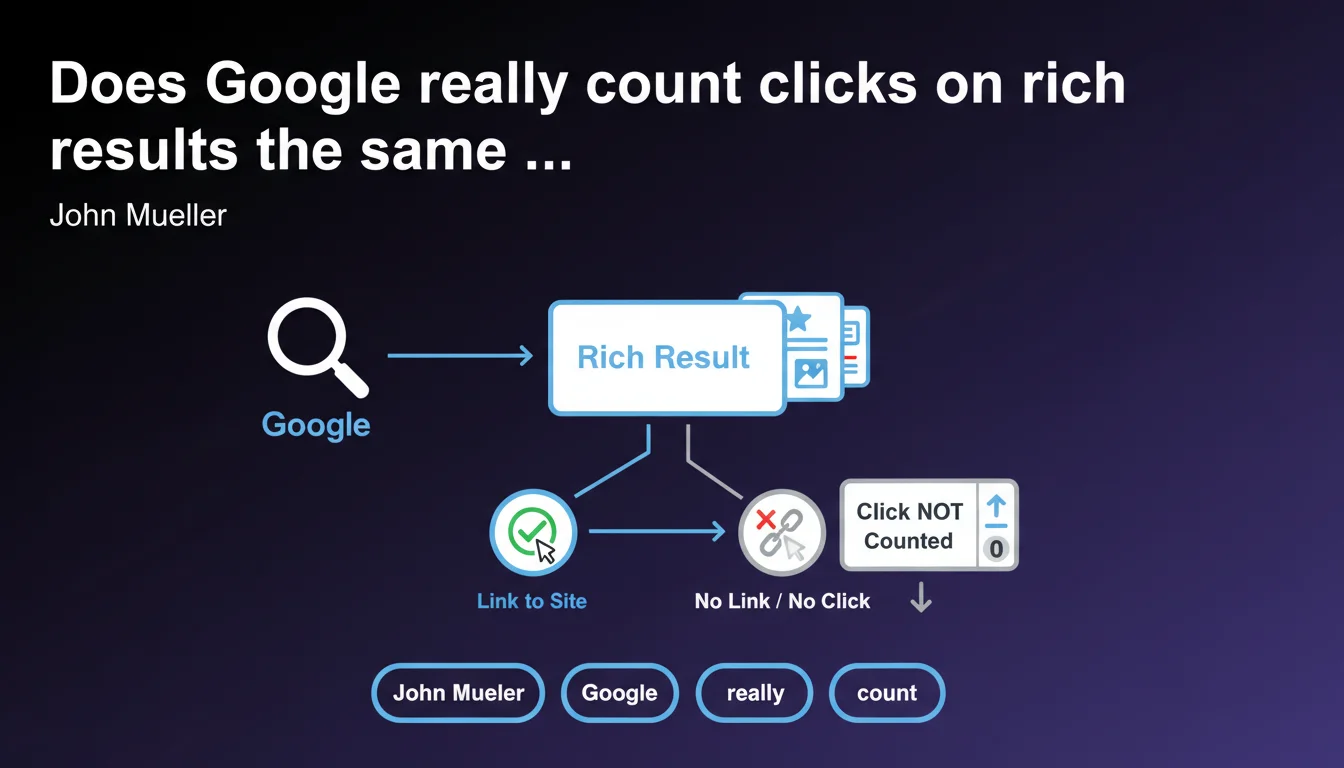
Google only counts a click in Search Console if the user actually clicks on a link leading to your site. Simply displaying a rich result without any interaction generates no recorded clicks. This clarification directly impacts how you should interpret CTR data for sites using structured data extensively.
What you need to understand
Why does Google clarify this click counting rule?
The confusion stems from the fact that certain rich results display information directly in the SERPs without requiring a click. A user can see a recipe with ratings and preparation time, check business hours, or read a review — all without ever visiting the source site.
Mueller's statement is clear: no real click = no counted click. The visual appearance of an enriched element is not enough. Google doesn't artificially inflate your statistics to promote rich snippets.
What does this change for Search Console metrics?
Your clicks and impressions data remains reliable. If you see 1000 impressions with rich results but only 50 clicks, it means 950 users found their answer without clicking. There's no phantom metric that distorts your CTR.
This logic applies to all types of enriched results: FAQ, HowTo, Product, Recipe, Event. Only the click on the main link to your domain counts.
What are the cases where a rich result generates no clicks?
- The user reads the complete answer in a structured FAQ displayed as an accordion
- Business hours or phone numbers are visible without clicking
- A price comparison or rating displayed directly satisfies the query
- The rich snippet contains a concise answer that's sufficient (e.g., cooking temperature, duration)
- The user clicks on an internal carousel element without leaving Google
SEO Expert opinion
Does this statement match real-world observations?
Yes, and it's reassuring. Professionals who've been tracking their Search Console data for years notice this: CTR often drops after a rich result appears. Not because the position degrades, but because the displayed information answers the intent directly without requiring a visit.
Some publishers saw their traffic drop by 15 to 30% after massive FAQ or HowTo implementation — while maintaining their positions. Google isn't lying about this: rich result doesn't mean rich traffic.
Are there gray areas in this rule?
The statement remains silent on intermediate interactions. What happens when a user expands an FAQ question, reads the answer, then closes it without clicking? Does Google record this interaction as a relevance signal even without a final click? [To be verified]
Similarly, carousels of products or events raise questions. A user might scroll through 10 items before clicking on the 11th. Do these micro-interactions influence ranking even if they don't generate a counted click? Mueller doesn't specify.
Should you reconsider your rich results strategy?
Not necessarily. Rich results remain a visibility and authority tool. Occupying more space in the SERP and displaying reassurance elements (ratings, prices, availability) improves the click-through rate when users decide to click.
But let's be realistic: if your business model relies on traffic volume, enriching informational pages extensively can cannibalize your traffic. It's a trade-off to make based on your objective — visibility vs conversion on-site.
Practical impact and recommendations
How do you measure the real impact of rich results on traffic?
Start by segmenting your pages in Search Console: those with active rich results vs those without. Compare average CTR at equivalent positions. If the gap exceeds 20%, you have a measurable effect — positive or negative depending on context.
Use the search appearance reports to isolate impressions with enrichment. Cross-reference this data with Google Analytics to see if sessions from rich results convert better or worse.
What concrete actions should you implement?
Adapt your structured data strategy based on page type. Commercial pages (products, services) generally benefit from rich snippets — they reassure and trigger clicks. Purely informational pages can see their traffic plummet if the answer is complete in the SERP.
For high-value content, don't give everything away in the snippet. Structure your FAQs by teasing the full answer, use formats that encourage clicking rather than passive reading.
- Audit pages with active rich results and compare their CTR vs site average
- Identify pages where the rich snippet cannibalizes traffic without driving conversions
- Test variations in structured data (partial vs complete answers)
- Monitor CTR evolution after deploying new types of rich results
- Segment conversions by search appearance type (rich vs standard)
- Document cases where removing a rich result improves qualified traffic
How do you balance SERP visibility with traffic generation?
Ask yourself about the final intention. If your goal is brand awareness, massive visual presence in SERPs justifies lower CTR. If you monetize through ads or affiliate marketing, prioritize formats that encourage clicking.
For e-commerce sites, Product rich results remain winners: they increase qualified click-through rate even if they reduce raw volume. For media and informational content, it's trickier — each situation deserves analysis.
❓ Frequently Asked Questions
Un rich result sans clic a-t-il quand même un impact SEO positif ?
Les FAQ structurées détruisent-elles mon trafic si elles répondent complètement aux questions ?
Comment Google définit-il un lien réel vers mon site dans un rich result ?
Dois-je retirer mes données structurées FAQ si mon CTR baisse ?
Les rich results influencent-ils le ranking même sans générer de clics ?
🎥 From the same video 22
Other SEO insights extracted from this same Google Search Central video · published on 28/03/2022
🎥 Watch the full video on YouTube →
💬 Comments (0)
Be the first to comment.