
Official statement
Other statements from this video 22 ▾
- □ Pourquoi la position moyenne de Search Console ne reflète-t-elle pas un classement théorique mais des affichages réels ?
- □ Peut-on encore se permettre d'attendre qu'un classement instable se stabilise tout seul ?
- □ Faut-il vraiment produire plus de contenu pour améliorer son SEO ?
- □ Où placer son sitemap XML pour optimiser son crawl ?
- □ Faut-il vraiment utiliser l'outil d'inspection d'URL pour indexer un nouveau site ?
- □ Combien de temps faut-il attendre pour voir les backlinks dans Search Console ?
- □ Pourquoi les données Search Console et Analytics ne concordent-elles jamais vraiment ?
- □ Search Console collecte-t-elle vraiment toutes les données sur les gros sites e-commerce ?
- □ Faut-il vraiment préférer noindex à disallow pour contrôler l'indexation ?
- □ Les produits en rupture de stock peuvent-ils vraiment être traités comme des soft 404 par Google ?
- □ Les outils de test Google crawlent-ils vraiment en temps réel ou utilisent-ils un cache ?
- □ Google utilise-t-il des algorithmes différents selon votre secteur d'activité ?
- □ Pourquoi Google ignore-t-il les sites agrégateurs de faible effort ?
- □ Google compte-t-il vraiment les clics sur les rich results comme des clics organiques ?
- □ L'ordre des liens dans le HTML influence-t-il vraiment la priorité de crawl de Google ?
- □ Faut-il vraiment éviter les URLs avec paramètres pour le SEO ?
- □ Pourquoi robots.txt bloque le crawl mais n'empêche pas l'indexation de vos pages ?
- □ Le contenu dupliqué partiel pénalise-t-il vraiment vos pages ?
- □ Pourquoi Google refuse-t-il d'indexer plusieurs versions d'une même page malgré une canonicalisation correcte ?
- □ Comment Google choisit-il réellement quelle URL canoniser parmi vos contenus dupliqués ?
- □ Les mentions de marque sans lien ont-elles une valeur SEO ?
- □ Pourquoi un lien sans URL indexée ne sert strictement à rien ?
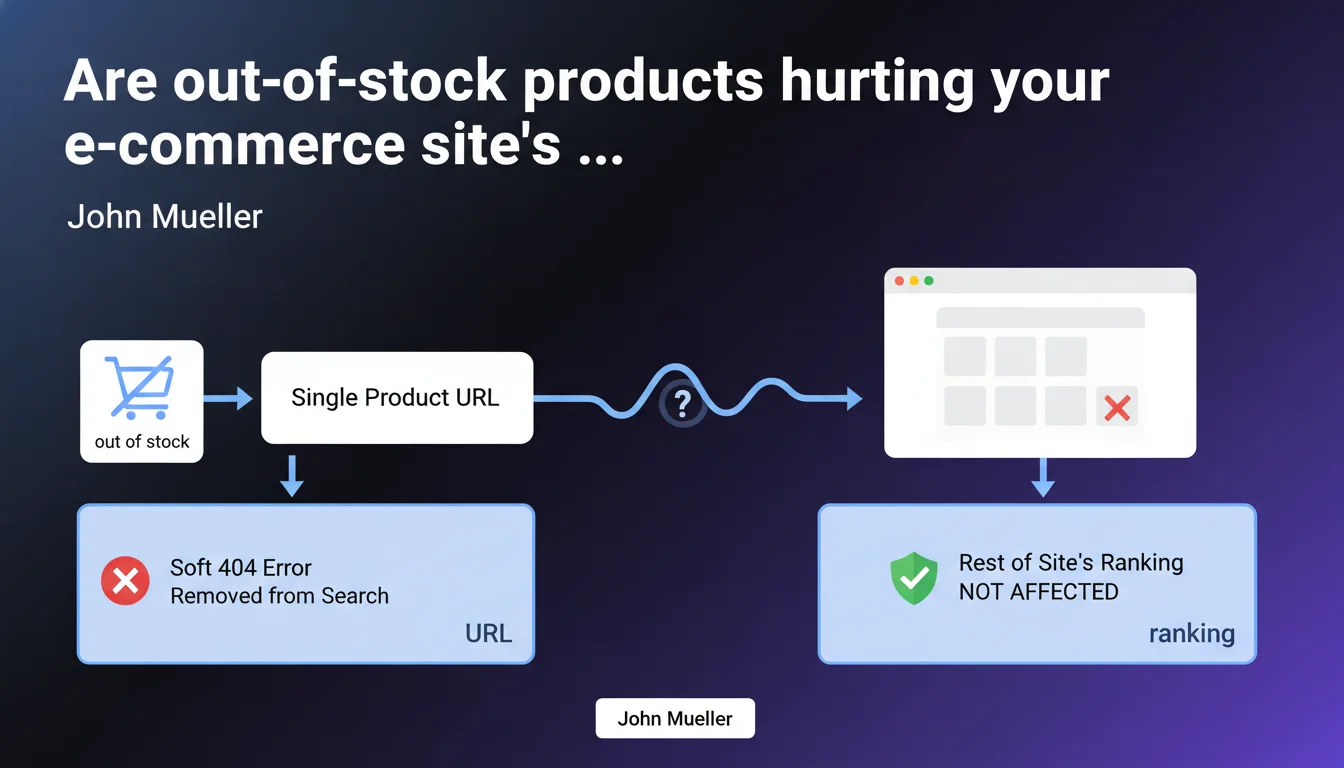
Google treats out-of-stock product pages as soft 404 errors and removes them from the index. Good news: a single unavailable product doesn't affect your site's overall ranking. The problem stays isolated to that specific URL.
What you need to understand
Why does Google remove out-of-stock products from the index?
Google believes that a product page with no available inventory no longer provides value to the user. The search engine treats this case as a soft 404 error — a page that's technically accessible (HTTP 200 status code) but whose main content has disappeared.
Unlike a true 404, the page still exists. But Google decides to temporarily deindex it, reasoning that it doesn't deserve a place in search results as long as the product remains unavailable.
Is this removal from the index permanent?
No. Once the product becomes available again and Google recrawls the page, it can return to the index normally. The mechanism is similar to how Google handles temporarily inaccessible content.
The deindexing duration depends on your site's crawl frequency and how quickly you update the product status. No fixed timeline is guaranteed.
Does this penalize the rest of your site?
Mueller is unambiguous: a single out-of-stock product doesn't impact your site's overall ranking. No domino effect on your other pages or general authority.
This isolation of the problem aligns with how Google typically operates, evaluating pages individually except in rare cases (very low-quality sites, massive spam).
- Out-of-stock pages are treated as soft 404s and deindexed
- Removal from the index is temporary, not permanent
- No impact on your site's overall ranking
- Reindexing occurs after recrawl once stock is restored
- No global penalty linked to occasional stockouts
SEO Expert opinion
Does this statement match real-world observations?
Yes, broadly speaking. We do observe Google progressively removing product pages marked "out of stock" after several consecutive crawls without status changes. The timeline varies — sometimes days, sometimes weeks depending on the bot's crawl frequency.
Where it gets murky: Mueller doesn't specify how long a page can remain out of stock before deindexing. [Needs verification] on your own sites, as tolerance appears proportional to domain authority and the crawl budget allocated to your site.
Do all e-commerce sites face the same rules?
Let's be honest: a giant like Amazon can keep out-of-stock pages indexed far longer than a small online shop. Domain authority, crawl freshness, and page depth obviously play a role.
Mueller speaks of a "single product reference" — but what happens when 30% of your catalog is chronically out of stock? The claim of "no global impact" deserves to be nuanced at scale. A site with a massive soft 404 rate eventually dilutes its crawl budget and degrades user experience, even without a direct algorithmic penalty.
Should you let Google automatically deindex these pages?
Not necessarily. The passive approach (letting it happen) works if your stockouts are rare and temporary. But for long-term or recurring unavailability, it's better to actively manage indexation.
You have three options: temporarily block via noindex, redirect to a similar category (301 or 302 depending on the situation), or keep the page indexed with enriched content (alternative suggestions, back-in-stock alerts). Each method has its merits depending on your business context.
Practical impact and recommendations
What should you do when a product goes out of stock?
It depends on the expected duration of unavailability. For a short stockout (less than a week), keep the page active with a clear message and a back-in-stock alert button. Maintain the schema.org status as "OutOfStock" to properly inform Google.
For a long or permanent stockout, you have three scenarios: a 301 redirect to a similar product if you don't plan to restock, a 302 redirect if the stockout is temporary but prolonged (several weeks), or noindex plus an informational message if you want the page accessible to users while keeping it out of the index.
How do you minimize damage in a catalog with frequent stockouts?
Enrich out-of-stock pages instead of leaving them bare. Add similar products, existing customer reviews, editorial content about product usage. The goal: maintain informational value even without a "Buy" button.
Implement an automatic email alert system. This maintains user engagement and justifies to Google that the page remains relevant despite temporary product unavailability.
What mistakes should you absolutely avoid?
Never let a product page return a 404 or 410 status code for temporary stockouts — you'd lose the page's historical benefits (backlinks, age, user signals). Google's automatic soft 404 is preferable to a true error you'd create yourself.
Also avoid systematically redirecting to your homepage or an overly generic category. Google may interpret these massive redirects as disguised soft 404s, with the same end result: deindexing.
- Use schema.org markup "availability": "OutOfStock" to explicitly inform Google
- For short stockouts: keep the page active with alert CTA and enriched content
- For long stockouts: evaluate the choice between temporary noindex or 302 redirect
- Permanently discontinued products: 301 redirect to a relevant alternative
- Maintain quality content even without stock (reviews, usage guides, alternatives)
- Monitor Google Search Console to detect soft 404s flagged by Google
- Regularly test reindexing speed after stock returns (via IndexNow or sitemap)
❓ Frequently Asked Questions
Combien de temps faut-il pour qu'une page en rupture soit retirée de l'index ?
Faut-il utiliser le code HTTP 410 pour un produit définitivement arrêté ?
Le balisage schema.org OutOfStock suffit-il à éviter la désindexation ?
Une page en rupture avec du contenu enrichi sera-t-elle quand même retirée ?
Les ruptures fréquentes peuvent-elles affecter le crawl budget global du site ?
🎥 From the same video 22
Other SEO insights extracted from this same Google Search Central video · published on 28/03/2022
🎥 Watch the full video on YouTube →
💬 Comments (0)
Be the first to comment.