
Official statement
Other statements from this video 22 ▾
- □ Pourquoi la position moyenne de Search Console ne reflète-t-elle pas un classement théorique mais des affichages réels ?
- □ Peut-on encore se permettre d'attendre qu'un classement instable se stabilise tout seul ?
- □ Faut-il vraiment produire plus de contenu pour améliorer son SEO ?
- □ Où placer son sitemap XML pour optimiser son crawl ?
- □ Faut-il vraiment utiliser l'outil d'inspection d'URL pour indexer un nouveau site ?
- □ Combien de temps faut-il attendre pour voir les backlinks dans Search Console ?
- □ Pourquoi les données Search Console et Analytics ne concordent-elles jamais vraiment ?
- □ Search Console collecte-t-elle vraiment toutes les données sur les gros sites e-commerce ?
- □ Faut-il vraiment préférer noindex à disallow pour contrôler l'indexation ?
- □ Les outils de test Google crawlent-ils vraiment en temps réel ou utilisent-ils un cache ?
- □ Google utilise-t-il des algorithmes différents selon votre secteur d'activité ?
- □ Pourquoi Google ignore-t-il les sites agrégateurs de faible effort ?
- □ Google compte-t-il vraiment les clics sur les rich results comme des clics organiques ?
- □ L'ordre des liens dans le HTML influence-t-il vraiment la priorité de crawl de Google ?
- □ Faut-il vraiment éviter les URLs avec paramètres pour le SEO ?
- □ Pourquoi robots.txt bloque le crawl mais n'empêche pas l'indexation de vos pages ?
- □ Les produits en rupture de stock nuisent-ils au classement global de votre site e-commerce ?
- □ Le contenu dupliqué partiel pénalise-t-il vraiment vos pages ?
- □ Pourquoi Google refuse-t-il d'indexer plusieurs versions d'une même page malgré une canonicalisation correcte ?
- □ Comment Google choisit-il réellement quelle URL canoniser parmi vos contenus dupliqués ?
- □ Les mentions de marque sans lien ont-elles une valeur SEO ?
- □ Pourquoi un lien sans URL indexée ne sert strictement à rien ?
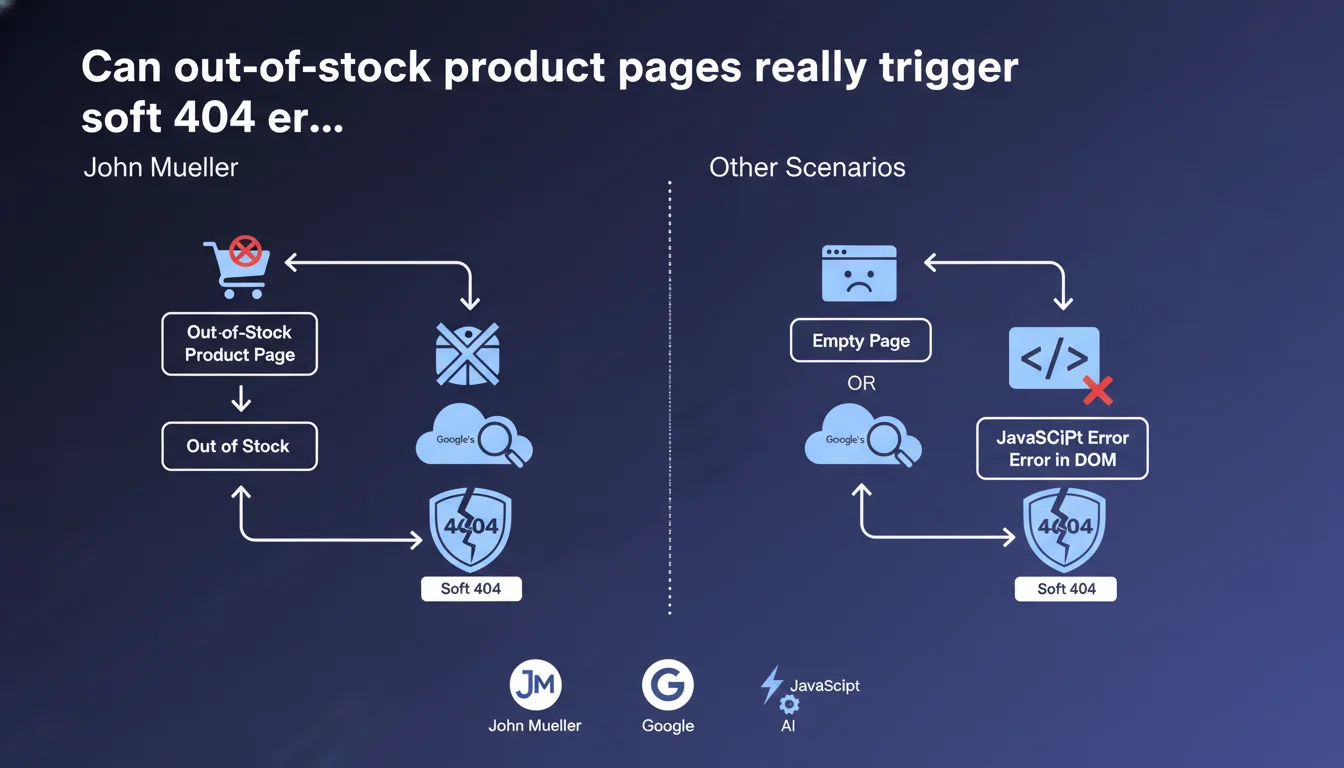
Google confirms that product pages showing out-of-stock or unavailable items can be interpreted as soft 404 errors. Empty pages or those displaying error messages via JavaScript (such as 'no information found') fall into this category. The stakes are high: prevent your temporarily unavailable product pages from disappearing from the search index.
What you need to understand
This statement from John Mueller touches on a classic friction point in e-commerce: how do you manage temporarily unavailable products without losing the SEO benefits of indexed pages?
A soft 404 is a page that returns an HTTP 200 status code (everything is fine) but whose content actually signals a lack of useful information. Google detects it as a disguised error.
Why do stock shortages pose a problem for Google?
When a product page only displays a "out of stock" message without context or alternatives, Google considers that the page no longer has value for the user. If the remaining content is too thin — just a title and a grayed-out button — the algorithm may classify the page as a soft 404.
The problem worsens with sites that use JavaScript to dynamically load the error message. If the final DOM contains only "no information found" or equivalent, Google sees an empty page at render time.
What specifically triggers a soft 404?
Several scenarios can alert Google: a product page stripped of its descriptive content, a redirect to a generic "product unavailable" page, or an error message loaded in JavaScript without HTML fallback.
The interpretation relies on semantic analysis of the final rendered content. If Google finds no description, no alternatives, no usable context, it classifies the page as an error.
What are the consequences of an unmanaged soft 404?
The page can be progressively deindexed, especially if the signal persists over time. You then lose the ranking you've built, the backlinks, and the page's history — even if the product returns to stock three weeks later.
- Soft 404 = signal of a valueless page to Google, even if the server returns 200
- Out-of-stock product pages can shift to soft 404 status if remaining content is too thin
- Error messages loaded in JavaScript ("no info found") increase the risk
- Progressive deindexing can occur if the signal persists
- The risk also affects empty category pages or internal search results with no results
SEO Expert opinion
Is this statement consistent with real-world observations?
Yes — and it's a recurring issue in e-commerce. We regularly observe visibility drops on sites that mishandle stock shortages. Product pages disappear from the index, sometimes within weeks, if they remain empty for too long.
The JavaScript part is particularly treacherous. Many modern sites load the "product unavailable" message via React or Vue, without SSR or HTML fallback. Google crawls, renders, sees an empty shell — and classifies it as soft 404. [To verify]: the exact timeframe before deindexing remains unclear and is probably variable depending on the site's authority.
What nuances should be added to this statement?
Let's be honest: Google doesn't specify where the threshold lies. How much residual content must you keep to avoid soft 404? Is a complete product description enough if the "buy" button is disabled? No numbers, no metrics.
Additionally, the notion of an "empty page" remains subjective. A product page with title, images, description, reviews but no stock — is it empty? Probably not. But a page with just a title and "temporarily out of stock" — there, the risk is real.
Another gray area: seasonal catalogs. A product out of season that returns each year — should you keep it indexed with an explicit message, or switch to temporary 404? Google doesn't decide.
In what cases doesn't this rule apply?
If the product page retains sufficient useful content — detailed description, alternatives, similar product suggestions, stock notification signup —, it keeps its value in Google's eyes. Soft 404 only triggers if the page becomes an empty shell.
Sites with strong authority also seem to benefit from wider tolerance. An Amazon or major retailer can afford lightweight pages without immediate deindexing — but this isn't a documented rule, more of an empirical observation.
Practical impact and recommendations
What should you concretely do to avoid soft 404s on out-of-stock items?
First step: retain maximum content on the product page even when out of stock. Complete description, visuals, customer reviews, technical specifications — everything that provides value to someone comparing or researching.
Next, add contextual elements: "notify me when available" button, similar product suggestions, estimated restock date. The goal is to transform the page into a useful resource, not a dead end.
What mistakes must you absolutely avoid?
Don't redirect all out-of-stock items to a generic "product unavailable" page. That's the best way to lose indexing and each product page's SEO history. Google detects these redirects as soft 404s.
Also avoid error messages loaded only through JavaScript without HTML fallback. If your SPA displays "no information found" after component mounting, Google may see only an empty page at crawl time.
And above all, don't leave a page in "empty out of stock" status for months. If the product doesn't return, it's better to switch to 404 or 410 to free up crawl budget.
How do you verify your site is compliant?
Use the URL Inspection tool in Search Console on a few out-of-stock product pages. Look at the rendered HTML version: do you see complete content or just a generic message?
Also check the "Coverage" or "Pages" report in Search Console. Pages classified as "Excluded: soft 404 detected" appear there. If you find any, analyze their common structure.
- Keep complete description, visuals, and customer reviews even when out of stock
- Add a "notify me" button and similar product suggestions
- Avoid batch redirects to a generic unavailability page
- Check the final HTML rendering (not just source) for JavaScript pages
- Monitor the "Pages" report in Search Console to detect soft 404s
- Switch to 404/410 for products permanently discontinued after several months
- Regularly test URL inspection on out-of-stock product pages
- Implement server-side stock notification systems if possible
Managing the technical aspects of stock shortages, combined with JavaScript rendering optimization and fine-grained indexing monitoring, can quickly become a headache — especially on catalogs with thousands of product references. If you're experiencing unexplained deindexing or having difficulty maintaining rankings on fluctuating products, an in-depth technical audit conducted by a specialized SEO agency can quickly identify bottlenecks and implement a strategy tailored to your technical stack.
❓ Frequently Asked Questions
Un produit en rupture temporaire doit-il renvoyer un code 404 ?
Combien de temps Google tolère-t-il une page en rupture de stock avant de la désindexer ?
Les pages catégories vides peuvent-elles aussi être classées en soft 404 ?
Comment savoir si mes pages en rupture sont détectées comme soft 404 ?
Faut-il mettre une balise noindex sur les produits en rupture de stock ?
🎥 From the same video 22
Other SEO insights extracted from this same Google Search Central video · published on 28/03/2022
🎥 Watch the full video on YouTube →
💬 Comments (0)
Be the first to comment.