
Official statement
Other statements from this video 22 ▾
- □ Pourquoi la position moyenne de Search Console ne reflète-t-elle pas un classement théorique mais des affichages réels ?
- □ Faut-il vraiment produire plus de contenu pour améliorer son SEO ?
- □ Où placer son sitemap XML pour optimiser son crawl ?
- □ Faut-il vraiment utiliser l'outil d'inspection d'URL pour indexer un nouveau site ?
- □ Combien de temps faut-il attendre pour voir les backlinks dans Search Console ?
- □ Pourquoi les données Search Console et Analytics ne concordent-elles jamais vraiment ?
- □ Search Console collecte-t-elle vraiment toutes les données sur les gros sites e-commerce ?
- □ Faut-il vraiment préférer noindex à disallow pour contrôler l'indexation ?
- □ Les produits en rupture de stock peuvent-ils vraiment être traités comme des soft 404 par Google ?
- □ Les outils de test Google crawlent-ils vraiment en temps réel ou utilisent-ils un cache ?
- □ Google utilise-t-il des algorithmes différents selon votre secteur d'activité ?
- □ Pourquoi Google ignore-t-il les sites agrégateurs de faible effort ?
- □ Google compte-t-il vraiment les clics sur les rich results comme des clics organiques ?
- □ L'ordre des liens dans le HTML influence-t-il vraiment la priorité de crawl de Google ?
- □ Faut-il vraiment éviter les URLs avec paramètres pour le SEO ?
- □ Pourquoi robots.txt bloque le crawl mais n'empêche pas l'indexation de vos pages ?
- □ Les produits en rupture de stock nuisent-ils au classement global de votre site e-commerce ?
- □ Le contenu dupliqué partiel pénalise-t-il vraiment vos pages ?
- □ Pourquoi Google refuse-t-il d'indexer plusieurs versions d'une même page malgré une canonicalisation correcte ?
- □ Comment Google choisit-il réellement quelle URL canoniser parmi vos contenus dupliqués ?
- □ Les mentions de marque sans lien ont-elles une valeur SEO ?
- □ Pourquoi un lien sans URL indexée ne sert strictement à rien ?
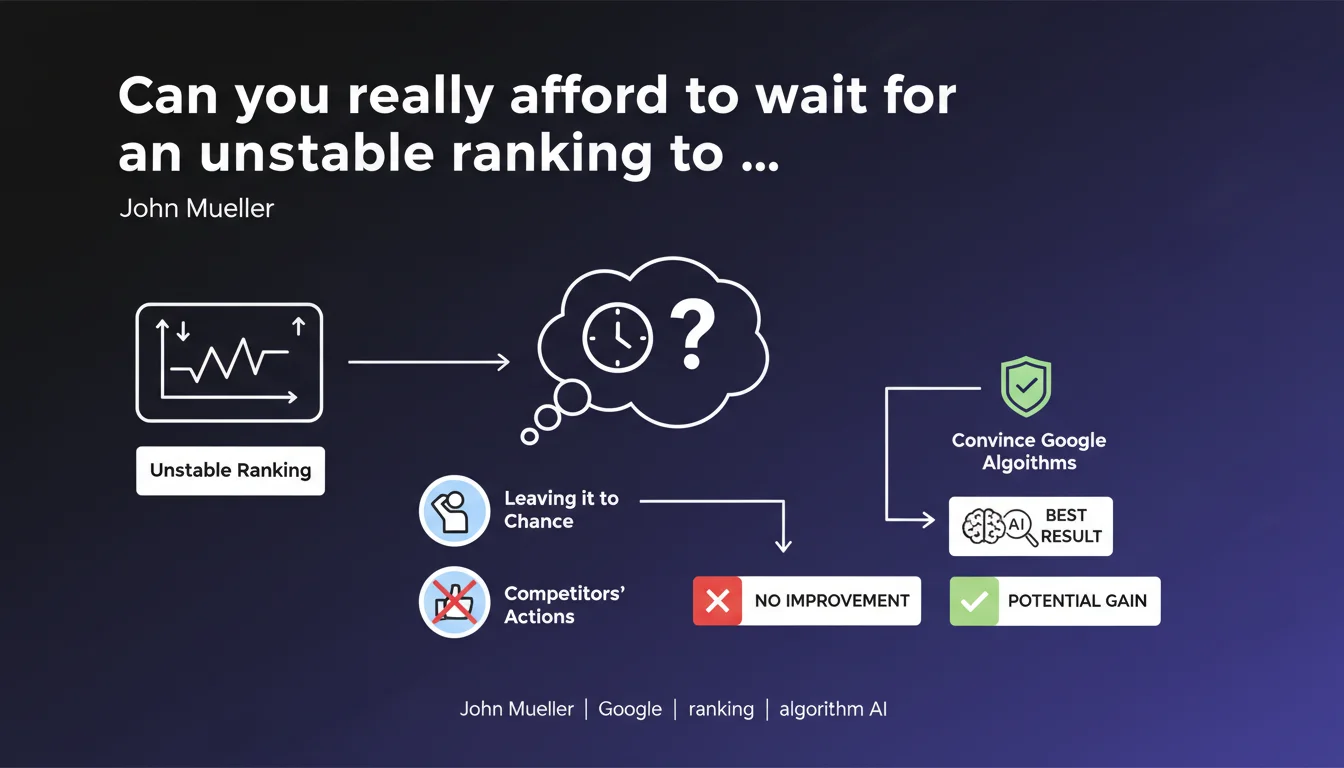
Google won't reward your patience in the face of ranking fluctuations. If you don't act proactively to prove to the algorithms that your site deserves its position, you're leaving the door wide open for your competitors. Inaction is equivalent to falling behind.
What you need to understand
Why does Google insist on the "proactive" dimension of SEO?
Because algorithms don't re-evaluate your site out of charity. They're constantly looking to refine their results based on fresh signals — updated content, new links, evolving topical authority, engagement signals.
If your site stagnates while your competitors move forward, Google has no objective reason to give you back ground. Waiting amounts to letting others play alone — and they won't do you any favors.
What does "convincing the algorithms" mean in concrete terms?
Google doesn't operate on the basis of promises or glorious history. Algorithms constantly evaluate comparative relevance: is your page still the best answer to the search intent, compared to available alternatives?
Convincing means producing tangible proof — content enrichment, improved user experience, reinforced authority signals, editorial freshness. No declarations of intent: measurable facts.
What's the real margin of maneuver against organic fluctuations?
This is where it gets interesting. Google claims you can "convince" its algorithms, but it never specifies which levers work for sure. Some fluctuations are due to algo adjustments you can't control.
However, one thing is clear: doing nothing guarantees you'll be swept along. Acting at least gives you a chance to influence the outcome. The question remains: what exactly should you do? — and there, Google deliberately stays vague.
- Algorithms don't automatically stabilize fluctuating rankings — inaction solves nothing.
- You're in permanent competition, even if you stand still, your competitors are moving forward.
- "Convincing" requires concrete signals: freshness, increased authority, greater relevance.
- Google doesn't provide a magic formula — you have to test, measure, adjust based on your context.
SEO Expert opinion
Is this statement consistent with what we observe in the field?
Yes, and that's even an understatement. Sites that stagnate almost always lose ground in the medium term — because their competitors don't stagnate. Search is a zero-sum game: if you're not moving forward, you're mechanically falling back.
However, saying that you just need to "convince the algorithms" is marketing oversimplification. Some signals carry more weight than others — but Google will never say which ones. And some fluctuations completely escape your control, especially during Core Updates.
What nuances should be added to this statement?
First nuance: not all fluctuations are created equal. If your site oscillates 2-3 positions, that's often statistical noise — frantic action can do more harm than good. If you lose 20 positions at once, then yes, you need to investigate.
Second nuance: "being clearly the best result" is a fuzzy notion. Best according to what criteria? Domain authority? Content freshness? Depth of coverage? User experience? Google mixes all of this in a black box that we can only interpret. [To verify]: no official document details how to "prove" you're the best.
Third nuance: sometimes the problem isn't with you. Google can favor a new type of content (videos, forums, featured snippets) and your classic format mechanically loses ground. In this case, "convincing" might mean changing your format — not just optimizing what exists.
In what cases does this rule not apply directly?
When your fluctuations are linked to external uncontrollable factors: seasonality, evolution of search intent, SERP display changes (BERT, MUM, SGE). You can optimize all you want, if Google decides your type of content no longer matches the majority intent, you'll fall back.
Another case: very new or low-authority sites. You can publish the world's best content, but if you have no authority signals (links, mentions, history), Google won't necessarily rank you — it tests first, then validates. There, "convincing" takes time, no matter what you do.
Practical impact and recommendations
What should you do concretely when facing ranking fluctuations?
First, qualify the fluctuation. Is it a one-off movement (2-3 days), an established trend (2-3 weeks), or a sudden drop post-update? The answer determines the action.
If it's one-off, monitor without panicking. If it's a trend, audit your competitors: what did they do that you didn't? New content, fresh links, UX overhaul? If it's post-update, cross-reference with community feedback — maybe Google adjusted its criteria for authority or relevance.
Next, identify the main lever to activate. Content freshness? Depth of coverage? Popularity signals? User experience? Don't pull all the levers at once — you won't know what worked.
What mistakes should you absolutely avoid?
Don't over-optimize out of panic. Stuffing your pages with keywords, multiplying low-quality backlinks, radically changing your structure — all of this can make the situation worse. Google detects sudden movements and may interpret them as manipulation.
Also avoid betting everything on a single signal. If you think "more content = better ranking" and you bloat your pages without adding real value, you're wasting your time. Google evaluates overall relevance, not raw length.
Finally, don't neglect technical signals. A slow site, indexation errors, misconfigured tags — all of this handicaps your editorial efforts. If the infrastructure is shaky, the world's best content won't compensate.
How do you measure the effectiveness of your actions?
Define specific indicators before you act: average positions on a cluster of target keywords, segmented organic traffic, SERP click-through rates, time on page. Compare before/after over a sufficiently long period (at least 4-6 weeks).
Use control groups if possible: test your modifications on part of your site before deploying everywhere. This limits risk and validates your hypothesis.
And most importantly, document everything. Note what you did, when, and what happened next. This will prevent you from repeating mistakes and give you a basis for refining your strategy.
- Qualify the nature of the fluctuation — one-off, trend-based, or post-update?
- Audit your competitors — which signals have they recently reinforced?
- Prioritize a clear action lever — freshness, depth, authority, UX?
- Avoid panic-driven over-optimization — Google detects suspicious movements.
- Control technical fundamentals — speed, indexation, structure.
- Measure impact on specific indicators — positions, traffic, engagement.
- Test before large-scale deployment — minimize risk.
- Document every action and its result — build a knowledge base.
When facing fluctuations, inaction is your worst enemy. But acting intelligently requires diagnosis, method, and perspective — three things that often go missing when you're under operational pressure.
If you lack the time or expertise to conduct these analyses rigorously, specialized SEO support can significantly accelerate the process. An experienced agency has the tools, benchmarks, and perspective needed to quickly qualify movements, identify priority levers, and pilot tests without over-optimization risk. Sometimes, delegating this technical part allows you to focus on what you do best — and recover peace of mind in the face of SERP's whims.
❓ Frequently Asked Questions
Combien de temps faut-il attendre avant d'agir sur une fluctuation de classement ?
Peut-on vraiment 'convaincre' les algorithmes de Google ou est-ce du marketing ?
Quels signaux pèsent le plus lourd pour stabiliser un classement ?
Est-il dangereux de modifier trop de choses en même temps sur un site qui fluctue ?
Les fluctuations peuvent-elles se résoudre d'elles-mêmes sans intervention ?
🎥 From the same video 22
Other SEO insights extracted from this same Google Search Central video · published on 28/03/2022
🎥 Watch the full video on YouTube →
💬 Comments (0)
Be the first to comment.