
Official statement
Other statements from this video 22 ▾
- □ Pourquoi la position moyenne de Search Console ne reflète-t-elle pas un classement théorique mais des affichages réels ?
- □ Peut-on encore se permettre d'attendre qu'un classement instable se stabilise tout seul ?
- □ Faut-il vraiment produire plus de contenu pour améliorer son SEO ?
- □ Où placer son sitemap XML pour optimiser son crawl ?
- □ Faut-il vraiment utiliser l'outil d'inspection d'URL pour indexer un nouveau site ?
- □ Combien de temps faut-il attendre pour voir les backlinks dans Search Console ?
- □ Search Console collecte-t-elle vraiment toutes les données sur les gros sites e-commerce ?
- □ Faut-il vraiment préférer noindex à disallow pour contrôler l'indexation ?
- □ Les produits en rupture de stock peuvent-ils vraiment être traités comme des soft 404 par Google ?
- □ Les outils de test Google crawlent-ils vraiment en temps réel ou utilisent-ils un cache ?
- □ Google utilise-t-il des algorithmes différents selon votre secteur d'activité ?
- □ Pourquoi Google ignore-t-il les sites agrégateurs de faible effort ?
- □ Google compte-t-il vraiment les clics sur les rich results comme des clics organiques ?
- □ L'ordre des liens dans le HTML influence-t-il vraiment la priorité de crawl de Google ?
- □ Faut-il vraiment éviter les URLs avec paramètres pour le SEO ?
- □ Pourquoi robots.txt bloque le crawl mais n'empêche pas l'indexation de vos pages ?
- □ Les produits en rupture de stock nuisent-ils au classement global de votre site e-commerce ?
- □ Le contenu dupliqué partiel pénalise-t-il vraiment vos pages ?
- □ Pourquoi Google refuse-t-il d'indexer plusieurs versions d'une même page malgré une canonicalisation correcte ?
- □ Comment Google choisit-il réellement quelle URL canoniser parmi vos contenus dupliqués ?
- □ Les mentions de marque sans lien ont-elles une valeur SEO ?
- □ Pourquoi un lien sans URL indexée ne sert strictement à rien ?
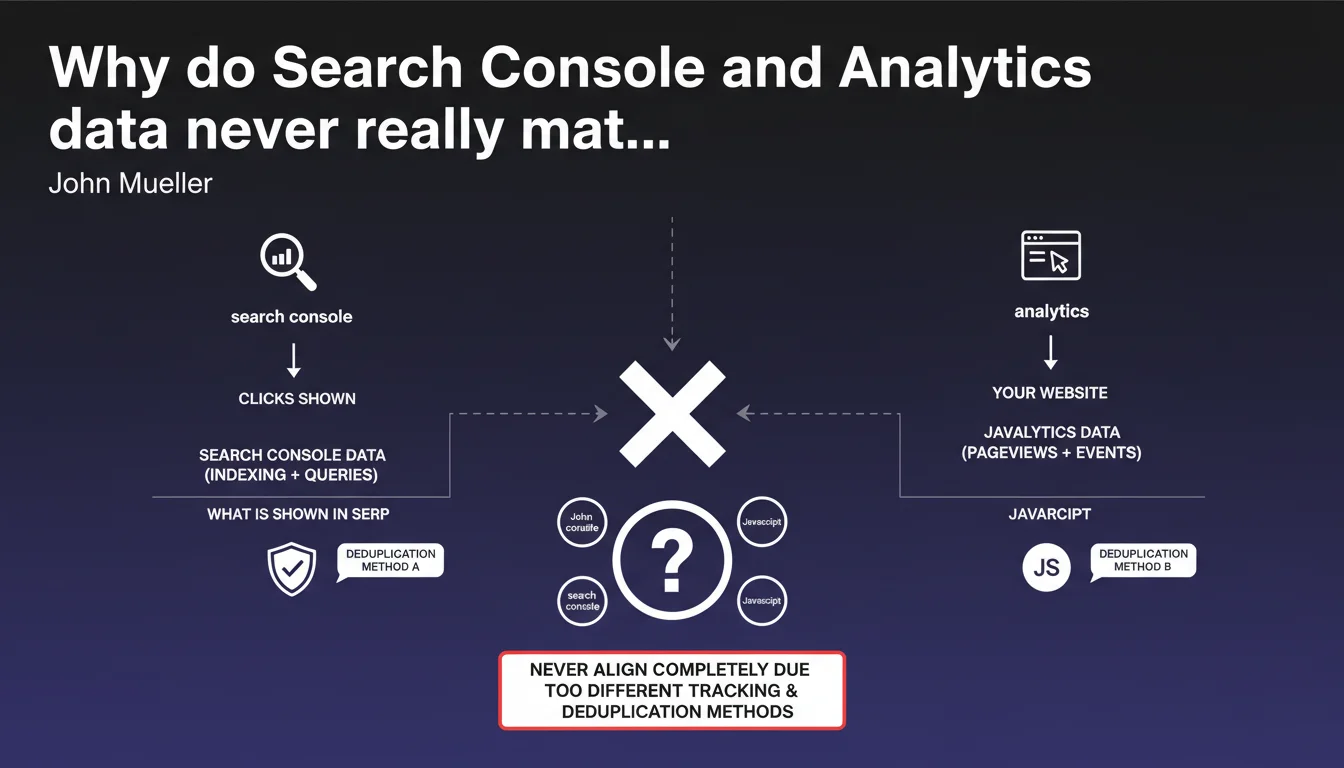
Search Console and Analytics measure two different realities: one captures what appears in search results, the other tracks what actually happens on your site via JavaScript. Deduplication methods diverge between these tools, making perfect alignment impossible. Accepting this gap allows you to leverage each tool for what it does best.
What you need to understand
What is the fundamental difference between these two tools?
Search Console records impressions and clicks as they appear in the SERPs. This is a count on Google's side, before the user even reaches your site. If your page displays in position 3 and a user clicks, Search Console knows it immediately.
Analytics, on the other hand, triggers once the browser loads your page and executes the tracking JavaScript code. If the JS doesn't load, if the user leaves before execution, or if an ad blocker intervenes — no data is recorded. This is a client-side count, after landing.
Why do we talk about different deduplication methods?
Each tool applies its own rules to avoid counting the same action multiple times. Search Console deduplicates impressions according to Google's own criteria — for example, if a user scrolls through results and sees your page twice, it may only count one impression.
Analytics deduplicates differently: it relies on user sessions, cookies, client identifiers. If a visitor returns after 30 minutes of inactivity, that's a new session. These logics don't overlap.
What are the practical consequences of this divergence?
You will always have a gap between the number of Search Console clicks and the number of organic Analytics sessions. This gap is not an error — it's structural. Trying to make these numbers match is a waste of time.
What matters is knowing when to use which data. Search Console for diagnosing SERP visibility and indexing issues. Analytics for analyzing user behavior once on site.
- Search Console measures impressions and clicks on Google's side, before landing on the site
- Analytics tracks events on the browser side, after JavaScript loads
- Deduplication methods diverge between the two tools, making perfect correspondence impossible
- A systematic gap between SC clicks and GA sessions is normal and expected
- Each tool has its own domain of relevance — don't try to artificially merge them
SEO Expert opinion
Does Google's explanation on this really hold up?
Yes, and it's actually one of Mueller's most honest statements on the subject. For years, SEOs have tried to reconcile this data with improbable pivot tables. Google admits here that it's futile.
The real problem isn't technical — it's methodological. Many non-technical clients or managers demand that "the numbers add up." This statement provides an official answer to present: no, they never will add up, and that's normal.
What nuances should be added to this statement?
Mueller doesn't mention cases where the gap becomes abnormally large. If you observe 10,000 SC clicks and 2,000 organic GA sessions, that's no longer a deduplication issue — it's probably a tracking problem. [Verify] systematically if the gap exceeds 30-40%.
Another point: AMP, rich results, carousels. In certain formats, Search Console counts an impression even if the user never reaches your main domain. Analytics sees nothing. These cases create structural divergences that Mueller doesn't detail.
In what contexts does this rule not apply fully?
On sites with very low traffic (a few dozen sessions per day), the gap should be minimal. If it's not, that's a red flag. Deduplication divergences mostly show up at high volume.
Next, sites where JavaScript is disabled or blocked massively (certain B2B corporate audiences with strict firewalls) will see a huge gap between SC and GA. But again, this isn't deduplication at fault — it's the complete absence of tracking.
Practical impact and recommendations
What should you do concretely to manage this gap?
First, document the average gap between your Search Console clicks and your Analytics organic sessions over 3 months. Establish a baseline. If you're typically at +25% SC clicks versus GA sessions, that's your normal.
Next, alert if this gap suddenly changes. A sudden shift from +25% to +60% signals a tracking problem, not a deduplication fluctuation. Automate this alert in your dashboards.
What errors should you avoid in interpreting this data?
Never use Search Console to calculate a conversion rate. You can't divide Analytics conversions by Search Console clicks — the measured populations aren't the same. This is a common mistake that skews reporting.
Also avoid comparing Analytics page views to Search Console impressions. A SERP impression doesn't equal a page view — the user may click, go back, and generate only one page view for multiple recorded clicks. These metrics aren't comparable.
How do I verify that my tracking is working correctly?
Test manually: perform an organic search, click your result, and verify in real-time in Analytics (Real-Time report) that the session is recorded. If not, your tracking JS has an issue.
Use Google Tag Assistant or tools like GTM Preview to confirm that the Analytics tag fires on page load. Also verify that your CMP doesn't block tracking before consent if you're in Europe.
- Establish a baseline of normal gap between SC clicks and GA sessions over a 3-month rolling period
- Set up automatic alerts if the gap exceeds 40% or varies sharply
- Never mix Search Console and Analytics metrics in the same calculation (conversion rate, ROI, etc.)
- Regularly test tracking in real conditions (organic search → click → real-time verification)
- Audit Analytics JavaScript loading with Tag Assistant or GTM Preview
- Verify that the CMP doesn't block tracking before consent
❓ Frequently Asked Questions
Quel écart entre Search Console et Analytics est considéré comme normal ?
Puis-je utiliser Search Console pour calculer le taux de conversion de mon trafic organique ?
Pourquoi Analytics affiche-t-il parfois plus de sessions organiques que Search Console de clics ?
Les bloqueurs de publicité affectent-ils ces écarts ?
Faut-il privilégier les données Search Console ou Analytics pour mesurer la performance SEO ?
🎥 From the same video 22
Other SEO insights extracted from this same Google Search Central video · published on 28/03/2022
🎥 Watch the full video on YouTube →
💬 Comments (0)
Be the first to comment.