
Official statement
What you need to understand
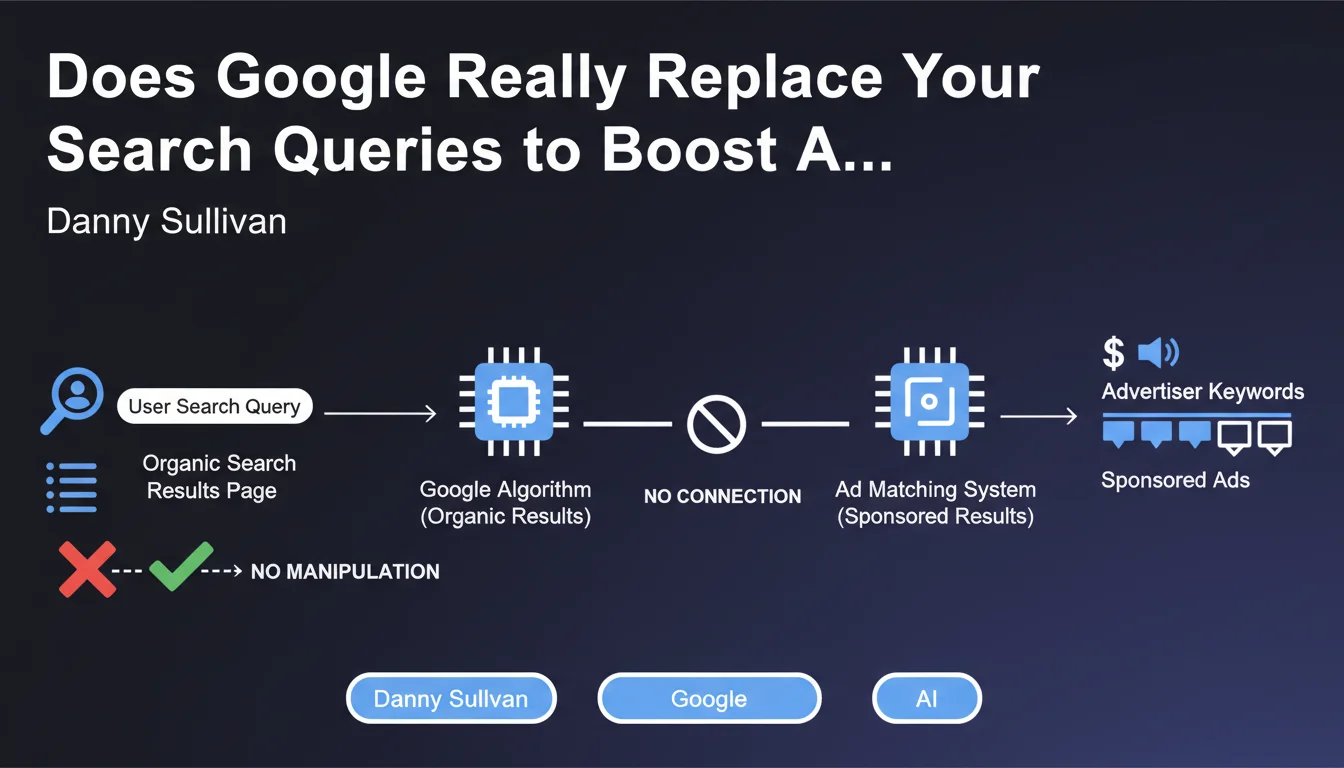
Google has firmly denied accusations that it modifies user queries to display commercially more profitable results. This clarification follows a controversial article suggesting manipulation of searches for financial purposes.
The company insists on a clear separation: organic results and paid advertisements operate through completely distinct systems. Ad matching with keywords is a well-known and long-documented process, with no influence on natural rankings.
Google also emphasizes that its search engine goes beyond the literal words of a query to understand the actual intent. This semantic interpretation aims to display more relevant results, even if the query is reformulated or imprecise.
- Organic results are not influenced by advertising systems
- Ad/keyword matching is a separate and transparent process
- Query interpretation serves relevance, not monetization
- This defense comes amid growing skepticism from the SEO community
SEO Expert opinion
This statement is part of Google's defensive communication strategy in response to recurring criticism. While the technical separation between organic results and advertising is likely real at the architectural level, the reality is more nuanced in practice.
Google's interpretation of queries is indeed documented and generally useful for users. However, some professionals observe that this "understanding" sometimes leads to displaying results for queries with strong commercial intent, even when the user was seeking neutral information.
For SEO practitioners, the question is not so much whether Google is "lying" but rather understanding how to optimize for a search engine that increasingly interprets queries rather than treating them literally.
Practical impact and recommendations
- Optimize for search intent, not just exact keywords: Google interprets queries semantically
- Diversify your semantic coverage by creating content for different formulations of the same intent
- Analyze actual SERPs for your target keywords: observe how Google interprets queries and what types of content it favors
- Don't neglect long-tail variations where Google's interpretation can work in your favor
- Monitor SERP evolution: advertising space is increasing, adapt your visibility strategy accordingly
- Invest in quality content that precisely answers user questions, regardless of their formulation
- Test different formulations in your title tags and meta descriptions to match various possible interpretations
Whether or not Google intentionally replaces queries, the observation remains the same: the search engine increasingly interprets searches instead of treating them literally. This evolution requires an SEO approach focused on user intent and semantic richness.
The growing complexity of algorithms and the constant evolution of SERPs make optimization increasingly technical. Faced with these multiple challenges – understanding intent, adapting to new features, continuous performance monitoring – many businesses choose to rely on the expertise of a specialized SEO agency to develop a personalized and sustainable strategy, perfectly aligned with these new realities of organic search.
💬 Comments (0)
Be the first to comment.