
Official statement
Other statements from this video 22 ▾
- □ Why doesn't Google Search Console's average position reflect a theoretical ranking but actual display results instead?
- □ Can you really afford to wait for an unstable ranking to stabilize on its own?
- □ Does boosting your SEO really require producing more content?
- □ Does the location of your XML sitemap really affect crawl efficiency?
- □ How long does it really take to see your new backlinks in Google Search Console?
- □ Why do Search Console and Analytics data never really match up?
- □ Is Google Search Console really collecting all the data from your massive e-commerce site?
- □ Should you really prefer noindex over disallow to control indexation in Google?
- □ Can out-of-stock product pages really trigger soft 404 errors in Google's eyes?
- □ Do Google's testing tools really crawl in real-time or do they rely on cached data?
- □ Does Google really use different ranking algorithms depending on your industry?
- □ Why does Google deprioritize crawling low-effort aggregator sites?
- □ Does Google really count clicks on rich results the same way as organic clicks?
- □ Does the order of links in your HTML code really affect Google's crawl priority?
- □ Should you really avoid URLs with parameters for SEO?
- □ Why does robots.txt prevent Google from crawling your pages but still allow them to be indexed?
- □ Are out-of-stock products hurting your e-commerce site's overall search rankings?
- □ Does partial duplicate content really hurt your search rankings?
- □ Does Google really ignore your canonical tags when it decides pages are too similar?
- □ Does Google really use just one signal to choose which URL to canonicalize among your duplicate content?
- □ Do brand mentions without backlinks actually help your SEO rankings?
- □ Why does a link without an indexed URL essentially do nothing for your SEO?
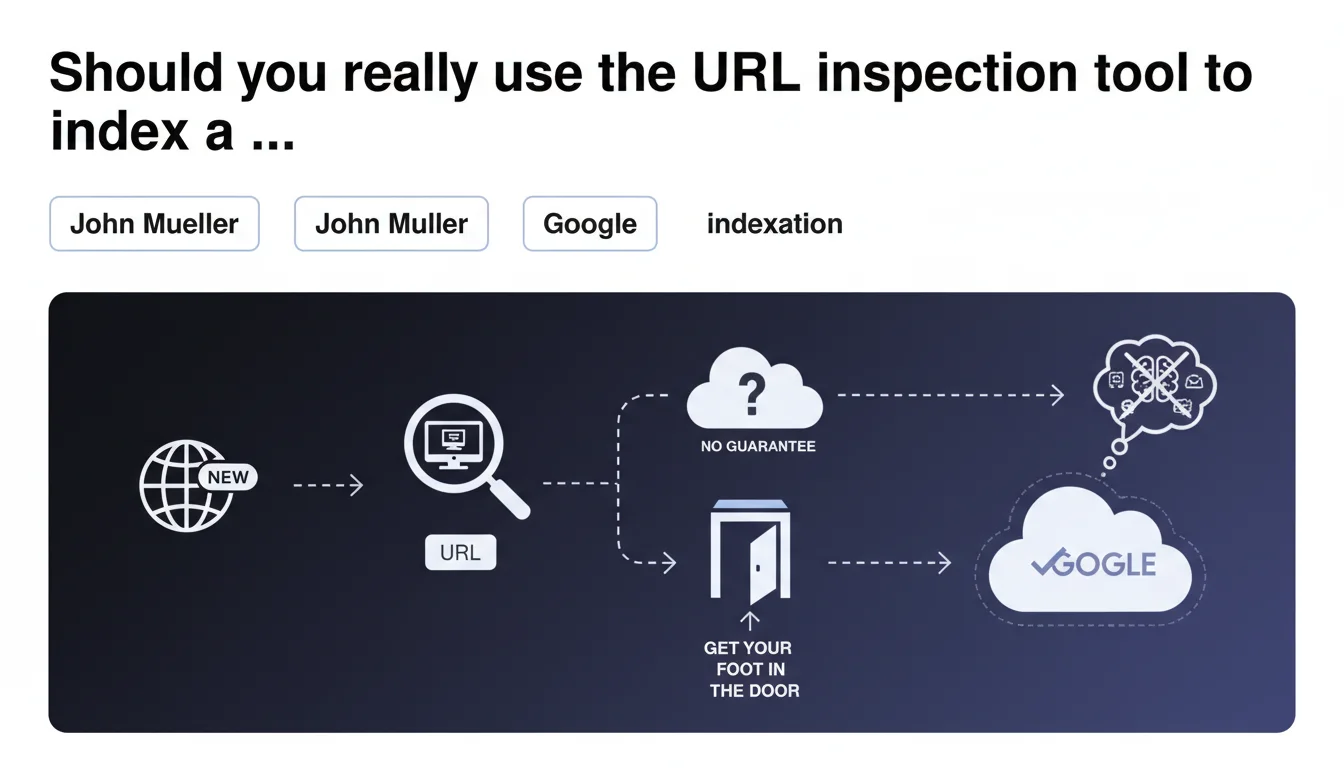
John Mueller confirms that the URL inspection tool (Search Console) can help a new site with no track record get its first Googlebot crawl, but with zero guarantee of indexation. It's one signal among many, not a magic wand. For an already established site with natural signals (backlinks, traffic), this tool adds nothing extra.
What you need to understand
What counts as a "signal" in Google's eyes?
Google uses the term signals to describe any indicator that helps it evaluate a site's relevance, authority, and freshness. In practical terms: external backlinks, domain age, organic traffic volume, brand mentions, indexation history.
A brand new site (recent domain, zero backlinks, no organic visits) has none of these markers. Google doesn't know if it's a serious project or spam thrown together in 10 minutes. That's where the inspection tool can serve as initial contact—but only as initial contact.
Why talk about "getting your foot in the door" rather than guaranteed indexation?
Mueller's wording is deliberately cautious. Requesting indexation via the inspection tool sends a priority request to Googlebot, which will indeed crawl the submitted URL. But crawl ≠ index.
Google can easily visit the page, see that it answers no useful query (thin content, duplicate, ultra-competitive niche with no differentiation), and decide not to add it to the index. "Getting your foot in the door" just means being on the radar—not a promise of results.
What are the key takeaways?
- The inspection tool isn't a magic button: it triggers a crawl, but indexation depends on content quality and site signals.
- Only useful for new sites: if your domain already has backlinks or a history, Google crawls naturally—the tool becomes pointless.
- No unlimited quota: Google limits the number of indexation requests per day and per Search Console property. Use it sparingly.
- Doesn't replace an XML sitemap: the sitemap remains the standard method to signal your URLs to Google. The inspection tool is a one-off supplement, not a strategy.
SEO Expert opinion
Does this statement align with what we see in practice?
Yes, completely. We regularly observe that new sites (fresh domains, zero backlinks) can wait several weeks before their first natural crawl, even with a properly configured sitemap. The inspection tool speeds up that first contact—often within 24-48 hours.
But here's the catch: accelerating the crawl doesn't change the indexation criteria. If your content is weak, duplicate, or poorly structured, Google will visit it and reject it anyway. [To be verified]: Google never communicates a precise threshold for what defines a "new site without signals"—is it 0 backlinks? Fewer than 10? A domain less than 3 months old? The usual vagueness.
What nuances should we add?
First point: the inspection tool is completely useless for an established site. If you already have organic traffic, backlinks, and regular crawls, submitting URLs manually via this tool is pointless—Google will discover them through the sitemap or internal links.
Second nuance: Mueller talks about "getting your foot in the door," but doesn't specify what happens next. If Google indexes your page, then finds it generates zero clicks and zero engagement, it can drop from the index after a few weeks. Indexation is never permanent—it's a revocable status.
When does this rule not apply?
If you launch a new site on an expired domain you purchased with a backlink history, you're no longer in the "new site without signals" category. Google already has data (even if old) and will crawl naturally—the inspection tool becomes superfluous.
Another case: e-commerce sites with thousands of product pages. Submitting each product sheet manually via the inspection tool is impractical and counterproductive. Better to optimize your XML sitemap and internal link structure so Google discovers priority URLs on its own.
Practical impact and recommendations
What should you actually do when launching a new site?
Start with the fundamentals: clean XML sitemap, submitted in Search Console, containing only indexable URLs (no redirects, no 404s, no canonicals pointing elsewhere). That's the foundation—the inspection tool comes after, not before.
Next, if your site is truly new (recent domain, zero backlinks), use the inspection tool to manually submit your 5-10 most strategic pages: homepage, main category pages, pillar content. No need to submit 200 URLs—you're limited on daily quota anyway.
What mistakes must you absolutely avoid?
- Never submit URLs with thin, duplicate, or auto-generated content—you risk triggering a spam signal on the very first crawl.
- Don't use the inspection tool as a substitute for an XML sitemap: Google crawls the sitemap regularly and automatically; the inspection tool stays ad-hoc.
- Don't loop-submit the same URLs hoping to force indexation—if Google refuses to index after a first crawl, there's a quality or relevance problem.
- Avoid submitting technical pages (legal notices, terms, contact): they have zero SEO value and waste your inspection quota.
How do you verify your site is being crawled and indexed?
Use the coverage report in Search Console to identify URLs discovered but not indexed. If Google refuses to index certain pages despite submission, check the exact reasons (duplicate content, low quality, robots.txt blocking, etc.).
Supplement this with server log analysis: it shows you if Googlebot actually visits your pages and how often. If crawl activity is minimal after 2-3 weeks, it's a signal your site lacks external signals (backlinks, mentions, traffic). In that case, focus on acquiring natural links rather than spamming the inspection tool.
❓ Frequently Asked Questions
L'outil d'inspection d'URL peut-il forcer l'indexation d'une page ?
Combien d'URLs peut-on soumettre par jour via l'outil d'inspection ?
Faut-il utiliser l'outil d'inspection pour chaque nouvelle page publiée ?
Que faire si Google refuse d'indexer une page malgré sa soumission ?
L'outil d'inspection améliore-t-il le crawl budget ?
🎥 From the same video 22
Other SEO insights extracted from this same Google Search Central video · published on 28/03/2022
🎥 Watch the full video on YouTube →
💬 Comments (0)
Be the first to comment.