
Official statement
Other statements from this video 22 ▾
- □ Why doesn't Google Search Console's average position reflect a theoretical ranking but actual display results instead?
- □ Can you really afford to wait for an unstable ranking to stabilize on its own?
- □ Does boosting your SEO really require producing more content?
- □ Does the location of your XML sitemap really affect crawl efficiency?
- □ Should you really use the URL inspection tool to index a brand new website?
- □ How long does it really take to see your new backlinks in Google Search Console?
- □ Why do Search Console and Analytics data never really match up?
- □ Is Google Search Console really collecting all the data from your massive e-commerce site?
- □ Should you really prefer noindex over disallow to control indexation in Google?
- □ Can out-of-stock product pages really trigger soft 404 errors in Google's eyes?
- □ Do Google's testing tools really crawl in real-time or do they rely on cached data?
- □ Does Google really use different ranking algorithms depending on your industry?
- □ Why does Google deprioritize crawling low-effort aggregator sites?
- □ Does Google really count clicks on rich results the same way as organic clicks?
- □ Does the order of links in your HTML code really affect Google's crawl priority?
- □ Should you really avoid URLs with parameters for SEO?
- □ Why does robots.txt prevent Google from crawling your pages but still allow them to be indexed?
- □ Are out-of-stock products hurting your e-commerce site's overall search rankings?
- □ Does Google really ignore your canonical tags when it decides pages are too similar?
- □ Does Google really use just one signal to choose which URL to canonicalize among your duplicate content?
- □ Do brand mentions without backlinks actually help your SEO rankings?
- □ Why does a link without an indexed URL essentially do nothing for your SEO?
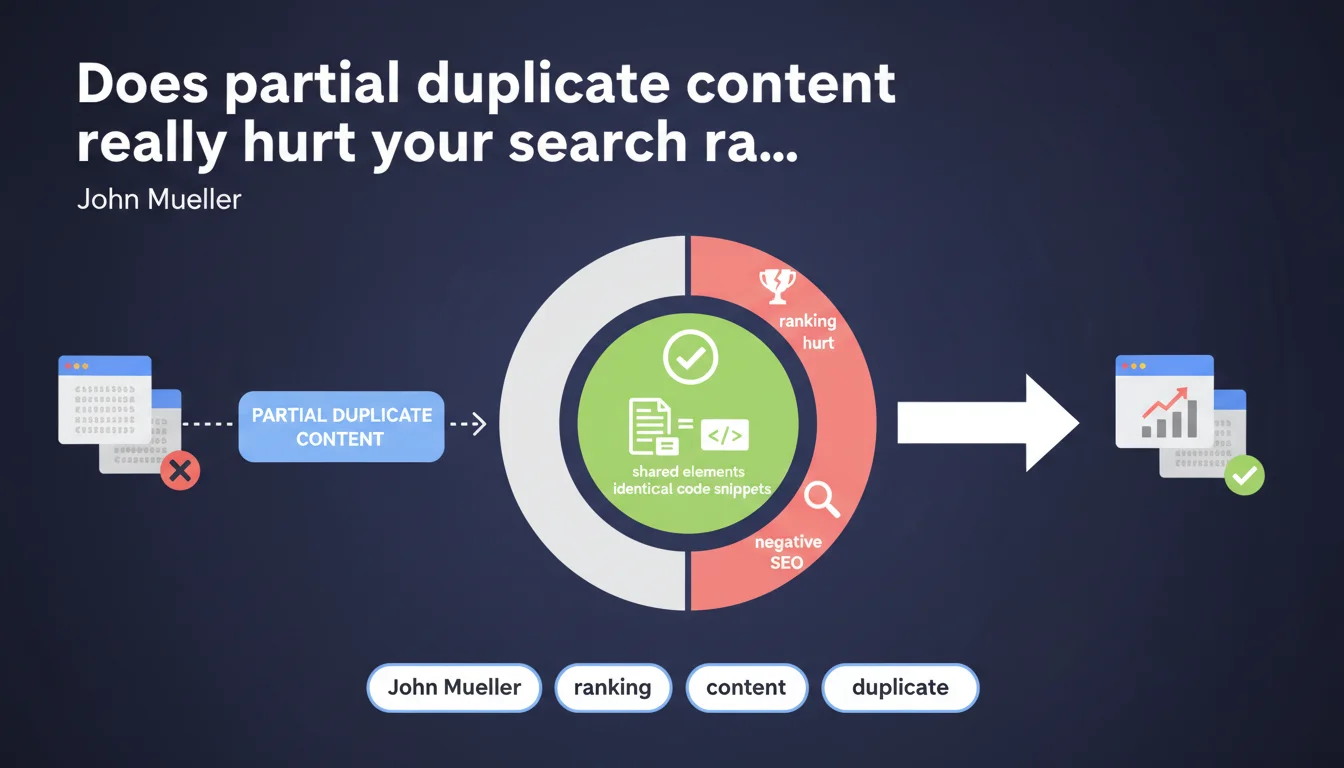
Google confirms that partial content duplication on a page is not penalizing. Recurring elements like code snippets, citations, or shared structural elements between similar pages are perfectly acceptable according to John Mueller.
What you need to understand
What exactly does "partial duplicate content" mean in this statement?
Mueller is talking here about identical portions of content present on multiple pages of the same site or between different sites. Concretely: blocks of code, recurring definitions, comparative data tables, standardized legal notices.
The nuance is important — we're not talking about entirely duplicate pages, but rather structural or informational elements that naturally repeat themselves. Google admits that this repetition is part of the editorial logic of certain technical or vertical content.
Why does Google tolerate this partial duplication?
Because the algorithm is supposed to distinguish between manipulative duplication and functional duplication. A Python code snippet explaining the same function across 10 different tutorials has no reason to be penalized if the rest of the content brings differentiated value.
Google seeks to identify editorial intent. If the repetition serves the user — product comparisons, technical documentation, practical examples — it's not considered spam. This is the logic behind this tolerance.
- Partial duplication (recurring blocks) is tolerated if it has editorial sense
- Total or near-total duplication remains problematic for ranking
- Google evaluates the global context of the page, not just the presence of identical segments
- Technical elements (code, formulas, data) benefit from particular tolerance
SEO Expert opinion
Is this statement consistent with what we observe in the field?
Yes and no. In practice, many sites with massive recurring blocks — product sheets with generic descriptions, category pages with standardized intros — don't experience any visible penalty. But let's be nuanced: some ultra-competitive sectors see their pages cannibalized or deindexed despite "acceptable" duplication according to this logic.
The problem is that Mueller provides no quantitative threshold. 10% partial duplication? 30%? 50%? Impossible to know where Google draws the line. [To verify]: does this tolerance apply uniformly across all sectors or is Google stricter on saturated niches (finance, health, e-commerce)?
What are the gray areas Google avoids addressing?
Mueller doesn't discuss automatically generated technical pages — think real estate sites with 5000 city cards following the same template. Technically, it's partial duplication. In practice, Google tolerates it… up to a certain point that remains unclear.
Another blind spot: cross-domain duplication. If you republish the same code snippet on your blog and Medium, is that equally "acceptable"? The statement doesn't clarify this. Experience shows Google often favors the original source, but not systematically.
Practical impact and recommendations
What should you concretely do with your recurring content?
Auditing the proportion of unique content remains the priority. Even if Google tolerates shared blocks, a page with 70% duplicate content and 30% unique will always carry less weight than a page with 80% unique. Use tools like Copyscape or Siteliner to measure similarity rates.
For technical elements — code, formulas, definitions — no need to panic. But add differentiated context around them: specific use cases, complementary explanations, implementation variations. It's this context that tips the page toward "added value".
What mistakes should you absolutely avoid?
Don't hide behind this statement to justify lazy pages. "Google says it's OK" doesn't compensate for content that brings nothing new. If your 20 regional pages follow the same pattern with just the city name changing, you're in the red zone — partial duplication or not.
Also avoid duplicating critical SEO elements: title, meta description, H1, first paragraph. These zones have disproportionate weight in relevance assessment. Even if the body text shares segments, these elements must be unique.
- Measure the ratio of unique content to shared content on your strategic pages
- Identify legitimate recurring blocks (code, data, citations) versus lazy duplications
- Systematically enrich the context around shared elements
- Guarantee uniqueness in high-impact SEO zones (title, H1, intro, meta)
- Monitor performance of pages with partial duplication: position loss = warning signal
- Test the impact of progressive rewriting of shared blocks on test pages
❓ Frequently Asked Questions
Un snippet de code identique sur 50 pages techniques peut-il pénaliser mon site ?
Quel pourcentage de duplication partielle est acceptable ?
La duplication partielle cross-domaine est-elle tolérée de la même manière ?
Dois-je utiliser rel=canonical sur des pages avec duplication partielle ?
Les pages avec blocs récurrents sont-elles moins bien classées ?
🎥 From the same video 22
Other SEO insights extracted from this same Google Search Central video · published on 28/03/2022
🎥 Watch the full video on YouTube →
💬 Comments (0)
Be the first to comment.