
Official statement
Other statements from this video 22 ▾
- □ Can you really afford to wait for an unstable ranking to stabilize on its own?
- □ Does boosting your SEO really require producing more content?
- □ Does the location of your XML sitemap really affect crawl efficiency?
- □ Should you really use the URL inspection tool to index a brand new website?
- □ How long does it really take to see your new backlinks in Google Search Console?
- □ Why do Search Console and Analytics data never really match up?
- □ Is Google Search Console really collecting all the data from your massive e-commerce site?
- □ Should you really prefer noindex over disallow to control indexation in Google?
- □ Can out-of-stock product pages really trigger soft 404 errors in Google's eyes?
- □ Do Google's testing tools really crawl in real-time or do they rely on cached data?
- □ Does Google really use different ranking algorithms depending on your industry?
- □ Why does Google deprioritize crawling low-effort aggregator sites?
- □ Does Google really count clicks on rich results the same way as organic clicks?
- □ Does the order of links in your HTML code really affect Google's crawl priority?
- □ Should you really avoid URLs with parameters for SEO?
- □ Why does robots.txt prevent Google from crawling your pages but still allow them to be indexed?
- □ Are out-of-stock products hurting your e-commerce site's overall search rankings?
- □ Does partial duplicate content really hurt your search rankings?
- □ Does Google really ignore your canonical tags when it decides pages are too similar?
- □ Does Google really use just one signal to choose which URL to canonicalize among your duplicate content?
- □ Do brand mentions without backlinks actually help your SEO rankings?
- □ Why does a link without an indexed URL essentially do nothing for your SEO?
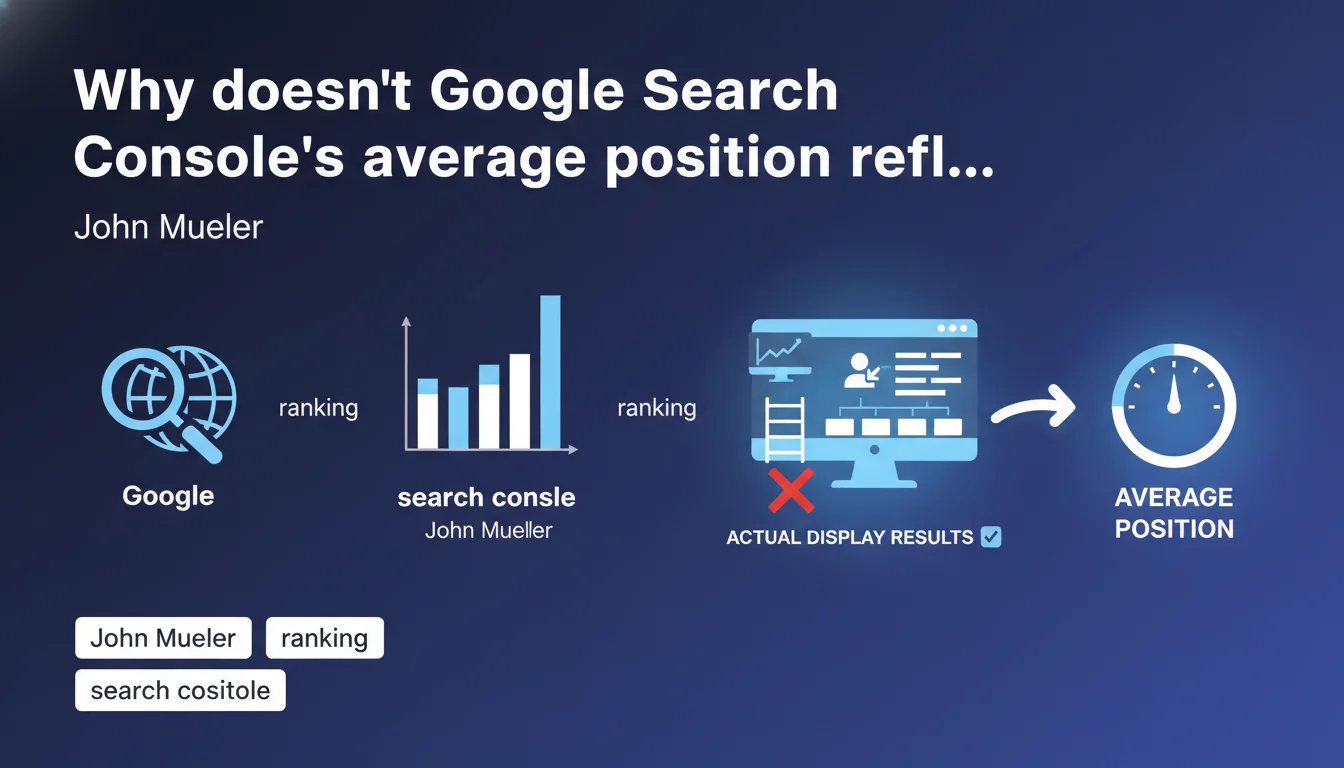
The average position in Search Console corresponds to positions actually displayed to users, not a theoretical or hypothetical ranking. Google doesn't calculate an average position based on all possible results, but only on what was concretely shown during actual searches.
What you need to understand
What's the difference between displayed position and theoretical ranking?
When Google talks about displayed position, it refers to what actually appears in the SERPs at the moment of a user query. Theoretical ranking would be a position calculated independently of the search context — location, personalization, history, device used.
This distinction changes everything. Your average position isn't absolute data, but the average of positions in highly varied contexts. The same result can appear 3rd in Paris and 8th in Lyon, producing an average of 5.5 when there's no actual display at that position.
How does Google actually calculate this average position?
Google aggregates only the positions of actual impressions. If your page appears 100 times in position 4 and 50 times in position 7, the average will be (100×4 + 50×7) / 150 = 5. Mathematically simple, but tactically complex to interpret.
The trap? This average hides enormous variations depending on audience segments, device types, or geographic areas. An average position of 6 can hide a position 2 on mobile and 12 on desktop — two radically different SEO realities.
Why is Mueller's precision so important?
Because too many SEOs still treat average position as an absolute score, comparable from one site to another. That's wrong. Two sites with identical average positions can have completely different distributions.
Mueller cuts short the idea that there would be a "true" ranking in Google's index, independent of user context. This ranking doesn't exist. There are only contextualized displays, and Search Console gives you the average of these displays.
- Average position = average of positions actually displayed, not a fixed ranking in the index
- Contextual variations (location, personalization, device) directly impact this metric
- The same URL can have very different positions depending on search context
- Comparing average positions between sites only makes sense if audience contexts are comparable
- This metric reflects the reality experienced by your users, not theoretical performance
SEO Expert opinion
Does this statement contradict common analysis practices?
Yes, and it's a problem. Many SEO tools and dashboards treat average position as a stable and absolute KPI. We set typical goals like "achieve an average position of 3" without questioning what it really means.
Mueller's statement sets the record straight: this metric is a statistical average of contextualized events, not a fixed performance score. In practice? Your average position can drop while your traffic increases — simply because you're generating more impressions in less favorable contexts.
What nuances should be added to this Google assertion?
Mueller is right in principle, but he omits a critical point: Search Console only shows part of actual impressions. Data is sampled, especially for high-volume sites. The average position you see is therefore the average of a sample of displays, not all displays.
Another nuance — displayed positions can vary rapidly. If Google is testing different rankings (which we observe regularly), your average position includes these experimental variations. [To verify]: to what extent do Google's algorithmic tests influence the stability of this metric over short periods? Google doesn't communicate about this.
In what cases does this metric become misleading?
When your audience is very heterogeneous geographically or by device type. I've seen cases where the same page had an average position of 8, but generated 80% of its traffic from displays in positions 1-3 on mobile in a specific region.
Aggregation crushes these variations. If you only drive based on global average position, you miss performing or problematic segments. Let's be honest: this metric is convenient for macro tracking, but it doesn't replace segmented analysis.
Practical impact and recommendations
How do you correctly use this metric in Search Console?
Stop looking only at global average position. Systematically segment by device type, country, and page. An average position of 5 on desktop and 15 on mobile for the same query tells you something concrete. An average of 10 doesn't.
Always cross average position with impression volume and CTR. An average position that rises slightly but CTR that skyrockets? You've probably optimized your snippets. Position stable, impressions up, CTR down? You're generating displays in less qualified contexts.
What interpretation mistakes must you absolutely avoid?
Never compare your average position to a competitor's without knowing the geographic and contextual distribution of their traffic. Two sites can have the same average position with completely different SEO realities.
Avoid setting objectives solely on this metric. "Moving from position 8 to position 5" means nothing if you don't specify in what contexts and for which segments. And that's where it gets stuck: too many SEO objectives are formulated on aggregated metrics that hide what matters.
What should you concretely implement for effective tracking?
- Systematically segment your Search Console data by device, country, and key query
- Create dashboards that cross average position, impressions, and CTR to detect inconsistencies
- Analyze position distributions (how many impressions in top 3, top 10, beyond) rather than just the average
- Identify queries where average position is stable but CTR varies — symptom of strong contextual variations
- Compare temporal evolutions on homogeneous segments (same device, same country) to avoid interpretation bias
- Use the Search Console API to extract non-aggregated data and reconstruct precise distributions
❓ Frequently Asked Questions
Search Console affiche-t-il toutes les impressions réelles ou seulement un échantillon ?
Pourquoi ma position moyenne peut-elle baisser alors que mon trafic augmente ?
La position moyenne tient-elle compte des résultats universels comme les featured snippets ?
Peut-on comparer la position moyenne d'un site sur deux périodes différentes de manière fiable ?
Comment Google calcule-t-il la position moyenne pour une requête qui déclenche des résultats locaux ?
🎥 From the same video 22
Other SEO insights extracted from this same Google Search Central video · published on 28/03/2022
🎥 Watch the full video on YouTube →
💬 Comments (0)
Be the first to comment.