
Official statement
Other statements from this video 22 ▾
- □ Why doesn't Google Search Console's average position reflect a theoretical ranking but actual display results instead?
- □ Can you really afford to wait for an unstable ranking to stabilize on its own?
- □ Does boosting your SEO really require producing more content?
- □ Does the location of your XML sitemap really affect crawl efficiency?
- □ Should you really use the URL inspection tool to index a brand new website?
- □ How long does it really take to see your new backlinks in Google Search Console?
- □ Why do Search Console and Analytics data never really match up?
- □ Is Google Search Console really collecting all the data from your massive e-commerce site?
- □ Should you really prefer noindex over disallow to control indexation in Google?
- □ Can out-of-stock product pages really trigger soft 404 errors in Google's eyes?
- □ Do Google's testing tools really crawl in real-time or do they rely on cached data?
- □ Does Google really use different ranking algorithms depending on your industry?
- □ Why does Google deprioritize crawling low-effort aggregator sites?
- □ Does Google really count clicks on rich results the same way as organic clicks?
- □ Does the order of links in your HTML code really affect Google's crawl priority?
- □ Should you really avoid URLs with parameters for SEO?
- □ Why does robots.txt prevent Google from crawling your pages but still allow them to be indexed?
- □ Are out-of-stock products hurting your e-commerce site's overall search rankings?
- □ Does partial duplicate content really hurt your search rankings?
- □ Does Google really use just one signal to choose which URL to canonicalize among your duplicate content?
- □ Do brand mentions without backlinks actually help your SEO rankings?
- □ Why does a link without an indexed URL essentially do nothing for your SEO?
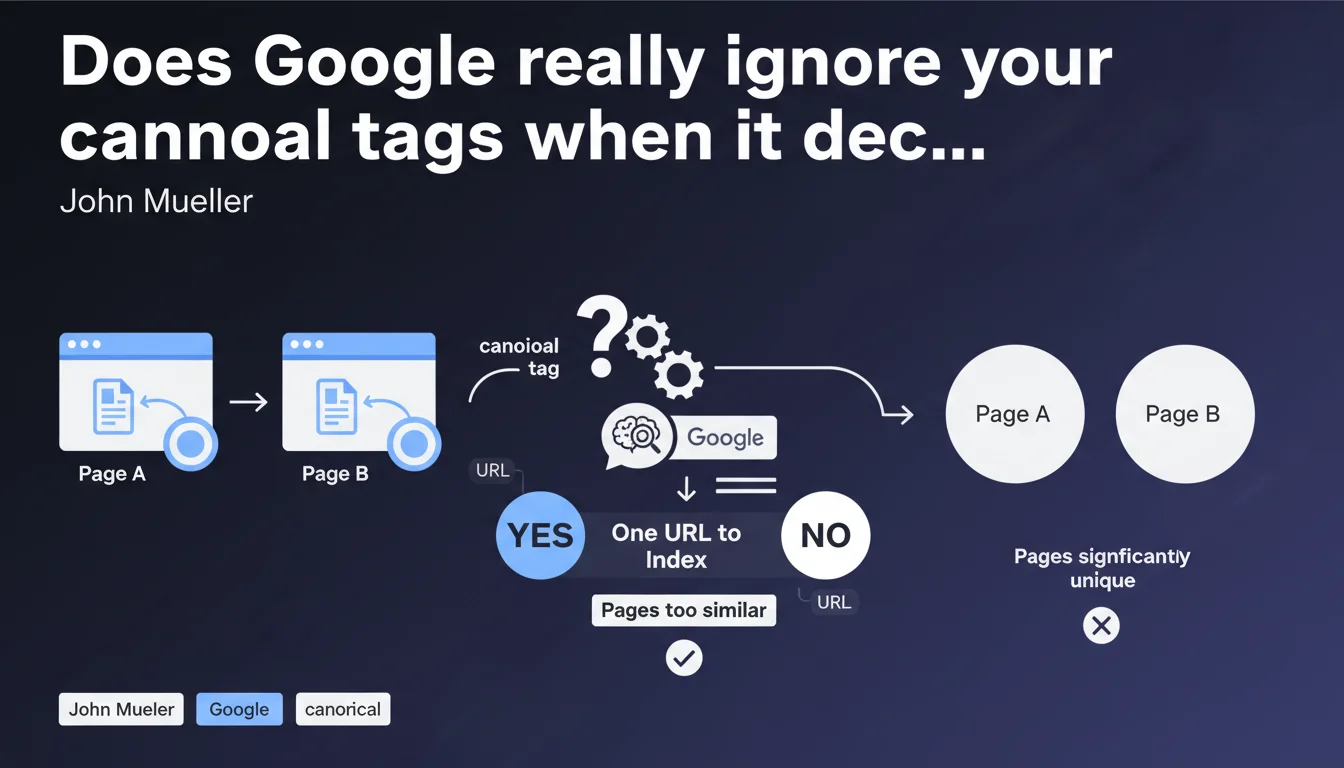
Google decides itself which URL to index when it considers multiple pages "essentially the same," regardless of your preferences. The only solution: ensure your pages are different enough for the algorithm to consider them unique. The threshold for differentiation remains unclear.
What you need to understand
Does Google really ignore your canonical tags?
Not exactly. Google takes your canonicalization signals into account, but reserves the right to override them if its algorithm detects substantial similarity between multiple URLs. This is what Mueller calls "doing you a favor" — an elegant way of saying Google does whatever it wants.
The canonical tag becomes just a simple advisory signal among others. If the text content, HTML structure, and search intent are judged too similar, Google chooses a master URL and ignores the others, regardless of your technical preferences.
What exactly is a "significantly unique" page according to Google?
Good question. Google provides no quantitative threshold. No percentage of text difference, no specific HTML criteria. We're in a total gray area.
Field experience suggests you need substantial content differentiation, not just a different sidebar or footer. But where exactly do you draw the line between "a few different sentences" and "complete redesign"? Google won't tell you — and that's probably intentional.
Why does Google merge my product variants?
Because its algorithm detects duplicate or near-duplicate content between your product pages with different colors, sizes, or options. If only the title and a photo change, Google considers the search intent identical and thinks one URL is enough.
This issue particularly affects e-commerce sites with poorly structured product variants. Google prefers to consolidate signals on one URL rather than spread crawl budget and authority across a dozen near-identical versions.
- Canonicalization is not an absolute directive — Google keeps final control
- "Significantly unique" remains a vague concept with no publicly defined threshold
- Main content must be differentiated, not just peripheral elements
- Google favors consolidation when it detects overly similar pages
SEO Expert opinion
Is this statement consistent with what we observe in the field?
Yes and no. In principle, it's accurate: Google has always operated through URL clustering of similar pages. What Mueller confirms here is that Google doesn't blindly follow your technical signals.
But the vagueness around "significantly unique" is problematic. In practice, we observe inconsistent behavior: pages with 40% different content get merged, while others with 15% difference stay indexed separately. Sensitivity varies by industry, crawl budget, and domain authority. [To verify]: Does Google apply the same threshold to all sites or does it adjust its requirements based on context?
What nuances should be added to this advice?
First, "essentially the same" doesn't mean "strictly identical." Google uses near-duplicate detection far more sophisticated than simple hash comparison. It analyzes main content, semantic structure, and named entities.
Second, this rule applies differently depending on content type. For e-commerce product pages, a price or availability change isn't enough to create uniqueness. For blog articles, rewriting a few paragraphs fools no one. Google is looking for real editorial differentiation.
In what cases does this rule cause problems?
Mainly on high-volume sites with legitimate but subtle variations. A real estate site with similar listings in neighboring neighborhoods. A job board with near-identical offers in multiple cities. An e-commerce store with product variants.
The paradox: you need these pages to target specific long-tail queries, but Google decides they're too similar and only indexes one. Result: you lose coverage without clear notification. And Mueller simply tells you "make them more unique" — thanks for the tip.
Practical impact and recommendations
What should I do concretely to differentiate my pages?
First step: audit clusters of similar pages. Identify URLs in Search Console marked "Excluded - Another page with appropriate canonical tag" or "Detected, currently not indexed." These are your consolidation candidates.
Next, enrich the main content of each page with truly differentiating elements. Not just reworded paragraphs: unique sections, specific FAQs, dedicated testimonials, contextualized case studies. Google must see distinct editorial intent.
For e-commerce sites, structure your product variants differently: a master page with variant selector instead of distinct URLs, or create genuinely unique content per variant (usage guides, comparisons, specific use cases).
What mistakes should you absolutely avoid?
Don't rely on content spinning or automated rewriting. Google detects these practices easily and it adds no value. If you have nothing unique to say about a variant, don't create a dedicated page.
Also avoid over-optimizing filters. Not every combination of filters needs to be indexed. If "red shoes size 42" and "red shoes size 43" have the same descriptive content, Google will only index one version — you might as well control which one with strategic noindex.
How do I verify that my site follows this rule?
Use Search Console to track pages excluded for canonicalization. If the volume increases, Google is consolidating aggressively. Compare with your crawl plan: do the merged pages match your strategy?
Test with a content similarity tool (like Copyscape or Siteliner) to measure duplication rate between your pages. If two URLs exceed 70-80% text similarity, it's a red flag.
- Audit excluded pages in Search Console to identify victims of forced canonicalization
- Enrich main content with truly unique sections (minimum 300+ differentiating words)
- Restructure product variants: master page + selector or truly distinct content per variant
- Measure text similarity between supposedly different pages (threshold < 70%)
- Implement strategic noindex on filter combinations without added value
- Create FAQ, guides, and testimonials specific to each page to mark the difference
❓ Frequently Asked Questions
Quel pourcentage de différence de contenu faut-il pour que Google considère deux pages comme uniques ?
Si Google choisit la mauvaise URL canonique, puis-je forcer mon choix ?
Les pages filtres de mon site e-commerce sont-elles concernées ?
Comment Google détecte-t-il que deux pages sont "essentiellement les mêmes" ?
Faut-il supprimer les pages que Google refuse d'indexer à cause de la canonicalisation ?
🎥 From the same video 22
Other SEO insights extracted from this same Google Search Central video · published on 28/03/2022
🎥 Watch the full video on YouTube →
💬 Comments (0)
Be the first to comment.