
Official statement
What you need to understand
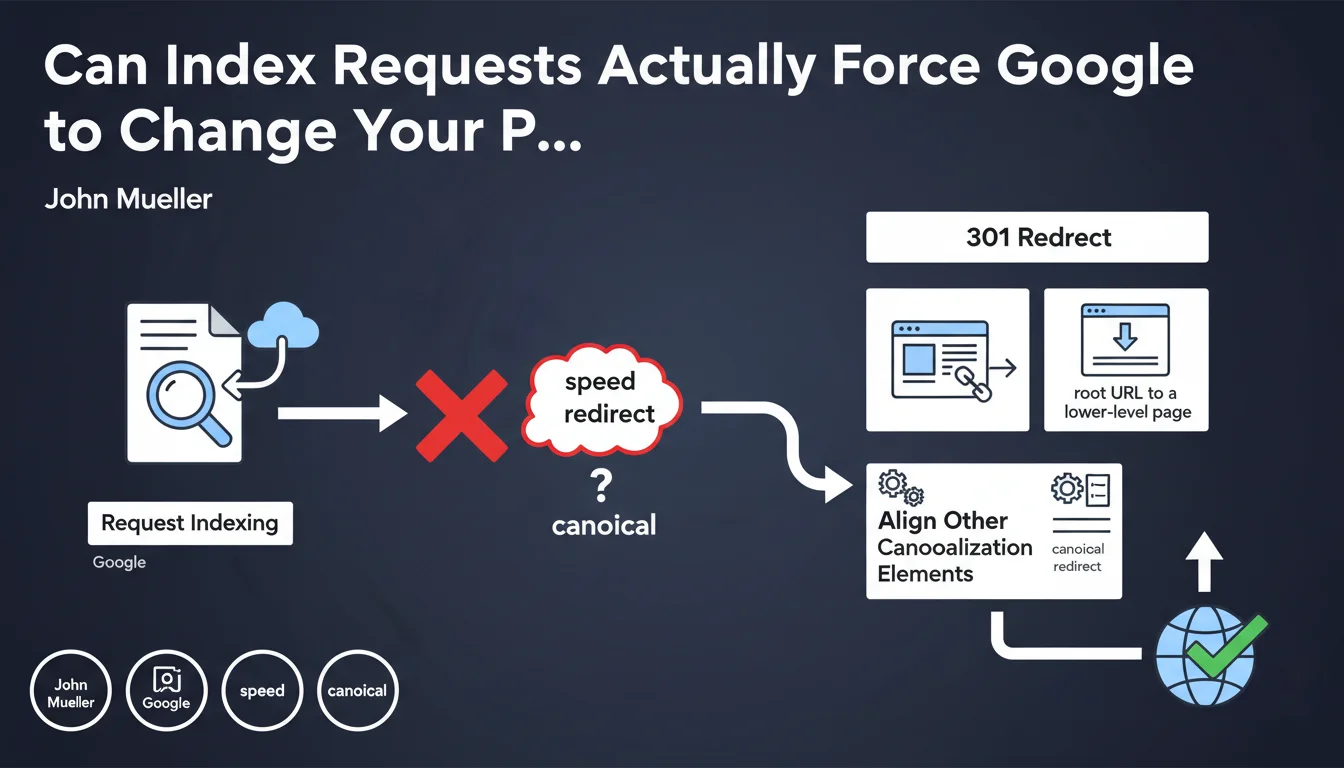
Google has just clarified an important technical point: the "Request Indexing" feature in Search Console does not influence the choice of canonical URL. This statement addresses a common misconception among SEO practitioners who thought they could force Google's hand by using this functionality.
The context is that of an implemented 301 redirect, where the webmaster would like to accelerate the canonicalization process toward the new URL. Google's response is unequivocal: requesting indexing will not change anything in the canonical URL selection process.
Even more interesting, Google specifies that a 301 redirect doesn't even guarantee canonicalization. The example given is revealing: when a site redirects its root URL to a lower-level page, Google may very well decide to index the root URL rather than the redirect destination.
- Index requests do not modify canonicalization signals
- 301 redirects do not guarantee that a URL will be chosen as canonical
- Google uses a set of signals to determine the optimal canonical URL
- Canonicalization elements must be consistent and aligned with each other
- The canonical tag, indexability, and absolute URL are levers to optimize
SEO Expert opinion
This statement is totally consistent with field observations from recent years. Numerous cases indeed show that Google does not systematically follow 301 redirects for canonicalization, particularly on high-authority sites or when the original URL has a significant history of inbound links.
The essential nuance here concerns the notion of "aligned canonicalization signals". Google operates with a voting system where several factors come into play: redirects, canonical tags, internal links, external links, XML sitemap, URL structure, URL history. When these signals are contradictory, Google makes its own judgment call.
Special attention: Sites that migrate their homepage to a subpage (example: example.com redirected to example.com/en/) frequently encounter this problem. Google often considers that the root URL remains more relevant for indexing, even with a 301 in place. This behavior can create inconsistencies in your SEO strategy.
Google's recommended approach of "better aligning canonicalization elements" implies a truly comprehensive strategy rather than an isolated action. It's the overall consistency of your signals that will make the difference, not a single lever.
Practical impact and recommendations
Summary: Stop relying on index requests to influence canonicalization. Focus instead on aligning all your canonicalization signals to guide Google toward the right URL choice.
- Audit your current canonicalization signals: verify consistency between redirects, canonical tags, internal links, and XML sitemap
- Implement explicit canonical tags on all your pages, pointing to the URL you want to see indexed
- Systematically use absolute URLs in your canonical tags (https://example.com/page) rather than relative (/page)
- Ensure the target URL is indexable: no noindex, no robots.txt blocking, no server errors
- Strengthen internal links to the desired canonical URL, avoiding creating links to variants
- Update your XML sitemap to reference only the canonical URLs you want indexed
- Monitor Search Console to identify cases where Google chooses a different URL from the one you indicated
- In the case of homepage redirects to subpages, evaluate whether this structure is really necessary or if a different architecture would be more appropriate
- Document your canonicalization strategy to maintain consistency during future site evolution
- Stop using the "Request Indexing" feature with the goal of influencing canonicalization; reserve it only for accelerating the discovery of new content
Optimal canonicalization management requires precise technical expertise and an overall vision of your site architecture. The interactions between redirects, canonical tags, internal linking, and URL authority create a complexity that demands in-depth analysis. For large sites or complex migrations, engaging a specialized SEO agency can prove wise to avoid costly mistakes and benefit from personalized guidance on these strategic technical aspects.
💬 Comments (0)
Be the first to comment.