
Official statement
What you need to understand
This statement reveals a significant tension between the personal positions of certain Google representatives and the company's official policy regarding AI-generated content.
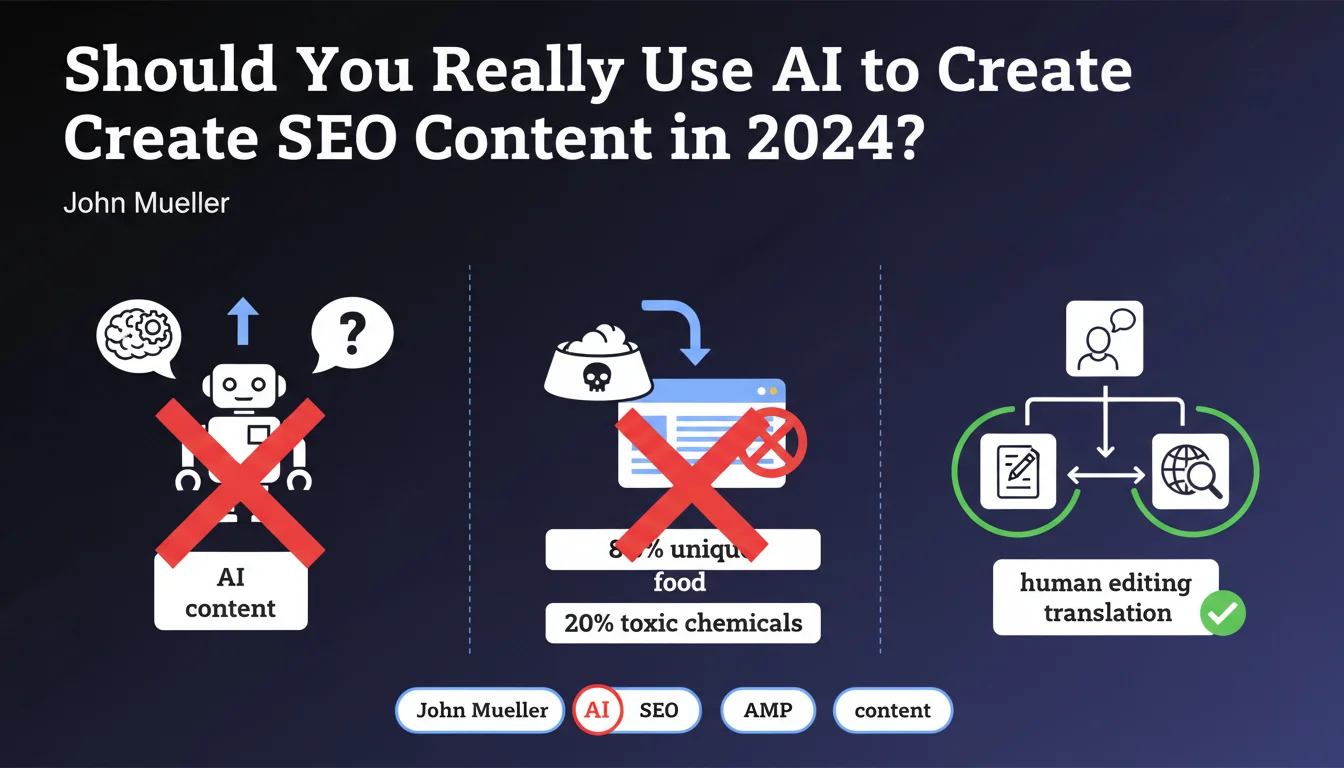
John Mueller uses provocative metaphors to express his personal skepticism about using AI in content creation. His comparisons with toxic food or a lawyer using ChatGPT illustrate his mistrust regarding the quality of produced content.
However, Google's official position is more nuanced and pragmatic: AI is allowed as long as it doesn't serve to manipulate search results and the content remains useful and qualitative.
- Crucial distinction: personal opinion vs. Google's official policy
- AI is allowed if the content is useful and of quality
- Prohibition only in case of SERP manipulation
- The responsibility for final quality remains that of the content creator
- Necessary vigilance on facts, errors and editorial quality
SEO Expert opinion
This divergence between personal discourse and official policy is not insignificant for SEO practitioners. It reveals that Google evaluates the final result, not the production method.
In practice, we observe that sites using AI in an intelligent and supervised manner do not suffer penalties. On the other hand, those publishing AI content en masse without human editing often see their performance stagnate or decline.
Mueller's metaphor about "20% toxic" is actually very telling: raw AI content indeed contains approximately 20-30% problematic elements (inaccuracies, generalities, artificial phrasing). This is precisely what must be edited and enriched by human expertise.
Practical impact and recommendations
Here's how to integrate AI strategically into your content production without risking a penalty:
- Use AI as an assistant, not as the final writer: structure, angle research, first drafts
- Systematically edit all AI content: verify facts, add your expertise, personalize the tone
- Enrich with your experience: real case studies, proprietary data, unique insights
- Avoid unedited mass production: prioritize quality over quantity
- Test the added value: does your content provide more than a simple ChatGPT answer?
- Don't translate blindly: adapting is not translating, respect cultural nuances
- Maintain E-E-A-T consistency: demonstrate expertise, experience, authority and trustworthiness
- Monitor your metrics: time on page, bounce rate, conversions indicate perceived quality
💬 Comments (0)
Be the first to comment.