
Official statement
What you need to understand
What does John Mueller's statement about HCU really mean?
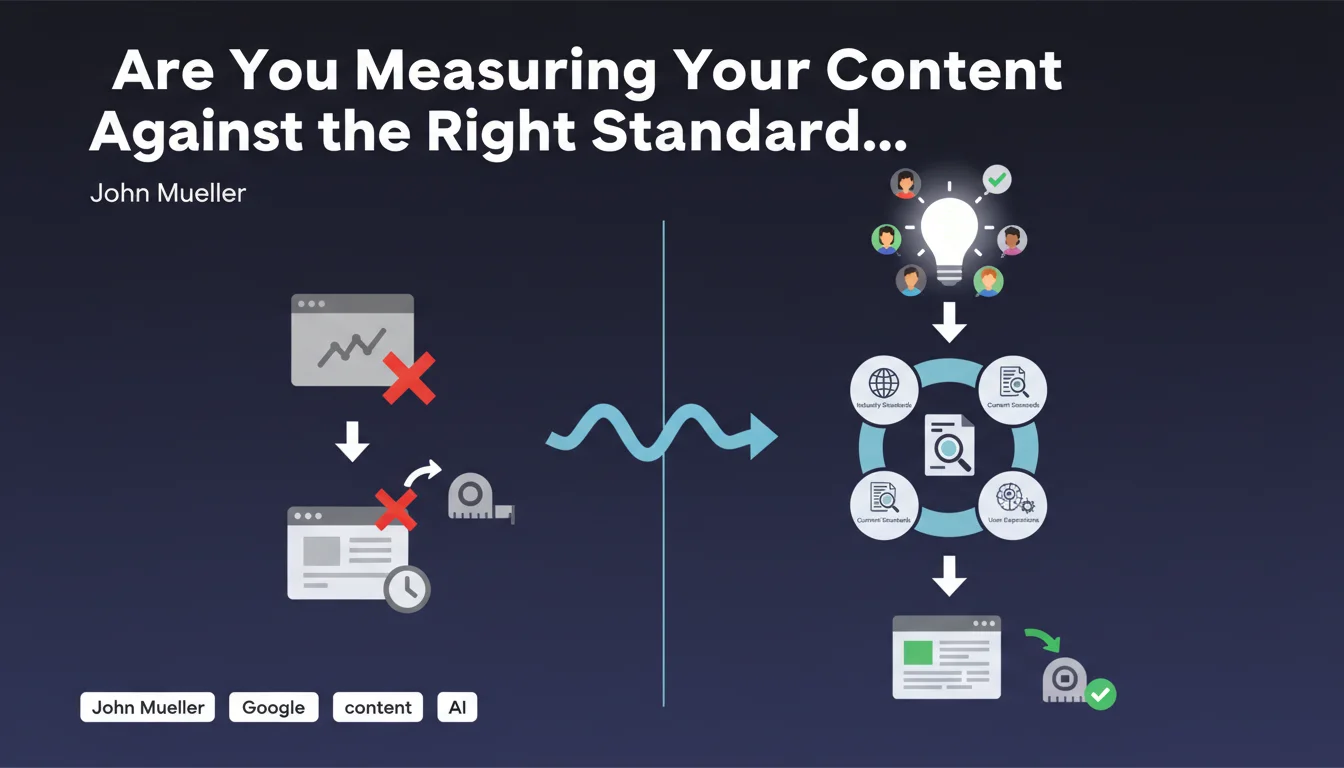
John Mueller's statement marks a turning point in understanding the Helpful Content Update. It's no longer enough to improve your content compared to what it was before the penalty.
Google now evaluates your content within the current context of your industry. This means your competitors may have made progress, user expectations have evolved, and quality standards are more demanding.
Why is comparing your site to its previous version insufficient?
Comparing yourself to yourself creates a dangerous reference bias. You can improve your content by 50% and still remain below current industry standards.
Google doesn't judge your improvement efforts, but only the final quality of your content compared to what users find elsewhere. Average content that's been improved remains average content if the competition offers excellence.
What are the current standards Google is talking about?
Current standards include depth of information, demonstrated expertise, user experience, and satisfaction of search intent. These criteria are constantly evolving.
They also vary depending on industries. A health article requires more expertise and sources than a leisure guide. Google compares your content to that of sites currently ranking in your niche.
- Don't compare yourself to your old content, but to sites currently ranking in your SERPs
- User expectations are constantly evolving and vary by industry
- Relative improvement doesn't guarantee compliance with current quality standards
- Google evaluates your content within the competitive context of your niche
- Absolute quality matters more than improvement efforts
SEO Expert opinion
Is this statement consistent with real-world observations?
Absolutely, and this explains why many sites haven't recovered despite substantial efforts. I've observed clients who rewrote 80% of their content without regaining their positions.
The problem lay in their frame of reference. They were optimizing compared to their old mediocre content, while competing sites had meanwhile established new standards of excellence in their niche.
What nuances should be brought to this recommendation?
The difficulty lies in identifying the true current standards. Not all ranking sites are models to follow; some benefit from historical authority.
You must distinguish quality standards from technical performance standards. Excellent content may not rank immediately if it lacks authority or established trust signals.
In what cases might this approach be insufficient?
This approach focuses on content only, but HCU also evaluates the entire site. Excellent content on a site with structural problems or poor user experience will remain penalized.
Additionally, some sites need a reassessment delay after corrections. Even when meeting current standards, recovery can take several months, especially if the site was heavily impacted.
Practical impact and recommendations
What should you actually do to comply with current standards?
Start with a thorough competitive analysis of your top 10 competitors in the SERPs. Analyze the depth, format, demonstrated expertise, and user experience of their content.
Identify the common characteristics of performing content: average length, structure, level of detail, visual elements, cited sources. These are your new reference standards.
Then, audit your own content with an objective evaluation grid. For each page, ask yourself whether it truly rivals the best available resources on the topic.
What mistakes should you avoid in this reassessment process?
The main mistake is focusing on superficial metrics like word count. A generic 3,000-word article will never match a 1,500-word article based on genuine expertise.
Also avoid mechanically copying what your competitors do. Google values differentiation and added value. Your content must bring something unique while respecting quality standards.
Don't neglect the regular update aspect. Standards evolve, and excellent content today can become obsolete in six months if you don't keep it updated.
How can you verify that your content meets current expectations?
Implement a systematic evaluation process for each piece of content. Use test users, satisfaction surveys, and analyze real behavioral signals.
Monitor your engagement metrics: time on page, bounce rate, pages per session. If your improved content doesn't engage better than the old version, it probably doesn't meet expectations.
- Analyze the top 10 results for your main queries to identify current standards
- Create an evaluation grid based on experience, expertise, authoritativeness, and trustworthiness (E-E-A-T)
- Compare your content to the best available resources, not to your old content
- Identify quality gaps: depth, demonstrated expertise, user experience
- Rewrite or enrich content to match or exceed observed standards
- Add proof of expertise: personal experience, case studies, original data
- Improve user experience: readability, navigation, relevant visual elements
- Implement a regular update process to maintain standards
- Measure engagement signals to validate that changes meet user expectations
- Document your sources and methodology to strengthen credibility
💬 Comments (0)
Be the first to comment.