
Official statement
What you need to understand
Why Does Google Downplay the Importance of External Links?
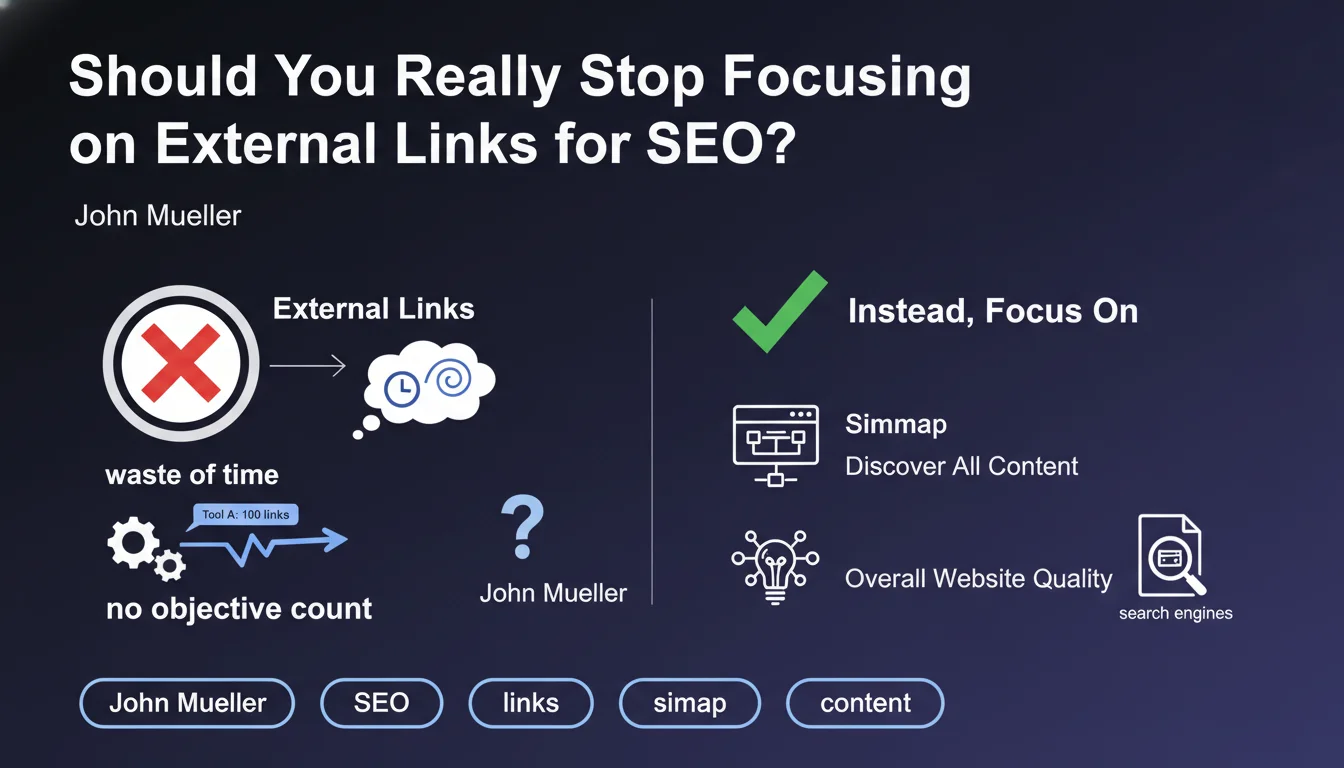
John Mueller adopts a nuanced position regarding backlinks. His statement primarily aims to discourage excessive obsession with link acquisition, which can lead to counterproductive practices.
Google emphasizes that there is no universal metric to precisely measure links. SEO tools (Ahrefs, Semrush, Majestic) each use their own crawlers with different databases, generating sometimes significant discrepancies.
What Does This Recommendation Actually Mean for SEO Professionals?
Mueller isn't saying that links have become useless. Rather, he suggests not dedicating all your energy to them at the expense of other quality factors.
The emphasis is placed on a holistic approach to quality: content, user experience, technical structure, and discoverability through tools like XML sitemaps.
What Are the Pitfalls to Avoid in Backlink Management?
- Don't base your strategy solely on third-party tool metrics (DA, DR, etc.) that don't reflect Google's algorithm
- Avoid obsessing over numerical link ratios rather than their contextual quality
- Don't neglect other fundamental SEO levers while chasing backlinks
- Understand that Google has far more comprehensive data than any market tool
- Don't overinvest in artificial link building tactics that can be penalizing
SEO Expert opinion
Is This Statement Consistent with Practices Observed in the Field?
There is a notable disconnect between this official discourse and observable reality. In competitive sectors (finance, insurance, e-commerce), links remain a major differentiating factor.
Empirical tests show that sites with a solid link profile systematically outperform their competitors with equivalent content. This field reality partially contradicts Mueller's message.
What Nuances Should Be Applied to This Advice?
The site's context determines the relevance of the advice. For an established authority site already with a good link profile, focusing on other aspects may indeed bring more value.
Conversely, for a new site or weak site, completely ignoring backlinks would be a strategic mistake. Links remain essential for initial discovery and authority.
In Which Cases Does This Recommendation Truly Apply?
This advice is particularly relevant when you observe diminishing returns: significant efforts for a few additional links having little measurable impact.
It also applies to sites neglecting fundamental technical issues (crawl, indexation, performance) or content quality, while aggressively pursuing links.
For low-competition sectors or informational queries, content excellence may indeed take precedence over link accumulation.
Practical impact and recommendations
What Should You Actually Do with This Information?
Adopt a balanced and proportionate approach. Don't dedicate more than 20-30% of your SEO efforts to backlinks, except in ultra-competitive contexts justifying more.
Prioritize contextual quality over quantity. A link from a thematically relevant site with real traffic is worth more than 10 low-quality links.
Simultaneously strengthen your technical fundamentals: optimized XML sitemaps, internal linking structure, Core Web Vitals performance, and clear information architecture.
What Mistakes Should You Avoid Following This Statement?
- Don't completely abandon link building, especially for new sites or competitive sectors
- Don't stop monitoring your link profile to detect toxic or negative links
- Don't ignore natural link opportunities (digital PR, linkable content, partnerships)
- Don't eliminate your quality editorial link building efforts in favor exclusively of technical work
- Don't forget that link signals also contribute to discovering new content
How Can You Optimize Your Overall Strategy Taking This Advice into Account?
Conduct an effort allocation audit: analyze where you're currently investing your SEO time. If more than 50% goes into link acquisition, rebalance toward content and technical.
Develop an "Earn, Not Build" approach: create content that naturally deserves links (original studies, tools, resources) rather than actively soliciting.
Implement segmented and optimized sitemaps as Mueller suggests, ensure that Google can easily discover and index your content without relying solely on external links.
💬 Comments (0)
Be the first to comment.