
Official statement
Other statements from this video 8 ▾
- □ Is page content really the most important relevance factor for Google?
- □ Does Google really strip stop words from your search queries?
- □ Does Google really preserve stop words within named entities, and how does this affect your SEO?
- □ Does Google really expand your search queries with synonyms automatically?
- □ Does your geographic location really reshape the search results Google shows you?
- □ Does page quality or site quality matter more in Google's ranking algorithm?
- □ Does content uniqueness really matter for your Google rankings?
- □ Does a page's relative importance really impact its quality according to Google?
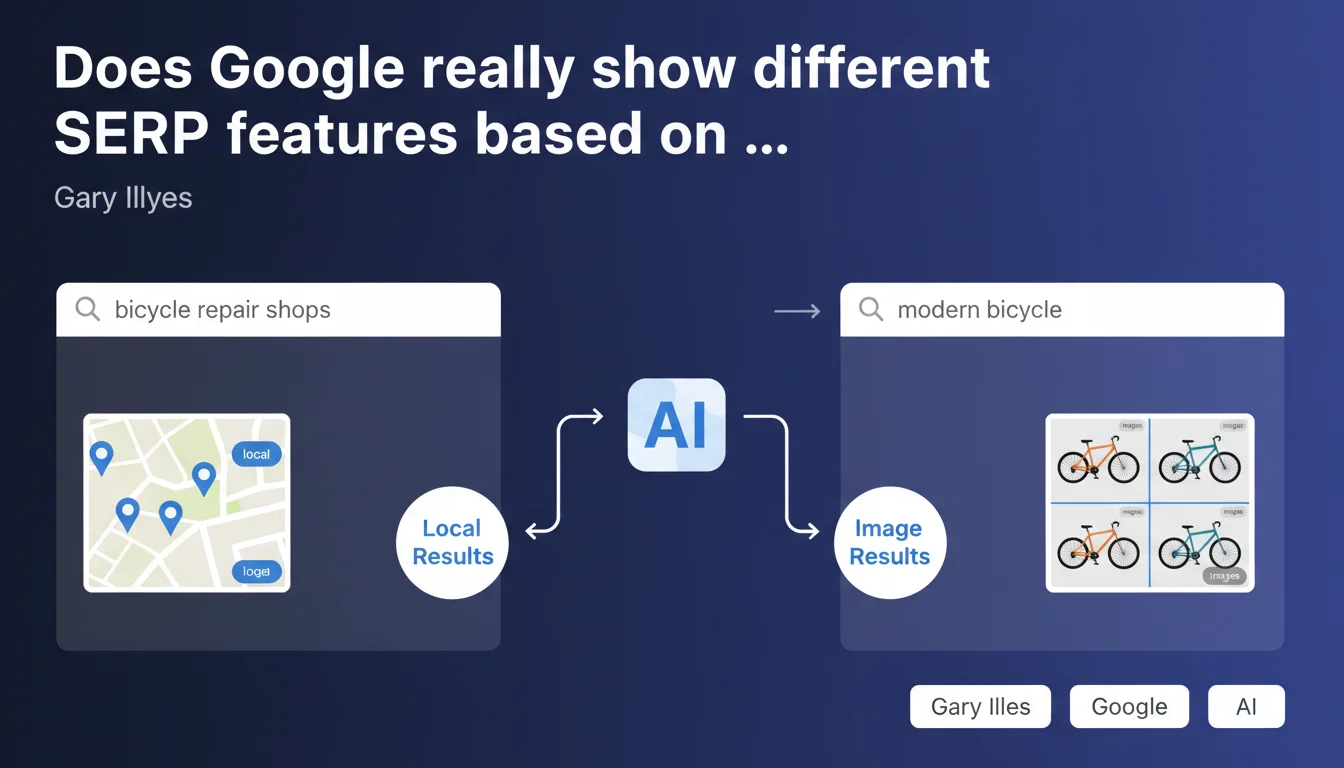
Google dynamically adjusts the features displayed (Local Pack, images, videos, featured snippets) based on the intent detected behind each query. A local transactional search will trigger geo-localized results, while an informational query will favor other formats. The SEO challenge: understand which intent your page targets to optimize its presence in the right SERP features.
What you need to understand
Gary Illyes reminds us here of a fundamental principle that is often misapplied: Google does not treat all queries the same way. The search engine analyzes user intent to determine which result format will be most relevant.
The example given is revealing. "Bicycle repair shops" triggers an immediate local need — the user is looking for a service nearby. "Modern bicycle" falls into an informational or commercial intent, where images provide more value than an address.
What types of intent does Google distinguish?
The search engine generally segments queries into four categories: navigational (finding a specific site), informational (learning something), commercial (comparing before buying), and transactional (buying now or finding a service)
Each intent activates specific SERP features. An informational query will favor featured snippets and People Also Ask. A commercial query often triggers product carousels and reviews. The Local Pack appears massively on localized transactional intents.
How does Google detect the intent behind a query?
Several signals come into play: the syntactic structure of the query, the keywords used ("near me", "buy", "how to"), the click history of previous users on that query, and contextual data like geolocation or device used.
The search engine constantly refines its understanding. If 80% of users click on local results for a given query, Google will interpret that query as having a strong local component — even without an explicit geographic modifier.
Why this statement now?
This communication comes at a time when many SEOs continue to optimize their pages without considering the dominant result format for their target query. Aiming for classic position 1 organic ranking makes no sense if that query systematically displays a Local Pack, featured snippet, or video carousel above.
Google reaffirms an obvious reality: your optimization strategy must align with the features actually displayed for your target queries.
- SERP features vary according to detected intent, not according to your desire to appear in them
- The same topic can trigger different formats depending on how the query is phrased
- SERP analysis comes before any content strategy or optimization
- Intent signals include: syntax, keywords, user behavior, context
- Optimizing for the wrong feature = wasting your SEO resources
SEO Expert opinion
Is this statement consistent with field observations?
Absolutely, and it's actually a daily finding for anyone analyzing SERPs systematically. The problem isn't the truthfulness of the statement — it's that Google remains deliberately vague about the exact criteria that trigger one feature or another.
Take "bicycle repair" without the "shops". Depending on the user's location and history, you can get either a Local Pack, tutorial videos, or how-to articles. Google doesn't say how to arbitrate these edge cases, or what exact weight to give conflicting signals.
What nuances should be added to this simplified view?
The chosen example — "bicycle repair shops" vs "modern bicycle" — is too binary to reflect reality. Most queries exist in a gray area where multiple intents coexist.
"Best running shoes" blends commercial intent (comparing) and transactional intent (buying). Google simultaneously displays product cards, comparative articles, and sometimes a Local Pack if geolocation suggests a physical store search. No single intent — so no exclusive feature.
[To verify] Google claims that intent determines features, but never clarifies how the search engine handles intent conflicts on the same query. SERP A/B tests show significant variations by user profile — suggesting personalization far more advanced than this official discourse suggests.
In what cases does this principle not apply as expected?
Brand queries often trigger standardized features (Knowledge Panel, sitelinks) regardless of actual intent. Searching "Nike running" will trigger a Knowledge Panel even if intent is purely navigational.
Very long-tail queries (fewer than 100 searches/month) sometimes escape this logic. Google doesn't have enough behavioral data to refine intent — SERPs then resemble generic results without enriched features, regardless of underlying intent.
Practical impact and recommendations
How do you identify the dominant intent of your target queries?
First step: manually analyze current SERPs. Open a private browsing window, disable geolocation (or test from multiple locations), and observe which features appear systematically.
Note the dominant format: classic organic results, Local Pack, featured snippet, People Also Ask, images, videos, product carousel, Knowledge Panel. If one feature takes up more than 50% of space above the fold, that's the one you should prioritize targeting.
Use tools like SEMrush or Ahrefs to track the evolution of SERP features on your keywords. But don't blindly rely on aggregated data — a feature displayed 30% of the time can represent 70% of traffic if it captures attention.
What concrete optimizations should you apply based on detected intent?
For a local intent (like "bicycle repair shops"), your absolute priority is Google Business Profile. Complete profile, recent photos, customer reviews, updated hours, precise categories. On-page content becomes secondary if you don't appear in the Local Pack.
For an informational intent displaying featured snippets, structure your answers in concise paragraphs (40-60 words), use bullet lists or tables, and place the direct answer at the top of the page. FAQ Schema markup can help for PAA.
For a visual intent (like "modern bicycle"), optimize your images: descriptive filenames, precise alt tags, high-resolution images, image sitemap. Test carousel formats if your CMS supports it. The text accompanying the image should be rich in context.
For a transactional e-commerce intent, structured product cards (Product Schema) and customer reviews become critical. Google Shopping can cannibalize your organic results — adapt your strategy accordingly.
What mistakes should you absolutely avoid?
Don't create long-form content optimized for a featured snippet if the query systematically displays a Local Pack. You'll never rank, no matter how high quality your text is. Intent trumps optimization.
Avoid targeting queries with contradictory intents on the same page. "Buy bike Paris" and "how to choose a bike" have different intents — create two separate pieces of content rather than one mediocre hybrid that satisfies neither.
Don't overlook minor semantic variations that radically change intent. "Plumber" vs "plumbing" vs "plumbing problem" trigger very different SERPs, even though the topic remains identical.
- Audit SERPs manually for your 20 priority queries in private browsing
- Identify the dominant feature for each target query
- Map your existing pages to detected intents (and spot misalignments)
- Create specific content for each intent type instead of "catch-all" pages
- Optimize Google Business Profile for any local intent, even without explicit geographic modifier
- Structure informational answers for featured snippets (short paragraphs, lists, tables)
- Enrich images for visual intents (filenames, alt text, contextual text)
- Implement appropriate schemas (Product, FAQ, HowTo) based on intent
- Track SERP feature evolution over time with dedicated tools
- Test your pages from different locations for queries with geographic component
❓ Frequently Asked Questions
Google utilise-t-il les mêmes critères d'intention pour toutes les langues et régions ?
Une page peut-elle apparaître dans plusieurs fonctionnalités SERP simultanément pour la même requête ?
L'intention détectée par Google peut-elle changer dans le temps pour une même requête ?
Comment savoir si mon contenu correspond à l'intention même s'il ne rank pas bien ?
Les recherches vocales modifient-elles l'intention détectée par rapport aux recherches textuelles ?
🎥 From the same video 8
Other SEO insights extracted from this same Google Search Central video · published on 09/04/2024
🎥 Watch the full video on YouTube →
💬 Comments (0)
Be the first to comment.