
Official statement
Other statements from this video 8 ▾
- □ Google supprime-t-il vraiment les mots vides de vos requêtes ?
- □ Comment Google préserve-t-il les mots vides dans les entités nommées ?
- □ Google élargit-il vraiment vos requêtes avec des synonymes automatiquement ?
- □ Comment la localisation de l'utilisateur transforme-t-elle réellement vos résultats de recherche ?
- □ Qualité de page vs qualité de site : laquelle pèse le plus dans l'algorithme Google ?
- □ L'unicité du contenu influence-t-elle vraiment le classement dans Google ?
- □ L'importance relative d'une page impacte-t-elle vraiment sa qualité selon Google ?
- □ Pourquoi Google affiche-t-il des fonctionnalités SERP différentes selon vos requêtes ?
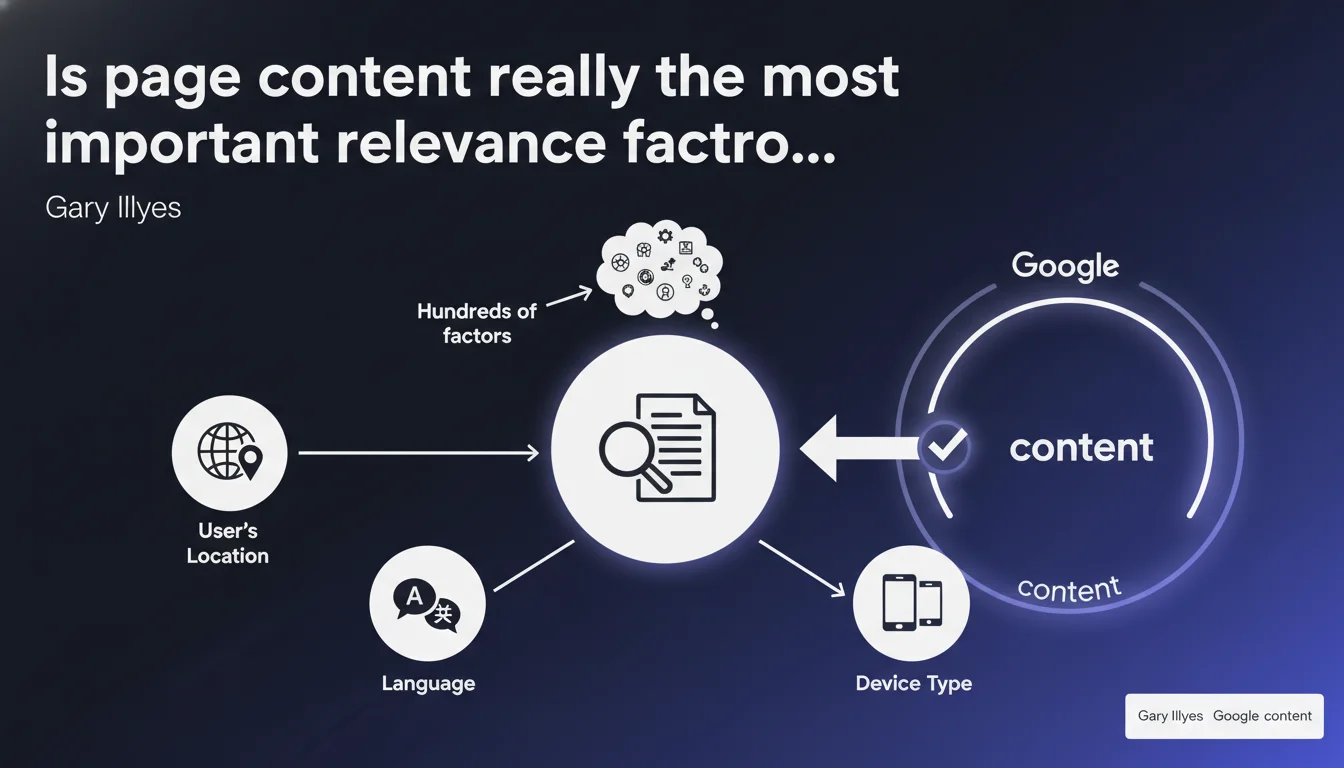
Google affirms that the actual content of the page remains the dominant relevance factor among hundreds of signals used to rank results. Other factors such as user location, language, and device type play a complementary role, but do not supersede the quality of the content itself.
What you need to understand
What exactly does Google mean by "actual page content"?
Google distinguishes here between visible and textual content and all other technical or contextual signals. We're talking about text, images, videos, semantic structure — in short, everything that directly answers the user's search intent.
This statement reminds us that editorial fundamentals take precedence over peripheral optimizations. A site can have solid backlinks and flawless speed, but if the content doesn't answer the query, it won't rank.
Why does Gary Illyes specify "hundreds of factors"?
This phrasing aims to contextualize the hierarchy of signals without minimizing the importance of other criteria. Google does indeed use hundreds of signals — loading time, domain authority, freshness, EEAT, etc.
But within this complex hierarchy, content remains the central pivot. Other factors modulate, refine, and personalize results, but they cannot compensate for poor or off-topic content.
How do content and result personalization work together?
Google explicitly mentions location, language, and device type as complementary factors. These elements don't change the intrinsic relevance of the content, but adapt its display and priority according to user context.
Content that's relevant in French on mobile in Paris won't receive the same treatment as identical content accessed in English on desktop in New York. Personalization operates after evaluating content relevance.
- Page content is the dominant relevance signal among hundreds of factors
- Location, language, and device are contextual filters, not substitutes for content
- Weak content will never be compensated by excellent technical signals
- The hierarchy of signals remains stable: content first, optimizations second
SEO Expert opinion
Is this statement consistent with field observations?
Broadly speaking, yes. Recent algorithm updates (Helpful Content, Core Updates) confirm that Google penalizes weak content even on technically flawless sites. Editorial quality has indeed become a major differentiator again.
That said, this assertion remains deliberately generic. It doesn't specify how Google evaluates this "relevance" of content: weight of named entities, semantic depth, intent matching, freshness... [To verify]: the exact evaluation mechanisms remain opaque.
In which cases does this rule not fully apply?
On ultra-competitive queries, content alone is no longer enough. When 50 sites offer equivalent content on "car insurance," secondary signals (domain authority, backlink volume, technical performance) become decisive.
Similarly, on local or transactional queries, other factors take precedence: geographic proximity, user reviews, product availability. Content remains important, but its relative weight decreases.
Should we therefore neglect other signals?
Obviously not. This statement doesn't say that other factors are negligible, simply that they are subordinate. Excellent content on a slow, unsecured site without backlinks will struggle to emerge.
The phrase "most important" doesn't mean "only important." It invites you to prioritize: if you have to choose between overhauling your content or gaining 0.2s in load time, start with content.
Practical impact and recommendations
What should you concretely do about your content?
Start with an editorial audit of your strategic pages. Ask yourself the tough question: does this content really answer the search intent, or does it merely exist for a keyword? Measure bounce rate, time spent, conversions.
Next, work on semantic depth. Relevant content isn't just long content or keyword-stuffed. It covers expected sub-topics, answers related questions, and provides real added value.
How do you verify that my content is truly "relevant" to Google?
Use actual search queries from your Search Console to compare search intents and ranking pages. If you're losing positions on queries where your content seemed relevant, it's likely because a competitor published something more comprehensive or better structured.
Also analyze Featured Snippets and People Also Ask on your target queries. These are direct indicators of what Google considers relevant and well-structured for answering the intent.
What mistakes should you absolutely avoid?
Don't fall into the trap of mass-produced or over-optimized content. Google increasingly detects texts written for robots rather than humans. Relevance requires real editorial thought, not algorithmic padding.
Also avoid neglecting peripheral signals under the pretext that "only content matters." Excellent content on a technically catastrophic site will never perform at its full potential.
- Audit strategic pages to verify content/intent alignment
- Enrich semantic depth without diluting the main message
- Analyze Search Console queries to detect intent gaps
- Study Featured Snippets and PAA to understand what Google values
- Remove or overhaul weak content that dilutes site authority
- Maintain balance between editorial quality and technical optimizations
❓ Frequently Asked Questions
Est-ce que cela signifie que les backlinks sont moins importants qu'avant ?
Comment Google mesure-t-il la pertinence du contenu concrètement ?
Un contenu court peut-il être considéré comme pertinent par Google ?
Faut-il arrêter d'optimiser les aspects techniques si seul le contenu compte ?
Comment cette déclaration s'applique-t-elle aux sites e-commerce avec peu de texte ?
🎥 From the same video 8
Other SEO insights extracted from this same Google Search Central video · published on 09/04/2024
🎥 Watch the full video on YouTube →
💬 Comments (0)
Be the first to comment.