
Official statement
Other statements from this video 8 ▾
- □ Le contenu de la page est-il vraiment le facteur de pertinence le plus important pour Google ?
- □ Comment Google préserve-t-il les mots vides dans les entités nommées ?
- □ Google élargit-il vraiment vos requêtes avec des synonymes automatiquement ?
- □ Comment la localisation de l'utilisateur transforme-t-elle réellement vos résultats de recherche ?
- □ Qualité de page vs qualité de site : laquelle pèse le plus dans l'algorithme Google ?
- □ L'unicité du contenu influence-t-elle vraiment le classement dans Google ?
- □ L'importance relative d'une page impacte-t-elle vraiment sa qualité selon Google ?
- □ Pourquoi Google affiche-t-il des fonctionnalités SERP différentes selon vos requêtes ?
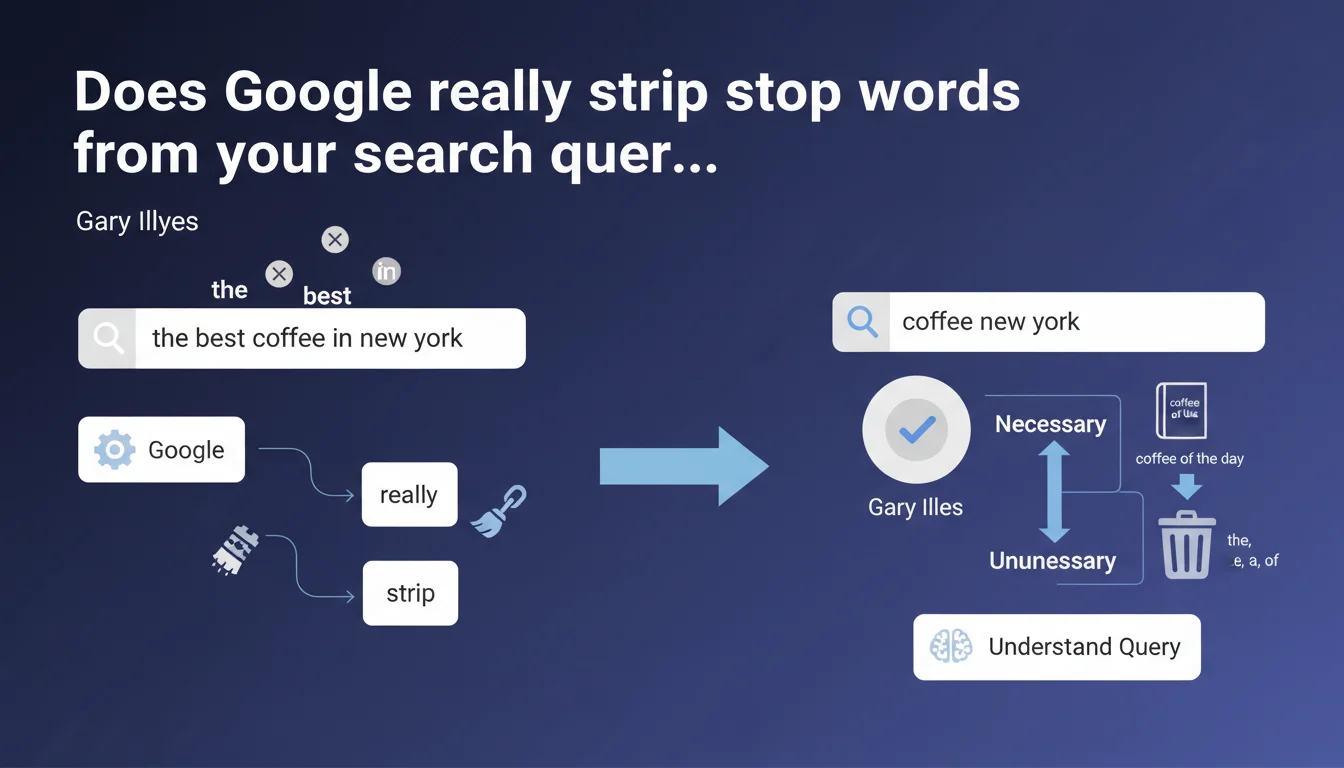
Google automatically cleans search queries by removing stop words (such as 'a', 'of', 'the') when they're not essential to understanding the query. This statement confirms a well-known mechanism, but raises a crucial question: when are these words actually ignored, and when do they matter? The nuance makes all the difference for optimizing your content.
What you need to understand
What are stop words and why does Google remove them?
Stop words are ultra-frequent grammatical words that, in isolation, carry no distinctive semantic value: articles (the, a, an), prepositions (of, in, on), conjunctions (and, or, but). In absolute terms, these words represent considerable noise for a search engine processing billions of queries daily.
Google applies automatic cleanup to lighten processing and focus analysis on meaning-bearing terms. This filtering occurs during query interpretation, before the matching phase with the index.
When does Google actually preserve these stop words despite everything?
This is where it gets complicated — and where Gary Illyes' statement remains deliberately vague. Google specifies "when they are not necessary to understand." In other words, the engine evaluates the criticality of each stop word in the context of the query.
Obvious examples: "to be or not to be" (literal query), "the who" (band name), "to the moon" (fixed expression). In these cases, removing a stop word would radically change the search intent. Google preserves them, therefore.
What's the difference from how indexed content is treated?
Stop word removal concerns query interpretation, not indexing of your pages. Google indexes all words of your content, including stop words. The problem arises at matching time: if a cleaned query matches your title or H1, it doesn't matter whether you included stop words or not in your tag.
This mechanism explains why two nearly identical titles ("Best practices for SEO" vs "Best practices SEO") can produce similar performance — but not always identical, as other factors come into play (naturalness, CTR, semantic context).
- Google filters stop words from queries to optimize processing, unless their removal alters meaning
- Indexed content retains all its words, including stop words
- Matching can work even if your title contains stop words absent from the cleaned query
- This logic applies to all languages, with language-specific stop word lists
- The algorithm evaluates context to decide which words are truly necessary
SEO Expert opinion
Is this statement really a revelation?
Let's be honest: no. Search engines' treatment of stop words has been documented since the 2000s. What Gary Illyes confirms here is that Google still applies this principle — but with a contextual nuance that early engines didn't have.
The problem is that the phrasing remains deliberately vague. "When they are not necessary": OK, but according to what exact criteria? What decision logic? No clarification. We remain in the typical Google obfuscation of declarations.
What limitations and inconsistencies are observed in the field?
[To be verified] In practice, we observe that certain stop words do indeed influence results, even outside fixed expressions. Example: "best laptop for gaming" vs "best laptop gaming" don't always produce strictly identical SERPs. The "for" sometimes seems to carry a nuance of intent (buying advice vs product list).
Another inconsistency: featured snippets and rich extracts often favor formulations with stop words, probably for readability and grammatical consistency reasons. If Google really ignores these words, why favor titles that contain them in position zero?
Should you remove stop words from your content?
Absolutely not. That would be a beginner's mistake. Stop words contribute to fluidity, readability, and naturalness of your texts. Google measures UX signals (reading time, bounce rate, engagement) that would penalize robotic and telegraphic content.
Moreover, voice assistants and conversational search rely on queries formulated in natural language — with all their stop words. Optimizing for "how do I" rather than "how I" is not a waste of time, it's anticipation.
Practical impact and recommendations
Should you modify your Title and Heading tags to remove stop words?
No. Keeping a natural formulation remains the best approach. A title like "The Ultimate Guide to Link Building" performs better than a choppy "Ultimate Guide Link Building", especially for CTR in SERPs. Users scan readable titles, not keyword sequences.
However, if you're torn between two variations ("tips for SEO" vs "SEO tips"), favor the shorter and more natural one. The "for" adds nothing here — better to save characters in a Title tag limited to 60 visible characters.
How do you optimize your internal link anchors given this mechanism?
Link anchors should remain descriptive and contextual. Google analyzes anchor text to understand the target page, but it also interprets the surrounding context. An anchor "the best SEO tools" conveys as much signal as an anchor "best SEO tools" — the difference is marginal.
Focus instead on semantic diversity of your anchors. Varying "guide to keyword research", "keyword research tutorial", "how to do keyword research" enriches the semantic graph far more than fussing over a "to" or "the".
What mistakes must you absolutely avoid?
First mistake: believing that stuffing text with keywords without stop words improves ranking. You'll get unreadable content that drives users away — and Google measures engagement.
Second mistake: neglecting long-tail conversational queries on the pretext that Google filters stop words. Voice and mobile searches heavily use complete formulations ("where can I find...", "what is the best way to..."). Ignoring these patterns deprives you of qualified traffic.
- Keep your titles and H1 natural and readable, with stop words if grammar requires them
- Prioritize Title length optimization (60 chars max), removing a stop word if needed to save space
- Vary your internal link anchors without obsessing over the presence or absence of stop words
- Target long-tail conversational queries with their complete formulation
- A/B test your meta descriptions to measure real impact on CTR
- Never sacrifice writing quality for hypothetical technical optimization
This Google declaration reminds us of an old mechanism but deliberately underestimates its real complexity. In practice, stop words sometimes influence results — not directly through matching, but indirectly through UX, CTR, and behavioral signals.
Your strategy must remain user-centered: readable content, engaging titles, descriptive anchors. The rest is marginal optimization. These trade-offs between naturalness, semantic density, and technical constraints can be tricky to resolve alone — many sites benefit from working with a specialized SEO agency to fine-tune these settings according to their specific context and objectives.
❓ Frequently Asked Questions
Google supprime-t-il les mots vides de mes pages lors de l'indexation ?
Dois-je retirer les stop words de mes balises Title pour améliorer mon SEO ?
Pourquoi certaines requêtes avec et sans stop words donnent-elles des résultats différents ?
Les recherches vocales sont-elles concernées par ce filtrage ?
Faut-il éviter les mots vides dans les ancres de liens internes ?
🎥 From the same video 8
Other SEO insights extracted from this same Google Search Central video · published on 09/04/2024
🎥 Watch the full video on YouTube →
💬 Comments (0)
Be the first to comment.