
Official statement
Other statements from this video 8 ▾
- □ Le contenu de la page est-il vraiment le facteur de pertinence le plus important pour Google ?
- □ Google supprime-t-il vraiment les mots vides de vos requêtes ?
- □ Comment Google préserve-t-il les mots vides dans les entités nommées ?
- □ Google élargit-il vraiment vos requêtes avec des synonymes automatiquement ?
- □ Comment la localisation de l'utilisateur transforme-t-elle réellement vos résultats de recherche ?
- □ L'unicité du contenu influence-t-elle vraiment le classement dans Google ?
- □ L'importance relative d'une page impacte-t-elle vraiment sa qualité selon Google ?
- □ Pourquoi Google affiche-t-il des fonctionnalités SERP différentes selon vos requêtes ?
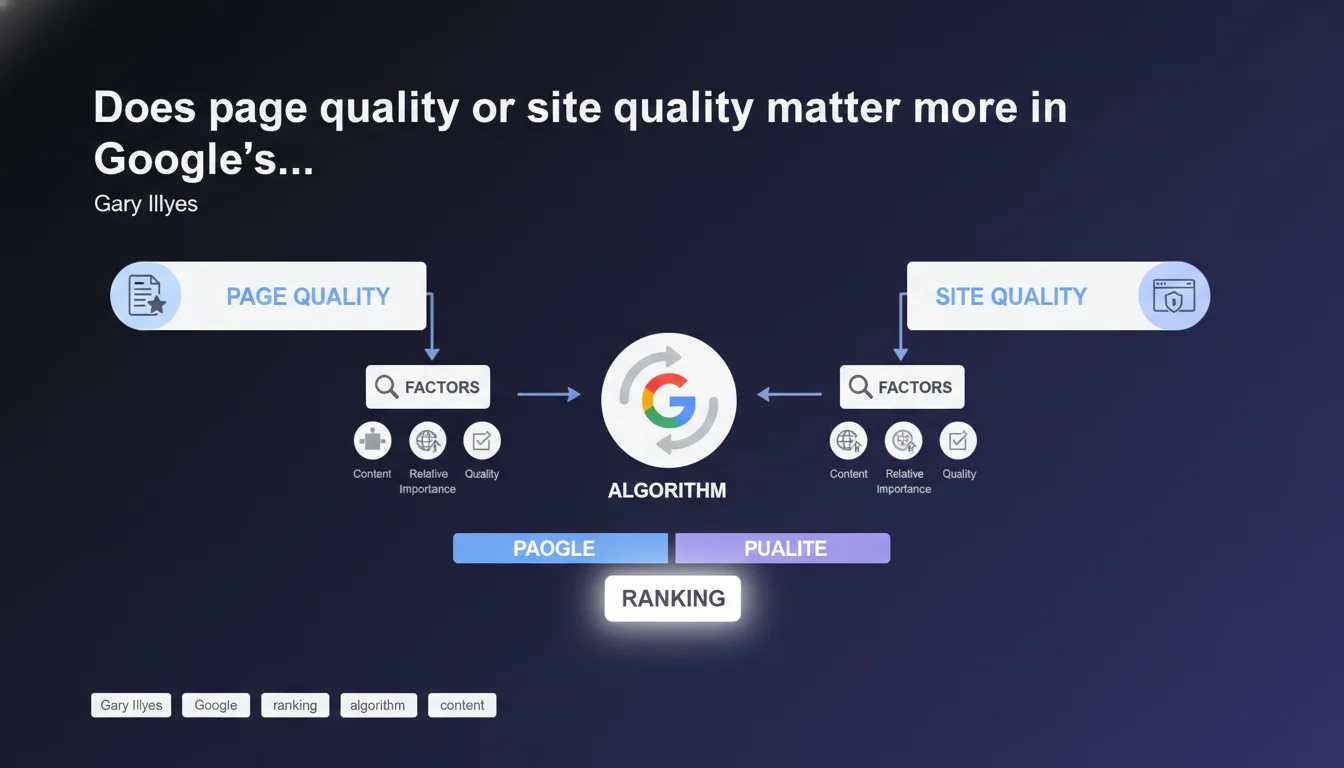
Google confirms that ranking relies on quality at two distinct levels: that of the individual page AND that of the site as a whole. Content uniqueness and the relative importance of the page on the web are among the determining criteria. The question remains how Google weights these two dimensions — and that's where it gets murky.
What you need to understand
Why does Google distinguish between page quality and site quality?
The distinction is not trivial. An isolated page can display flawless content, but if it belongs to a mediocre or untrustworthy site, its ranking potential becomes limited.
Conversely, an authoritative site can rank an average page higher than it would deserve on its own. This logic is based on the idea that the overall reputation of the site — built through history, backlinks, editorial consistency — acts as a trust signal.
What does "content uniqueness" concretely mean?
Google mentions uniqueness without specifying whether it's pure originality (content never published elsewhere) or added value (different angle, exclusive data, demonstrated expertise). Real-world experience suggests both count, but not to the same degree depending on the SERPs.
In YMYL niches, expertise and depth take precedence over simple absence of duplication. In less sensitive sectors, factual originality can be enough to stand out.
What does Gary Illyes mean by "the relative importance of the page on the Internet"?
Deliberately broad wording. You can read into it: popularity measured through backlinks, citation frequency, organic traffic volume, user engagement. Or all of the above.
The ambiguity is intentional — Google doesn't want to reveal the exact formula. But the central idea remains: a page that matters in the eyes of the web (citations, shares, references) benefits from an algorithmic boost.
- Ranking depends on two levels of quality: page AND site
- Content uniqueness remains a central criterion, but its exact definition remains unclear
- A page's relative importance is likely measured through backlinks, traffic, engagement
- A mediocre site can drag down a good page; a strong site can carry an average page
SEO Expert opinion
Is this statement consistent with on-the-ground observations?
Yes, broadly speaking. We have observed for years that an authoritative site (established domain, healthy link profile, clean architecture) positions new pages more easily than a young domain with the same content.
But the devil is in the details. Google says nothing about the relative weighting of the two dimensions — and that's where practitioners get stuck. On some queries, page quality overshadows everything else. On others, it's domain authority that makes the difference.
What nuances should be noted?
First nuance: content uniqueness alone is not enough. You can publish 100% original text and remain invisible if the page lacks engagement signals (time spent, scrolls, internal clicks) or if the site has no trust capital.
Second nuance: "relative importance on the Internet" is a circular concept. A page becomes important because it ranks well… which makes it more important. New players must therefore force their way in through ultra-targeted angles, exclusive data, or strategic partnerships.
[To verify]: Gary Illyes does not specify whether certain types of sites (YMYL, e-commerce, media) apply different weightings between page quality and site quality.
In which cases does this rule not fully apply?
Navigational queries (searching for a specific brand) largely bypass this logic. The brand's official page ranks high even if technical quality is questionable.
Featured Snippets and rich results sometimes prioritize answer quality (structure, conciseness) over domain authority — but that's temporary. Google often ends up favoring major players once the feature stabilizes.
Practical impact and recommendations
What should you prioritize: the page or the site?
Both, but not at the same time. If your site is young or penalized, invest first in overall architecture (crawlability, internal linking, clean link profile). A solid foundation multiplies the impact of each new page.
If your domain already has weight, focus on the uniqueness and depth of each page. Uniqueness is not limited to textual originality: proprietary data, case studies, exclusive methodologies are powerful levers.
How do you measure the "relative importance" of your pages?
Cross multiple metrics: backlinks pointing to the page (not just the domain), page-specific organic traffic, SERP CTR, time spent, bounce rate. No single metric is sufficient on its own.
Also use popularity tools (Ahrefs, Majestic) to compare your pages to competitors' on the same queries. If your competitors have 10× more backlinks to their target page, you're starting at a disadvantage — compensate through angle or depth.
What mistakes should you absolutely avoid?
Don't sacrifice site thematic consistency to chase trending topics outside your scope. Google penalizes catch-all sites where each page seems disconnected from the others.
Also avoid neglecting satellite pages (categories, tags, filters). They contribute to overall quality perception — a site with 80% thin pages drags down even the 20% of premium content.
- Audit the thematic consistency of your site: does each section reinforce perceived expertise?
- Identify your pages with the best backlinks/traffic ratio — these are your priority levers
- Eliminate or improve thin pages: average site quality = ceiling for all pages
- Structure content to facilitate Featured Snippet extraction (lists, tables, short definitions)
- Invest in exclusive data or differentiating angles: this is the only way to create real uniqueness
- Strengthen internal linking to distribute authority to your target pages
❓ Frequently Asked Questions
Google privilégie-t-il la qualité du site ou celle de la page dans son classement ?
Qu'est-ce que l'« importance relative d'une page sur Internet » ?
Un contenu unique suffit-il à bien se classer ?
Peut-on compenser un site faible avec une excellente page ?
Comment améliorer la qualité perçue de mon site dans son ensemble ?
🎥 From the same video 8
Other SEO insights extracted from this same Google Search Central video · published on 09/04/2024
🎥 Watch the full video on YouTube →
💬 Comments (0)
Be the first to comment.