
Official statement
Other statements from this video 9 ▾
- □ Does Google really fail to index most of your website pages—and is that actually a problem?
- □ Why are your pages stuck in 'Discovered - currently not indexed' status?
- □ Should you really wait for Google to index your pages, or is there a smarter way?
- □ Does Googlebot really slow down when your server struggles, and what does that mean for your indexation?
- □ How can you spot the server problems that are slowing down Google's crawl of your site?
- □ Do server problems really only impact massive websites, or can smaller sites suffer too?
- □ Is Google really ignoring entire sections of your site because of a low-quality pattern?
- □ Does internal linking alone really guarantee your undiscovered pages will get indexed?
- □ Should you really worry about pages Google refuses to index?
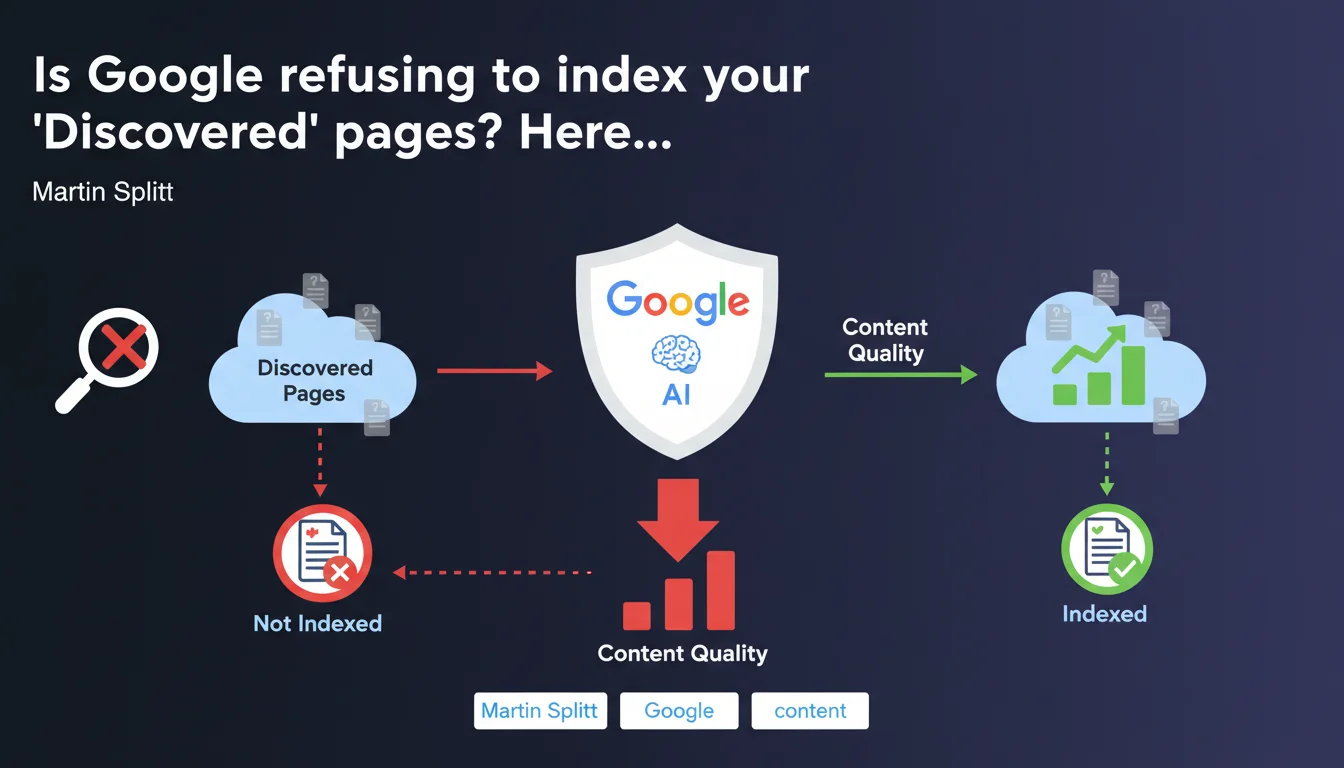
The main reason why pages remain in 'Discovered - currently not indexed' status is content quality. Google detects patterns of weak or poor content and decides not to index these pages, or even removes them from the index. A clear signal that the search engine prioritizes quality over quantity.
What you need to understand
Martin Splitt, Developer Advocate at Google, confirms what many suspected: the 'Discovered - currently not indexed' status often reflects a content quality issue. This status appears in Search Console when Googlebot has found a URL but chose not to index it.
This statement puts an end to certain speculation. Many SEOs thought this status was purely a technical problem — crawl budget, misconfigured robots.txt, lack of internal links. Splitt settles it: content quality comes first.
How does Google detect a pattern of low quality?
Google analyzes pages on a site and detects recurring instances of poor content. If multiple pages exhibit similar characteristics — thin content, low added value, partial duplication — the search engine may decide not to index all of these pages.
This mechanism relies on a pattern-based analysis rather than page-by-page evaluation. A single mediocre page isn't enough: it's the repetition of the problem that triggers the penalty.
What are the implications for your site's indexation?
If Google detects a pattern of weak content, two scenarios can unfold. Either new pages remain in 'Discovered' status and never get indexed. Or pages already in the index can be removed from it.
The second case is more concerning: you lose visibility on pages that may have been performing. The signal sent by Google is unambiguous: improve quality or accept disappearing from search results.
- The 'Discovered - currently not indexed' status often indicates a content quality problem.
- Google detects patterns of weak content across multiple pages, not just isolated cases.
- Pages can remain unindexed or be removed from the index if the problem persists.
- This mechanism prioritizes content quality over the quantity of crawled pages.
SEO Expert opinion
This statement confirms field observations repeated for months. On many sites, pages in 'Discovered' status accumulate negative signals: automatically generated content, pagination pages with no added value, duplicate product sheets.
But beware: Google remains vague about the precise criteria that define "low-quality content." Splitt provides no threshold, no measurable indicator. [To verify]: how do you determine if your content crosses the line?
Does this rule apply to all types of sites?
Not necessarily. E-commerce sites with thousands of product sheets are particularly exposed. Short and repetitive descriptions easily trigger this low-quality pattern.
Conversely, an editorial site with 50 long, well-researched articles has little risk. Even if one or two articles are mediocre, Google won't detect a systematic pattern. The volume of pages plays a key role in this evaluation.
What nuances should be added to this statement?
Splitt says "most common reason," not "only reason." Other technical factors can block indexation: incorrect canonicalization, orphan pages with no internal links, restrictive robots.txt.
A classic pitfall: confusing correlation with causation. A page in 'Discovered' status can suffer from both a quality problem AND a technical problem. Fixing just one of the two won't always be enough.
Practical impact and recommendations
What should you do concretely to exit 'Discovered' status?
First step: identify the affected pages in Search Console, under "Pages" section. Export the list and look for common patterns: same page type, same structure, same content length.
Next, evaluate the real added value of these pages. Ask yourself: if you were a user, would this page answer a specific search intent? If not, improve or delete it.
What mistakes should you absolutely avoid?
Don't try to force indexation through massive Search Console submissions. Google has already crawled these pages — the problem isn't discovery, it's the decision not to index.
Also avoid artificially padding content with useless text. Google detects keyword stuffing and hollow filler. Better 300 relevant words than 1000 diluted ones.
How do you measure improvement after fixes?
Track the evolution of the number of pages in 'Discovered' status in Search Console. A gradual decline indicates Google is reconsidering your pages. Be patient: recrawling can take several weeks.
In parallel, monitor organic traffic evolution in the corrected sections. If the content is truly better, you should see a rise in impressions and clicks within 30 to 60 days.
- Export the list of pages in 'Discovered' status from Search Console.
- Identify recurring weak content patterns (similar pages, thin content).
- Assess the added value of each page type: useful to the user or not?
- Substantially improve content or delete unnecessary pages.
- Avoid massive indexation submissions — this isn't a crawl problem.
- Monitor status evolution 4 to 8 weeks after corrections.
- Measure the impact on organic traffic for modified sections.
Fixing a quality issue at scale requires methodical auditing and strategic trade-offs. Every section of your site must deliver clear and differentiated value. If orchestrating this internally seems complex, partnering with a specialized SEO agency can accelerate diagnosis and implementation of corrections tailored to your context.
❓ Frequently Asked Questions
Le statut 'Découvert - actuellement non indexé' est-il toujours lié à la qualité du contenu ?
Combien de temps faut-il pour qu'une page corrigée sorte du statut 'Découvert' ?
Faut-il supprimer les pages en statut 'Découvert' ou les améliorer ?
Soumettre manuellement une page en statut 'Découvert' peut-il forcer son indexation ?
Comment savoir si mon contenu est considéré comme 'de faible qualité' par Google ?
🎥 From the same video 9
Other SEO insights extracted from this same Google Search Central video · published on 20/08/2024
🎥 Watch the full video on YouTube →
💬 Comments (0)
Be the first to comment.