
Official statement
Other statements from this video 9 ▾
- □ Pourquoi Google n'indexe-t-il jamais l'intégralité d'un site web ?
- □ Pourquoi vos pages restent-elles en 'Découvert - actuellement non indexé' ?
- □ Comment Googlebot ajuste-t-il sa vitesse de crawl en fonction des performances de votre serveur ?
- □ Comment diagnostiquer les problèmes serveur qui freinent le crawl de Google ?
- □ Les problèmes de serveur ne touchent-ils vraiment que les très gros sites ?
- □ Pourquoi Google refuse-t-il d'indexer vos pages en statut 'Découvert' ?
- □ Google peut-il vraiment ignorer des pans entiers de votre site à cause d'un pattern de faible qualité ?
- □ Le maillage interne suffit-il vraiment à faire indexer vos pages découvertes ?
- □ Faut-il vraiment se préoccuper des pages non indexées par Google ?
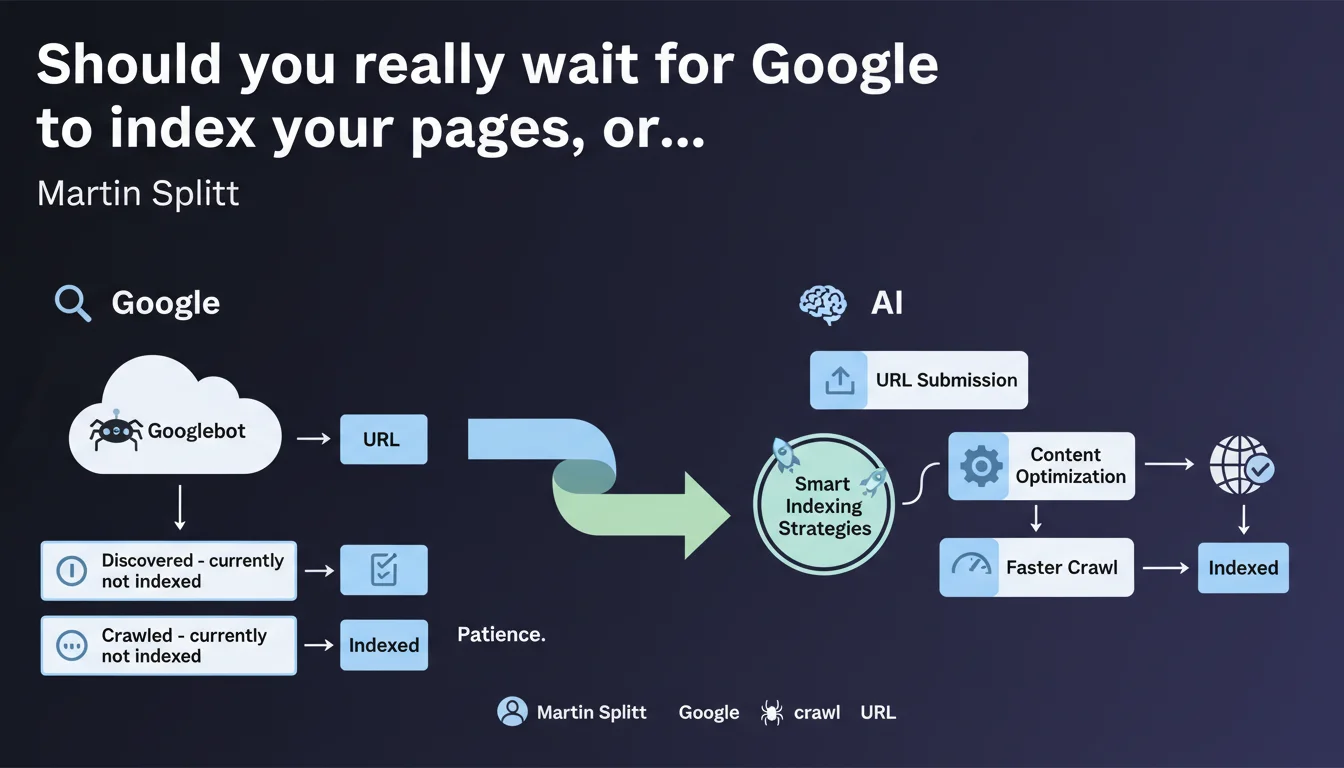
Martin Splitt from Google claims that the 'Discovered - currently not indexed' status often resolves itself through patience. Googlebot will eventually crawl the URL when it has the resources, after which it will move to 'Crawled - currently not indexed' status or be indexed. A statement that raises more questions than it provides concrete answers about actual indexing timelines and real criteria.
What you need to understand
What does the 'Discovered - currently not indexed' status really mean?
This status appears in Google Search Console when Googlebot has identified a URL (via a sitemap, internal or external link) but hasn't yet had the resources to crawl it. Google knows the page exists, but hasn't visited it or analyzed its content yet.
Splitt's statement suggests a queue system: your page is waiting its turn. The problem? No indication of how long you'll wait or what criteria Google uses to prioritize pages in this queue.
What's the difference between 'Discovered' and 'Crawled - currently not indexed'?
The transition from 'Discovered - currently not indexed' to 'Crawled - currently not indexed' marks a crucial milestone: Googlebot has visited the page and analyzed its content, but decided not to index it right now.
This is where things get tricky. If your page is crawled but not indexed, patience alone won't help — there's likely a quality issue, duplication problem, or relevance gap that Google doesn't deem sufficient for a spot in its index.
What factors determine how fast your pages get indexed?
Splitt vaguely mentions that Googlebot will crawl "when it has the time," but doesn't specify what influences this resource allocation. In reality, several factors come into play:
- Your crawl budget (internal PageRank, overall authority, update frequency)
- Page depth in your site structure (the deeper it's buried, the longer it waits)
- Content quality and freshness as perceived by Google
- Popularity signals (backlinks, social signals)
- Technical performance (page speed, server stability)
SEO Expert opinion
Does this statement match real-world observations?
Yes and no. [To verify] — patience does work sometimes, especially for established sites with a good crawl budget. I've seen pages move from 'Discovered' to 'Indexed' in 48 hours on authoritative sites. But I've also seen pages stuck in 'Discovered' status for months on mid-tier sites.
What Splitt doesn't mention: patience alone isn't enough if your SEO fundamentals aren't solid. Waiting passively is often just wasting time. On a site with crawl budget issues, weak internal linking, or mediocre content, nothing will happen — even after six months.
When does patience become an excuse for doing nothing?
Let's be honest: this statement can be interpreted as a "wait and see" approach, which benefits Google but frustrates SEO professionals. In my experience, sites that wait passively lose to those that take action.
If an important page remains 'Discovered' after 2-3 weeks, that's a red flag. You need to investigate — not sit around hoping for the best. Strengthening internal linking, adding targeted backlinks, improving content: these actions dramatically accelerate the process.
What does this statement reveal about Google's communication?
This claim perfectly illustrates Google's communication style: reassure without committing to specific timelines. "When it has the time" is deliberately vague — it could mean 24 hours or 6 months. No concrete metrics, no thresholds, no actionable levers.
For SEO professionals, that's insufficient. You can't build a strategy on "wait and hope." Clients want measurable results within reasonable timeframes — and it's our job to create the optimal conditions for accelerating indexation.
Practical impact and recommendations
What should you actually do when facing 'Discovered' status?
Don't sit around doing nothing. Yes, patience plays a role sometimes, but it must be paired with tactical optimizations to accelerate Googlebot's attention. Start by diagnosing why your page wasn't prioritized.
First, check your internal linking: how many clicks away is this page from your homepage? The deeper it sits, the longer it waits. Next, analyze your overall crawl budget using server logs — if Googlebot visits your site infrequently, increasing crawl frequency becomes your priority.
What concrete actions force indexation faster?
- Strengthen internal links pointing to your 'Discovered' page from already-indexed pages that Googlebot visits frequently
- Use the URL Inspection tool in Search Console to request priority indexation
- Add or update the page in your XML sitemap and resubmit it
- Acquire some quality backlinks pointing directly to this URL to boost its perceived priority
- Improve content quality and uniqueness if it's weak or duplicated
- Verify that no technical directives (noindex, canonical, robots.txt) are blocking indexation
- Monitor server logs to confirm Googlebot actually visits the page
What critical mistakes should you avoid?
The biggest mistake: waiting indefinitely without taking action. I've seen teams leave strategic pages in 'Discovered' status for entire quarters, losing valuable traffic and conversions in the process.
Another trap: mass-submitting dozens of URLs via the inspection tool. Google limits manual indexing requests — use this option only for your priority pages. Finally, don't overlook log analysis: that's where you'll see if Googlebot actually visits and how often.
❓ Frequently Asked Questions
Combien de temps faut-il attendre avant qu'une page en 'Découvert' soit crawlée ?
Peut-on forcer Google à crawler une page en 'Découvert - actuellement non indexé' ?
Quelle différence entre 'Découvert' et 'Crawlé - actuellement non indexé' ?
Le fait de soumettre manuellement une URL via la Search Console garantit-il son indexation ?
Comment savoir si mon crawl budget est trop faible ?
🎥 From the same video 9
Other SEO insights extracted from this same Google Search Central video · published on 20/08/2024
🎥 Watch the full video on YouTube →
💬 Comments (0)
Be the first to comment.