
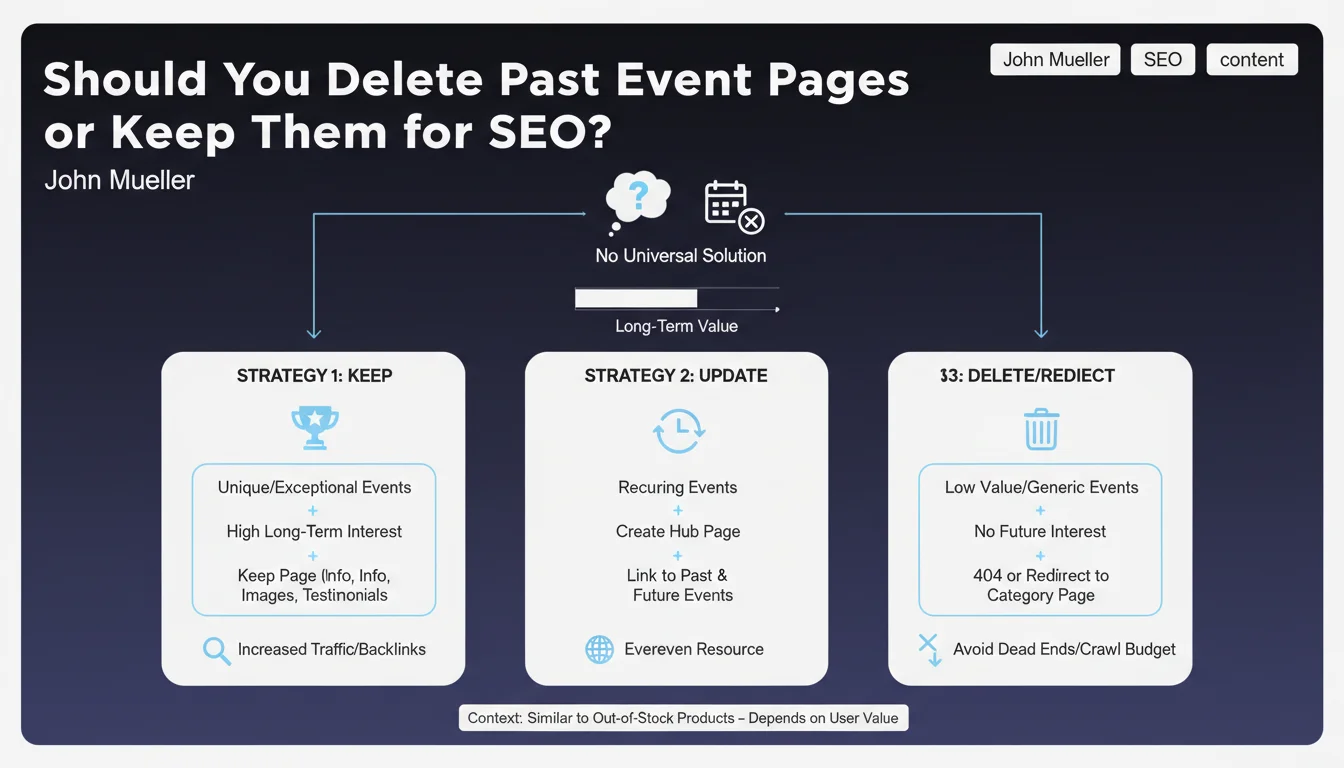
Official statement
He proposes three strategies depending on the type of content. For unique or exceptional shows likely to interest people long-term, he recommends keeping the page as a lasting reference by explaining its history. For events with limited temporary interest (a few months), he suggests waiting for interest to fade before creating a 404 error. Finally, for very generic content on sites with high turnover, he advises immediately deleting the pages (404) to clean up the site and move on.
This pragmatic approach reflects Google's SEO philosophy focused on user utility. The goal is to keep online only content that provides real value, while avoiding cluttering the index with obsolete pages of no interest. John Mueller also notes that using tags like "unavailable_after" would be excessive in this case.
What you need to understand
Managing completed event pages represents a frequent dilemma for cultural, sports or event-based websites. Google does not offer a universal rule, but rather an approach based on residual value for the user.
This official statement confirms that the algorithm prioritizes content that continues to provide real utility to visitors, even after the event date. The objective is to avoid accumulating obsolete pages that dilute the overall quality of the site.
John Mueller establishes a relevant analogy with out-of-stock products in e-commerce, where the decision depends on context and persistent search intent.
- No universal solution: each type of event requires a different strategy
- Main criterion: long-term value for the user determines the decision
- Three possible approaches: retention, delayed deletion or immediate deletion
- User focus: Google prioritizes experience and utility rather than technical gimmicks
- Specific tags: using "unavailable_after" is considered excessive in this context
SEO Expert opinion
This recommendation fits perfectly with Google's current logic that values quality over quantity of indexed pages. Field observations confirm that sites cluttered with obsolete content often suffer a dilution of their authority.
The distinction between exceptional events (legendary concerts, world premieres) and generic events is particularly relevant. A page about a historic concert can generate traffic for years through informational searches, while a mundane event has no archival value.
However, be careful with sites that have strong seasonality: deleting recurring event pages (annual festivals) too quickly can result in lost ranking history. In these cases, a 301 redirect to the next edition or a permanent page may be wiser than a brutal 404.
Practical impact and recommendations
- Audit your inventory: Classify your past event pages into three categories based on their long-term value potential
- Exceptional events: Keep pages with content enrichment (photos, videos, testimonials, historical context) to create documentary value
- Events with temporary interest: Maintain pages 2-4 months after the event, then switch to 404 or 410 once residual traffic is exhausted
- Generic events: Delete quickly (404) to avoid inflation of valueless pages and concentrate crawl budget on relevant content
- Avoid complex tags: Don't use "unavailable_after" which unnecessarily complicates management without real benefit
- Monitor signals: Analyze Search Console data (impressions, clicks) to identify past event pages still generating qualified traffic
- Create permanent pages: For recurring events, consider a single URL structure updated annually rather than multiple dated pages
- Strategic redirection: For major recurring events, redirect (301) the old edition to the new one rather than creating a 404
- Clean regularly: Establish a quarterly review schedule to maintain a clean site and avoid accumulation of obsolete content
💬 Comments (0)
Be the first to comment.