
Official statement
Other statements from this video 9 ▾
- □ Why are your pages stuck in 'Discovered - currently not indexed' status?
- □ Should you really wait for Google to index your pages, or is there a smarter way?
- □ Does Googlebot really slow down when your server struggles, and what does that mean for your indexation?
- □ How can you spot the server problems that are slowing down Google's crawl of your site?
- □ Do server problems really only impact massive websites, or can smaller sites suffer too?
- □ Is Google refusing to index your 'Discovered' pages? Here's why.
- □ Is Google really ignoring entire sections of your site because of a low-quality pattern?
- □ Does internal linking alone really guarantee your undiscovered pages will get indexed?
- □ Should you really worry about pages Google refuses to index?
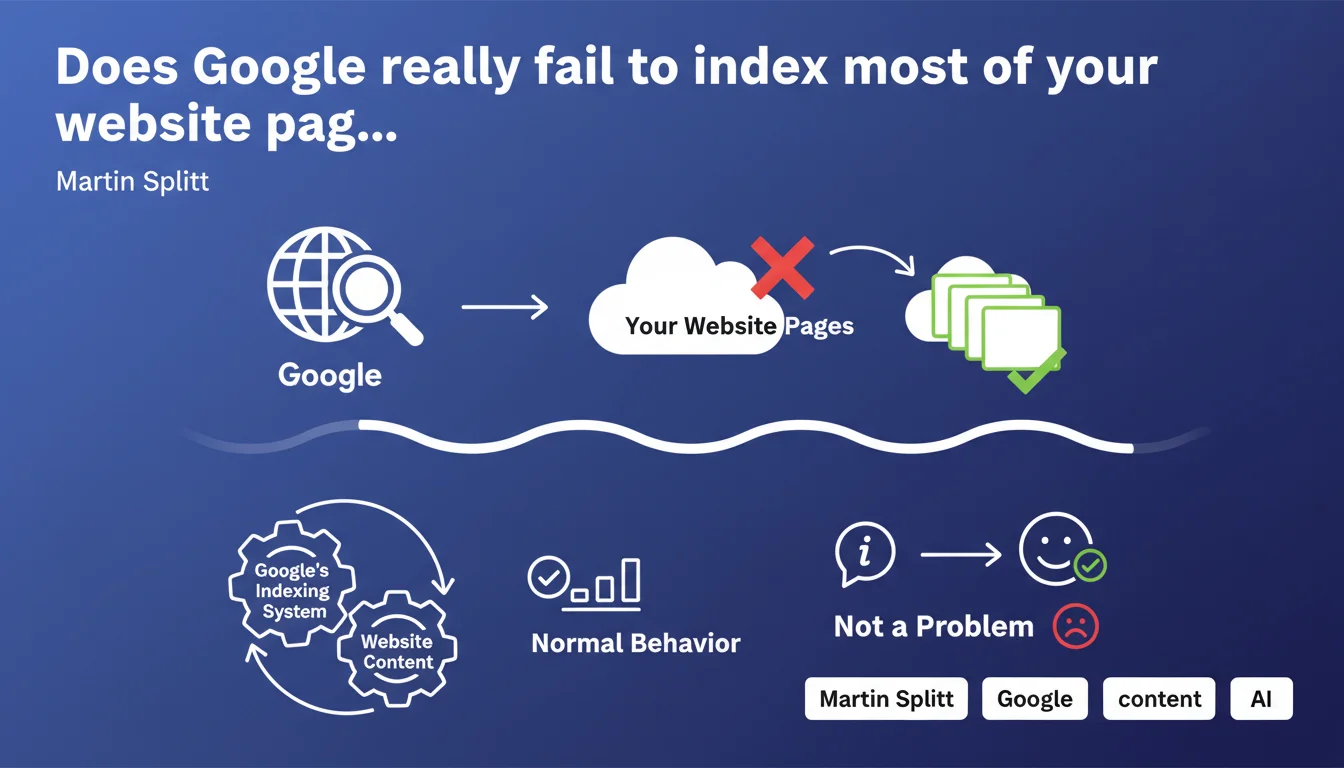
Google almost never indexes 100% of a website's pages, and that's completely normal. It's neither a bug nor a systemic issue requiring urgent action. For an SEO professional, the real challenge is ensuring the right pages get indexed—not every single page.
What you need to understand
What does Martin Splitt really mean by "almost never"?
Splitt establishes a key principle: exhaustive indexation is not Google's objective. The search engine selectively indexes based on multiple criteria—quality, relevance, crawl budget, duplication, and freshness.
In concrete terms? A 10,000-page website will probably only see 60 to 85% of its URLs in the index, and that's perfectly acceptable if the strategic pages are there. Google prioritizes efficiency over completeness.
Why is this behavior "normal" according to Google?
Because many pages deliver no distinctive value. Pagination pages, redundant product variants, old archives with no traffic—all the content that Google considers pointless to clutter its index with.
The search engine optimizes its infrastructure. Indexing is resource-intensive and costly. If a page has zero chance of ranking or providing user value, why index it?
What's the difference between "crawled" and "indexed"?
Google can absolutely crawl a page without indexing it. Crawling detects the page exists, reads it, extracts its links. Indexation, on the other hand, decides whether that page deserves to be stored and served in search results.
A URL can remain in "Discovered, currently not indexed" status in Search Console indefinitely without being a problem—unless it's a key commercial page, obviously.
- Full site indexation is neither a goal nor a reliable performance indicator
- Google filters upstream based on perceived content value, crawl budget, and duplication
- A crawled page isn't necessarily indexed—it's a separate algorithmic decision
- The real KPI: are your strategic pages indexed and ranking?
SEO Expert opinion
Is this statement consistent with what we observe in the field?
Yes, absolutely. For years now, average to large websites show indexation rates between 50 and 90% depending on their structure. E-commerce sites with thousands of redundant product variants are particularly affected.
But be careful—Splitt remains vague about the exact selection criteria. He talks about "quality" and "relevance" without precisely defining what makes a page indexable or not. [To verify] in each business context.
In what cases is this explanation insufficient to justify an indexation problem?
If your core product pages, pillar articles, or commercial landing pages aren't indexed, that's NOT normal. Splitt's statement shouldn't serve as an excuse to ignore a real structural problem.
A 30% indexation rate on a well-crafted 200-article editorial blog? There's an issue. A site with 80% of its URLs accidentally set to noindex or massive technical errors—same situation. Let's be honest: Google isn't saying "never worry about indexation," it's saying "don't panic if everything isn't indexed."
What nuances should we add to this message?
Splitt's message targets a broad audience, including beginners who panic unnecessarily. For a seasoned practitioner, the question is never "is everything indexed?" but rather "are the right pages indexed and ranking well?".
Moreover, Google provides no precise threshold. What's an acceptable indexation rate? 70%? 85%? It depends on site type, editorial quality, and technical infrastructure. There's no magic number—and that's frustrating for an SEO who loves clear KPIs.
Practical impact and recommendations
What should you do concretely after this statement?
First: audit the indexation of strategic pages. Use a Search Console export or Screaming Frog crawl combined with the Google Index API to identify which critical URLs aren't indexed.
Second: don't waste time forcing indexation of low-value pages—archives, infinite paginations, redundant product filters. Let Google do its sorting, or better yet, properly block them with noindex or robots.txt as appropriate.
What mistakes should you avoid when facing this reality?
Classic mistake: bulk submitting URLs via the Search Console "Request Indexing" tool to hit 100%. It's pointless and counterproductive—Google may interpret it as spam.
Another trap: ignoring a real technical problem (misconfigured canonicals, insufficient crawl budget, orphaned pages not linked) by telling yourself "Splitt said it's normal." No. If your core SEO landing pages are being ignored, there's a structural issue.
How do you prioritize indexation optimization actions?
Focus on pages that generate revenue or leads. Product pages, strategic SEO articles, commercial landing pages—they must be indexed, period.
For everything else, apply triage logic: pages with existing organic traffic, those with backlinks, those answering clear user intent. The rest can stay out of the index without issue.
- Extract your strategic URL list and verify indexation status via Search Console or third-party tools
- Identify non-indexed high-value business pages and diagnose the causes (accidental noindex, incorrect canonical, orphaned pages, low quality)
- Clean up redundant or weak content that wastes crawl budget without delivering SEO value
- Monitor monthly indexation rates by strategic segment, not your entire site
- Don't force indexation of pages with no user value—Google will ignore them anyway
❓ Frequently Asked Questions
Quel est le taux d'indexation moyen acceptable pour un site web ?
Google va-t-il finir par indexer mes pages si j'attends assez longtemps ?
Faut-il désindexer volontairement les pages que Google ignore ?
Comment savoir si mes pages non indexées posent un vrai problème ?
Peut-on forcer Google à indexer une page importante ?
🎥 From the same video 9
Other SEO insights extracted from this same Google Search Central video · published on 20/08/2024
🎥 Watch the full video on YouTube →
💬 Comments (0)
Be the first to comment.