
Official statement
Other statements from this video 8 ▾
- □ Le contenu de la page est-il vraiment le facteur de pertinence le plus important pour Google ?
- □ Google supprime-t-il vraiment les mots vides de vos requêtes ?
- □ Comment Google préserve-t-il les mots vides dans les entités nommées ?
- □ Google élargit-il vraiment vos requêtes avec des synonymes automatiquement ?
- □ Comment la localisation de l'utilisateur transforme-t-elle réellement vos résultats de recherche ?
- □ Qualité de page vs qualité de site : laquelle pèse le plus dans l'algorithme Google ?
- □ L'unicité du contenu influence-t-elle vraiment le classement dans Google ?
- □ Pourquoi Google affiche-t-il des fonctionnalités SERP différentes selon vos requêtes ?
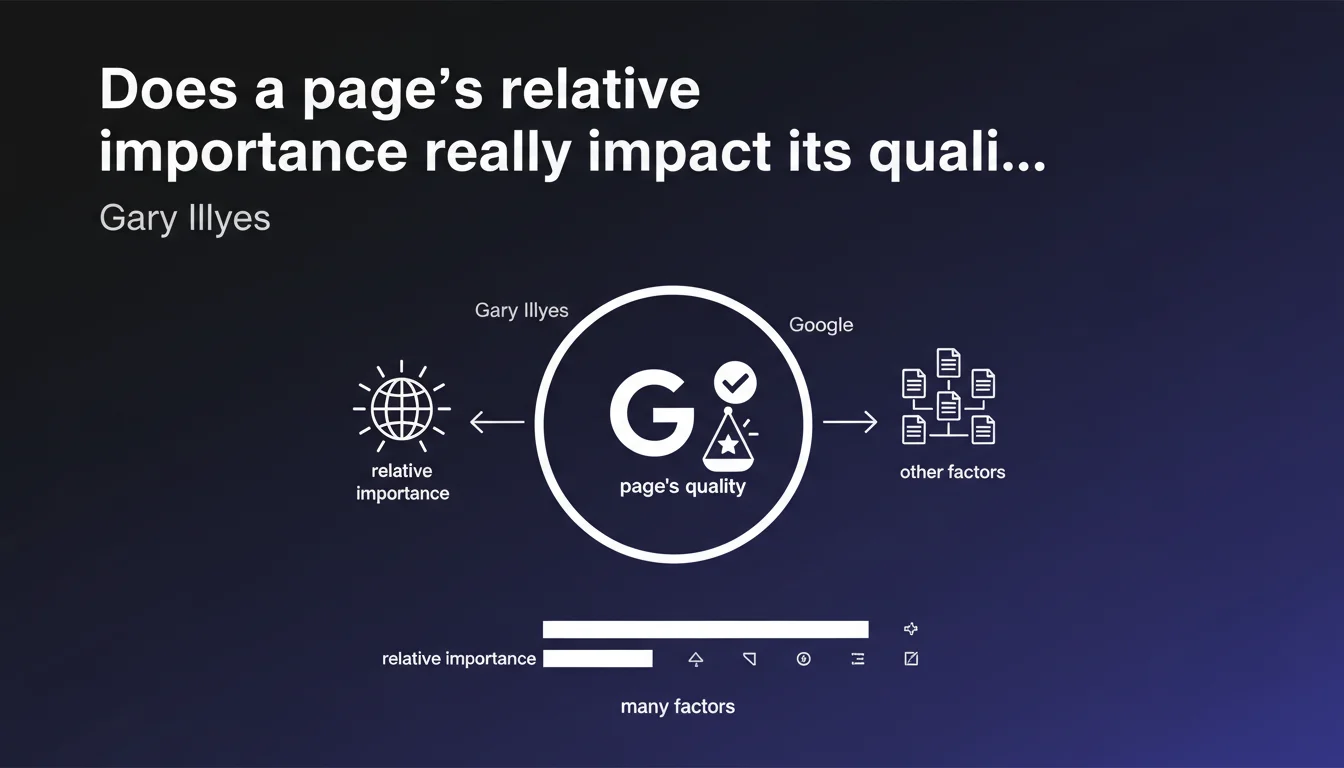
Google confirms that a page's relative importance on the web (its weight in the internet ecosystem) is a factor in evaluating its quality. In practice, a page deemed important by the network of links and external signals will receive better quality consideration. However, this is just one factor among many, not the sole criterion.
What you need to understand
What does "relative importance" really mean?
Relative importance refers to the weight a page has acquired in the web ecosystem. More concretely: how many other pages cite it, what is the quality of these citations, how much it is referenced as a resource in its field.
It's not just a matter of backlink volume. It's a combination of popularity signals, trust, and thematic relevance. A page can have few links but be crucial in a niche ecosystem — and vice versa.
How does Google evaluate this importance?
Google uses several mechanisms to measure this relative weight. The historical PageRank is part of it, but it has evolved far beyond its initial version. Co-citation signals, unlinked mentions, and user navigation patterns also come into play.
The engine doesn't just count — it weights according to quality, freshness, and source diversity. A citation in an academic article doesn't carry the same value as a link in a spam directory.
Why does Google link importance to quality?
The logic is straightforward: an important page is often a reference page, and therefore presumed to be quality. It's a heuristic proxy. If many credible sources point to it, there's a good chance it provides value.
But beware — this is just one of many factors. Google also considers content, expertise, user experience, and EEAT signals. Importance alone isn't enough.
- Relative importance isn't just about backlink volume
- Google weights according to the quality and diversity of citing sources
- It's an indicator among others in quality evaluation
- A page can be important in a niche context without having thousands of links
- Importance presumes quality, it doesn't guarantee it
SEO Expert opinion
Is this statement consistent with real-world observations?
Yes, generally. Sites with strong domain authority and well-cited pages in their ecosystem rank better, all else being equal. This has been observable for years.
But — and here's where it gets tricky — the notion of "relative importance" remains deliberately vague. Google doesn't say how it measures it, or what weight it carries against other criteria. [To verify]: impossible to quantify its real impact without large-scale controlled tests.
What nuances should be added?
Importance is not absolute, it's contextual. A page can be crucial in a highly technical sector with low mainstream visibility. Google appears capable of weighting according to thematic context — at least in theory.
Another point: a page's importance can be artificially constructed. Link farms, PBNs, and netlinking networks exist. If importance were the only criterion, these techniques would work perfectly. But Google crosses this with other signals to detect manipulation.
Finally, a page can lose its importance over time. Links die, sources disappear, context changes. Importance is dynamic, not fixed.
Does this statement change anything for practitioners?
Not really. SEO professionals have known for years that quality backlinks and authority signals matter. Gary Illyes is just confirming a principle already applied.
What's interesting is the wording: "one of many factors." This reminds us that importance alone doesn't save a mediocre page. We've seen highly linked sites with weak content lose rankings after Core Updates.
Practical impact and recommendations
What should you do concretely to increase relative importance?
First step: obtain quality citations from recognized sources in your sector. Prioritize specialized media, expert blogs, academic platforms if relevant.
Second axis: create reference content. Comprehensive guides, original studies, exclusive data that others will naturally want to cite. Linkbaiting isn't dead — it just requires substance.
Third lever: develop your influence network. Participate in sectoral discussions, speak as an expert, collaborate with other players. Natural links are born from relationships.
What mistakes should you avoid?
Don't fall into the raw volume trap. 100 mediocre links are worth less than one link from a major source in your domain. Google knows how to tell the difference.
Avoid artificial link schemes. PBNs, massive exchanges, low-quality directories — all of it is detectable and risky. Importance should be built organically.
Don't neglect the other quality pillars. A page with lots of links but weak content will eventually drop. Relative importance is just one brick in the building.
- Audit your current backlinks and identify quality vs toxic sources
- Create citation-worthy content: studies, data, in-depth analyses
- Develop a digital public relations strategy targeting media in your sector
- Monitor unlinked mentions of your brand and request link additions
- Diversify link types: editorial, resources, partnerships, quality guest posts
- Track the evolution of your domain authority and that of your competitors
- Regularly clean up toxic links via the disavow tool if necessary
How do you verify the effectiveness of your efforts?
Track the evolution of your positions on strategic keywords, not just link count. Relative importance should translate into better organic visibility.
Analyze the link profile of well-ranking competitors. Which sources cite them? What types of content attract links in your sector? Benchmark and adapt.
Use tools like Ahrefs, Majestic, or SEMrush to monitor your Domain Rating / Trust Flow. These metrics approximate relative importance as Google might perceive it.
❓ Frequently Asked Questions
L'importance relative remplace-t-elle le PageRank ?
Combien de backlinks faut-il pour qu'une page soit considérée comme importante ?
Les mentions non-linkées comptent-elles dans l'importance relative ?
Une page sans backlinks peut-elle ranker si elle a un excellent contenu ?
Comment Google détecte-t-il les liens artificiels qui gonflent l'importance ?
🎥 From the same video 8
Other SEO insights extracted from this same Google Search Central video · published on 09/04/2024
🎥 Watch the full video on YouTube →
💬 Comments (0)
Be the first to comment.